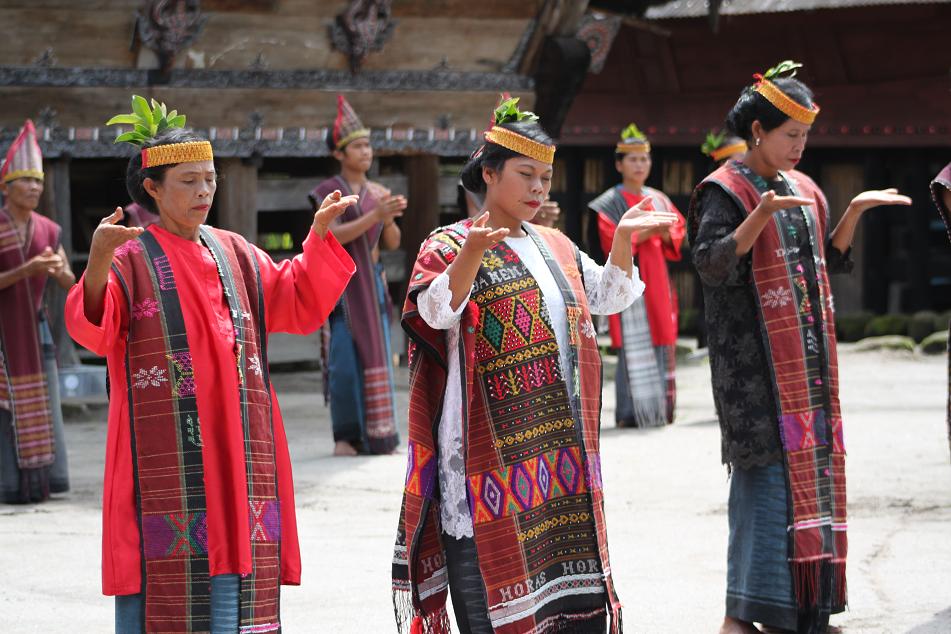
Colorful Dresses Worn by The Female Dancers
Simanindo, a small village at the northern part of Samosir Island, was the last place that I visited on a trip to Samosir’s historical and cultural places. When I parked the motorbike at Huta Bolon Simanindo, I could hear some traditional music instruments were being played. Finding out that the dance performance had just begun, I rushed my way to the inner courtyard where the performance took place. When I took a quick look at the sheet on which the program is written, I was relieved after knowing that I hadn’t missed that much.
The dance performance itself consists of several acts, each of them portrays different aspects in the life of Bataks. A young man coming to a young woman’s family to propose the daughter, the villagers dancing around a pole which is adorned with leaves to symbolize the sacred banyan tree, a shaman running around an egg while carrying a spear are, in my opinion, some of the most interesting acts throughout the dance performance. Before coming to the final act, the shaman would ask some visitors to dance with him and the other dance performers for a few minutes. Most of the dancers are quite old though, leaving a question in my mind, would there be more local young people willingly preserve this unique dance as a part of their culture and heritage? I surely do hope so.
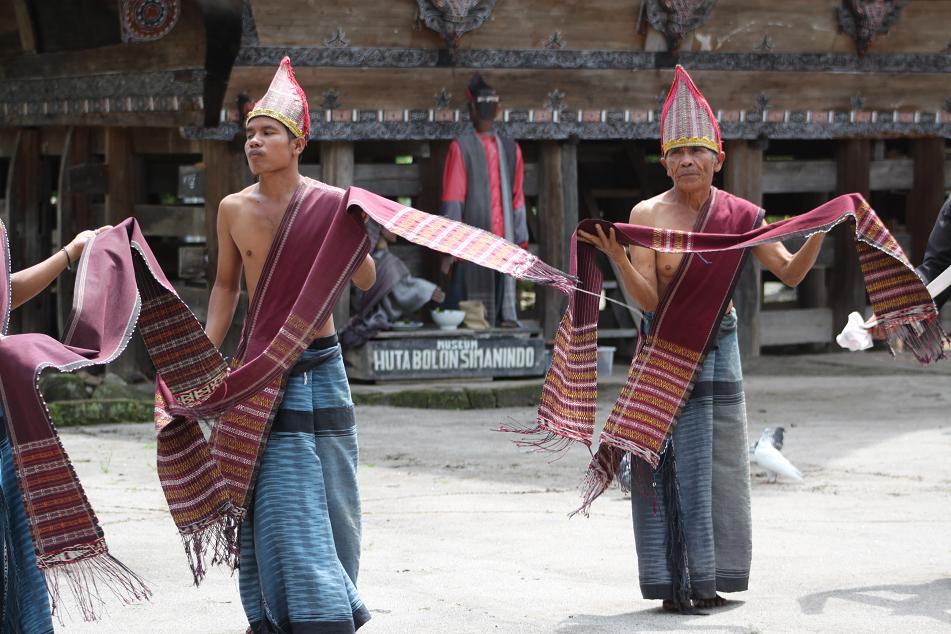
Swinging The Ulos
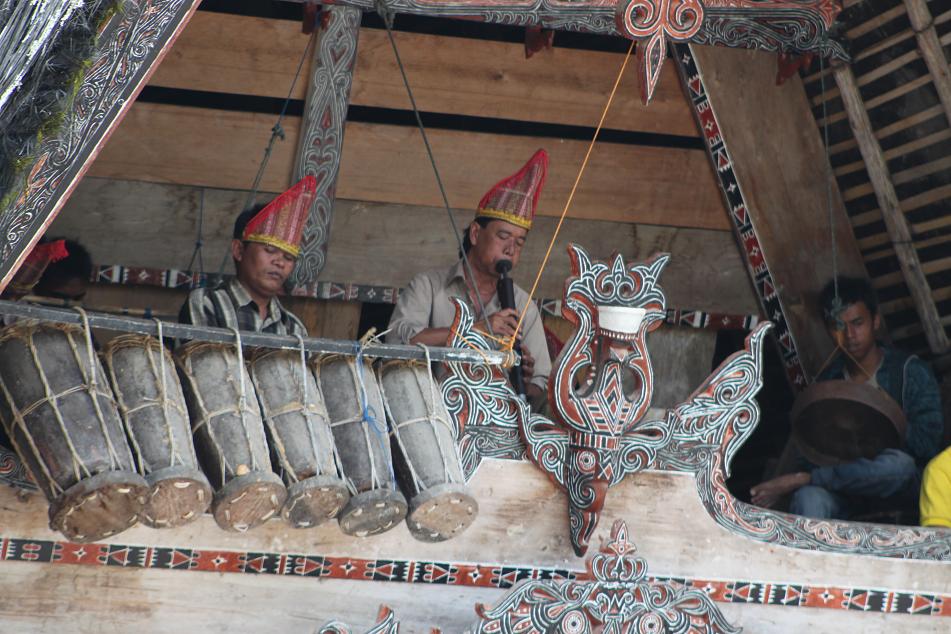
The Band
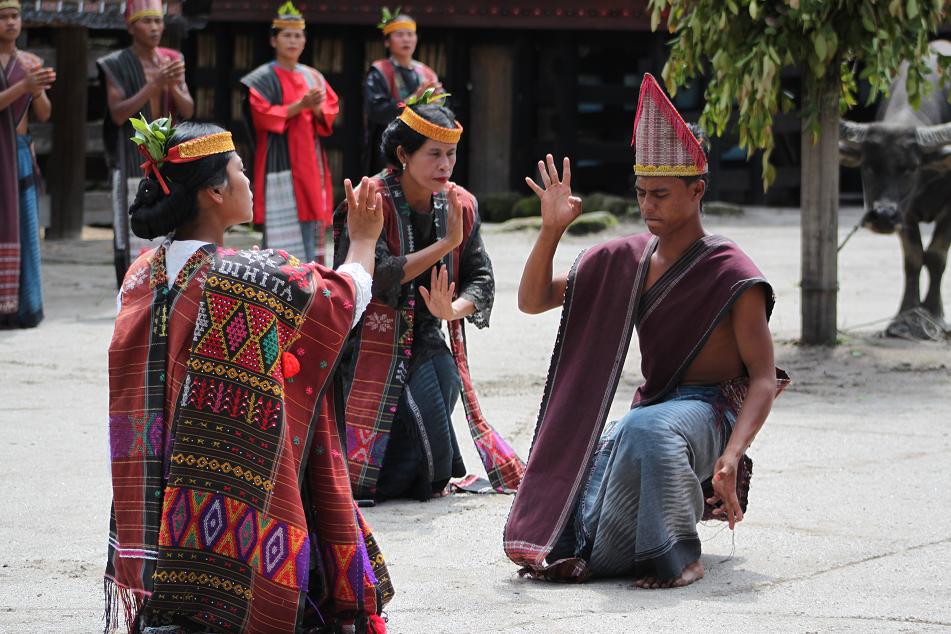
The Enactment of Proposal in Batak Culture
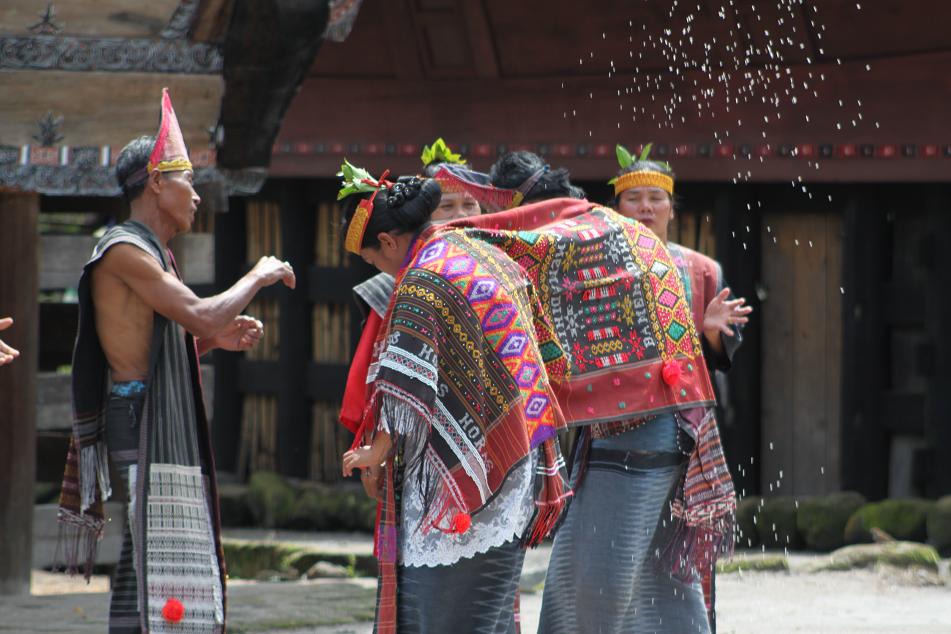
The Wedding
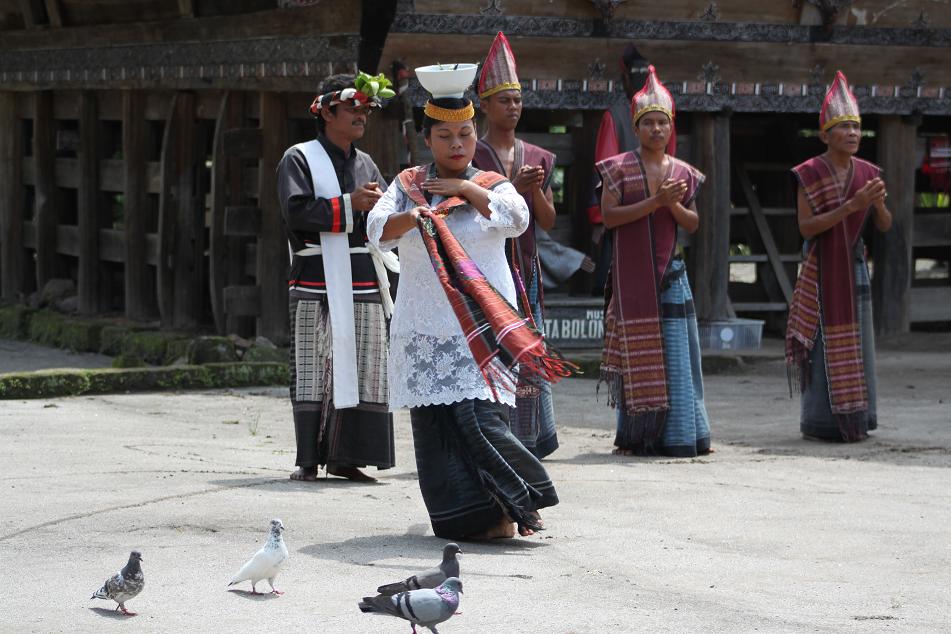
A Solo Dance Performed by The Bride
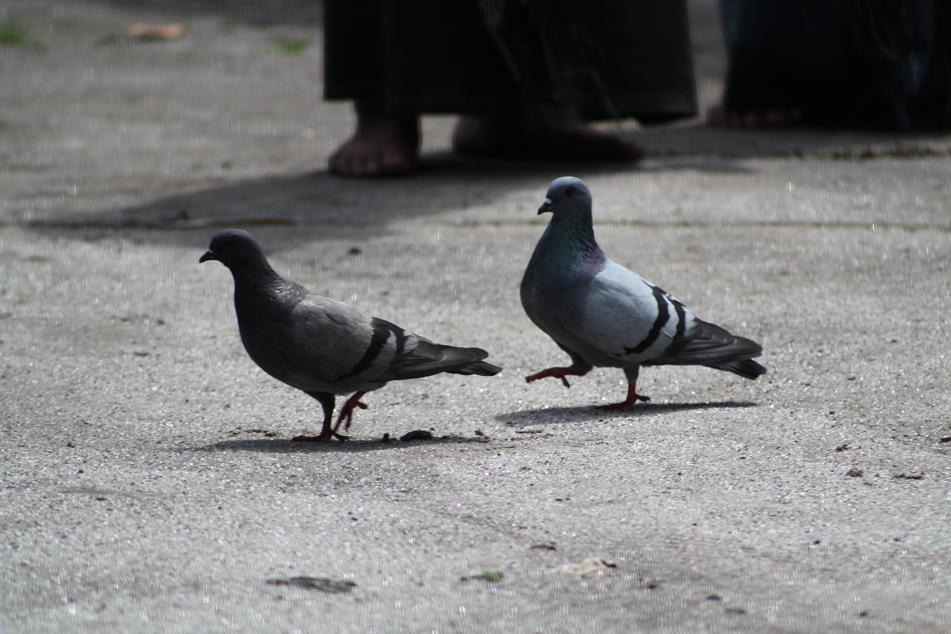
Uninvited Guests
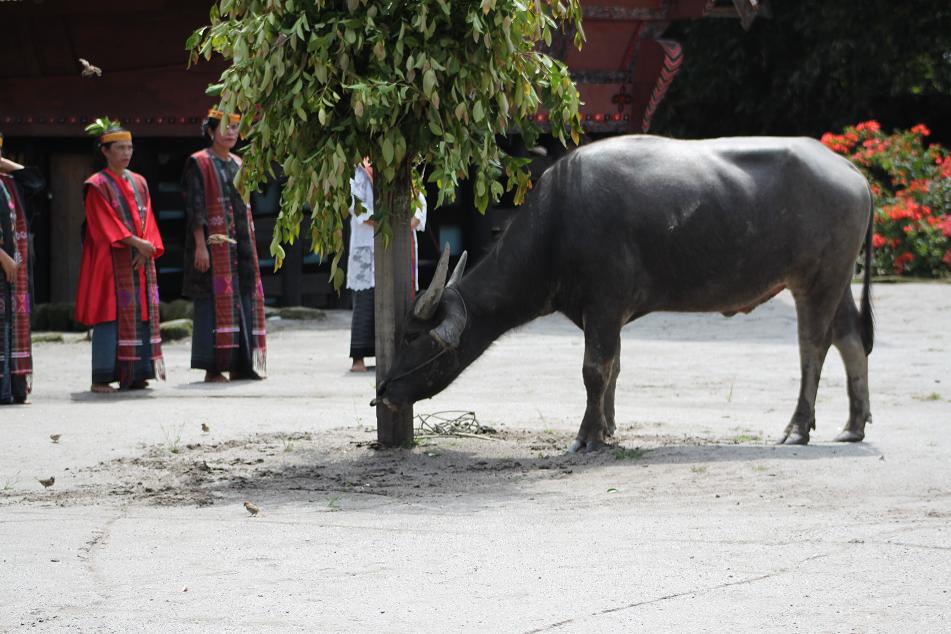
A Water Buffalo (Only Butchered in Real Celebrations)
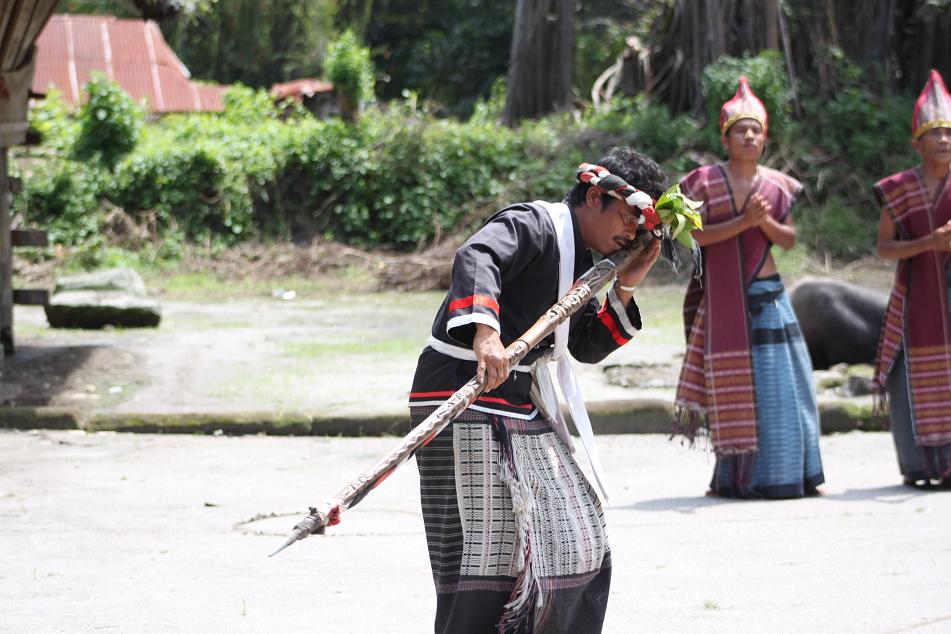
A Shaman Dancing and Praying for Blessings from The Gods
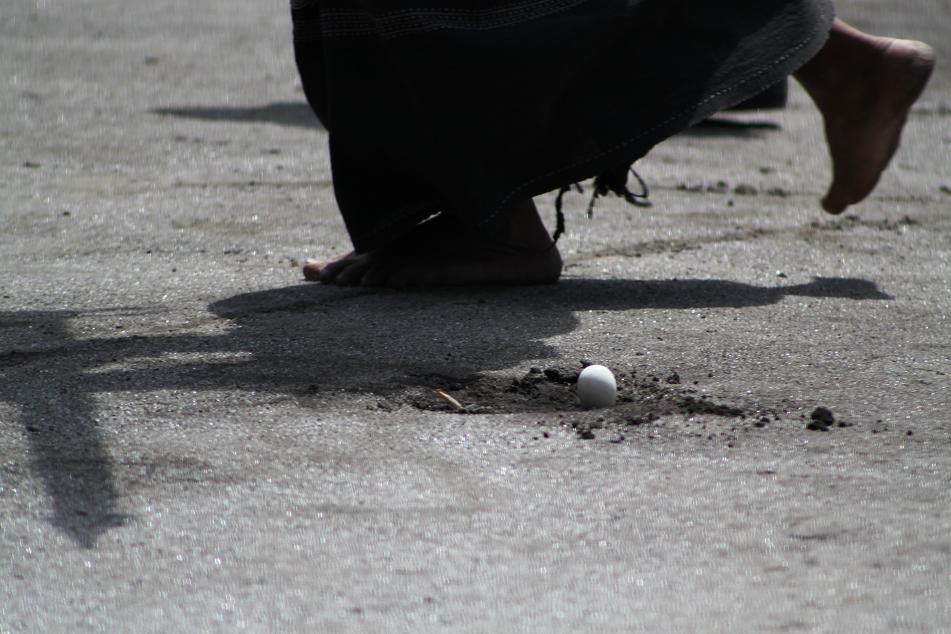
The Shaman Put An Egg on The Ground and Danced Around It
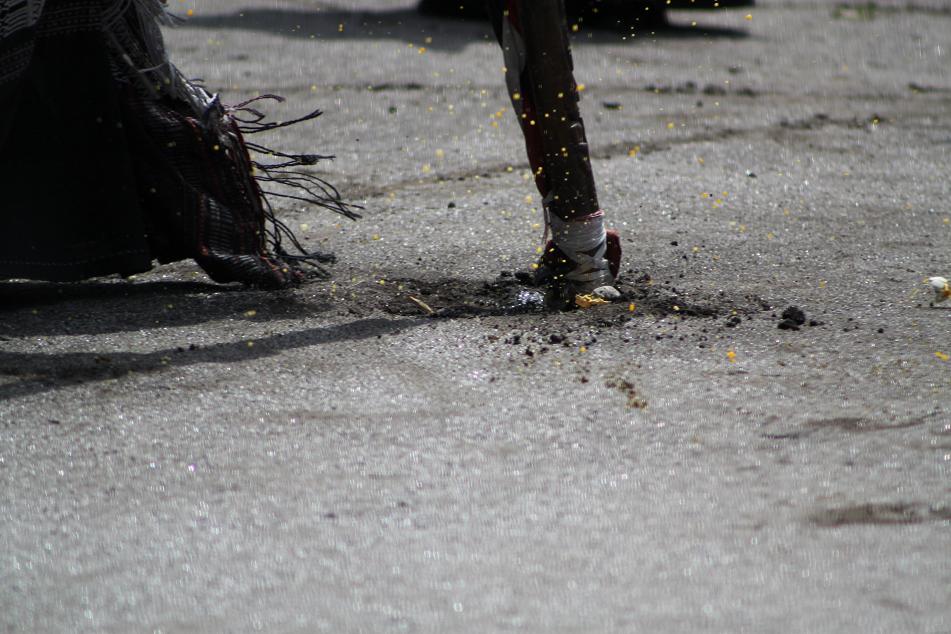
A Few Minutes Later He Smashed The Egg with His Spear
After the dance performance ended, all tourists left the place right away, leaving Robin and I as the only visitors at the huta (walled village). I, of course, took the liberty to take some photographs of bolon (literally house, after which the village is named) and sopo (rice barn). What makes the houses in this place special is because unlike other houses in other villages which had already used modern roofs — although still retain the look of a Batak traditional roof, at Huta Bolon Simanindo all of the bolons and sopos still use thatched roof.
Just outside the huta, there are some tombs of the deceased local royal family members, a museum, a royal barge and some other things which are used for different purposes. However it’s the museum that caught my attention the most due to its various collections of Batak artifacts. I’ve got some questions answered at this place, one of them is about the lizard and breasts carvings which can be found at many places in North Sumatra. Apparently the breasts symbolize fertility while the lizard is an allegory of how Bataks should spread all over the places, just like lizards which can be found on house walls, on trees, on the ground and many more.
Photographs were taken, curiosity was fulfilled, a new culture has been learned. It’s time for me to leave Samosir and head to the provincial capital, the ever bustling and vibrant Medan.
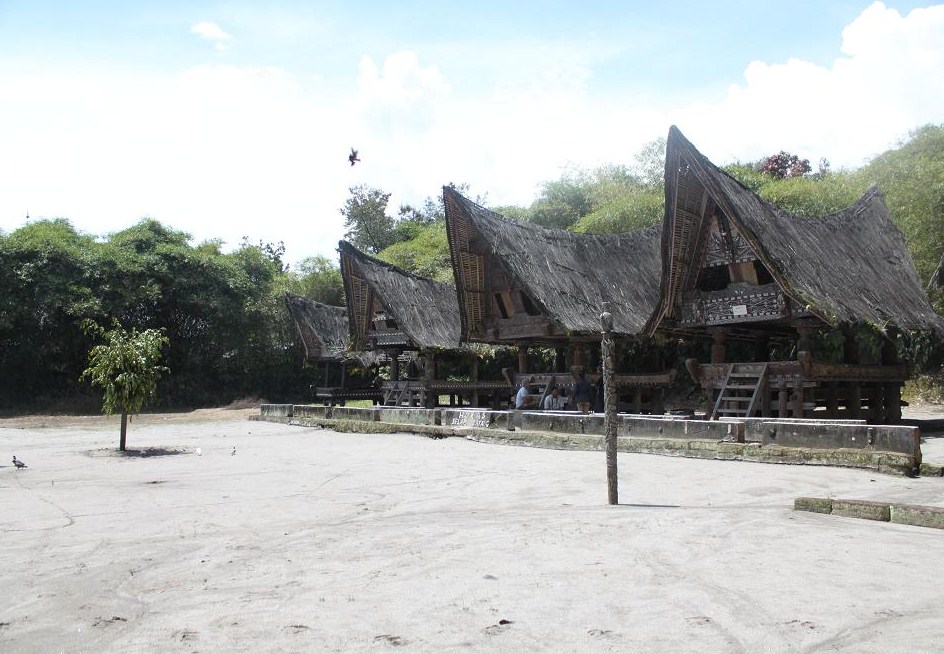
The Most Original Batak Architecture with Thatched Roof
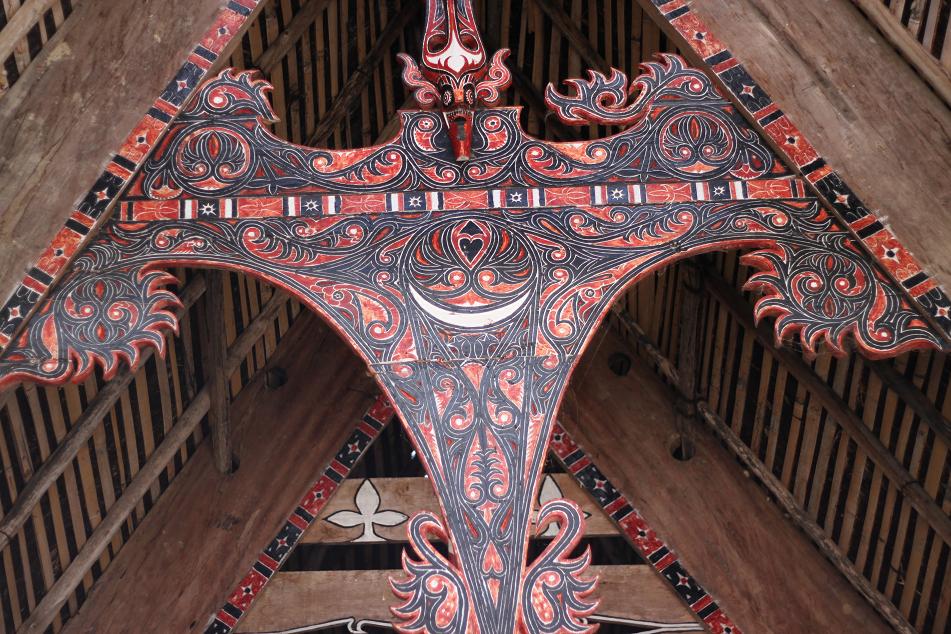
Intricate Decoration
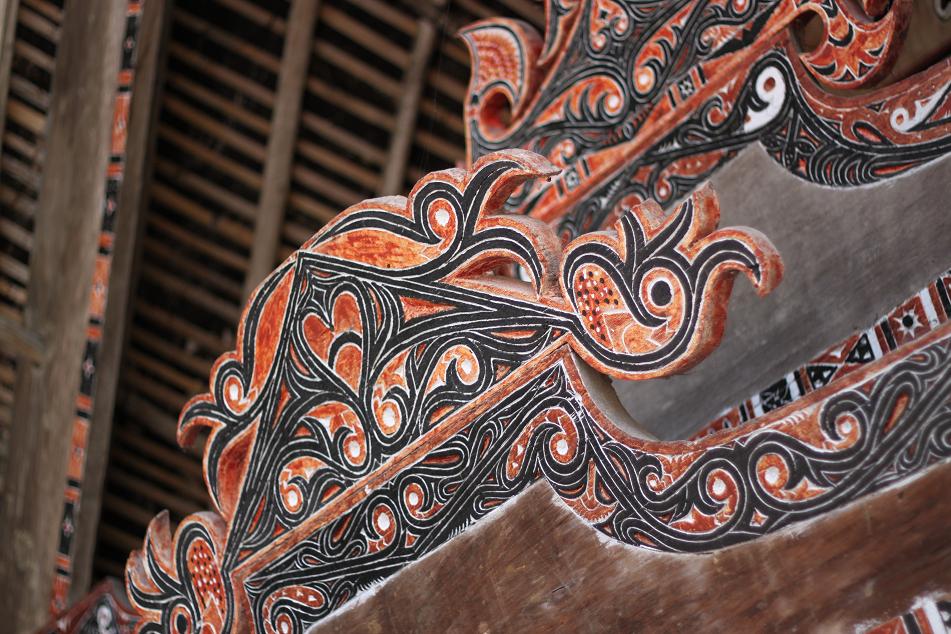
Red, Black and White Are The Most Widely-Used Colors in Batak Traditions
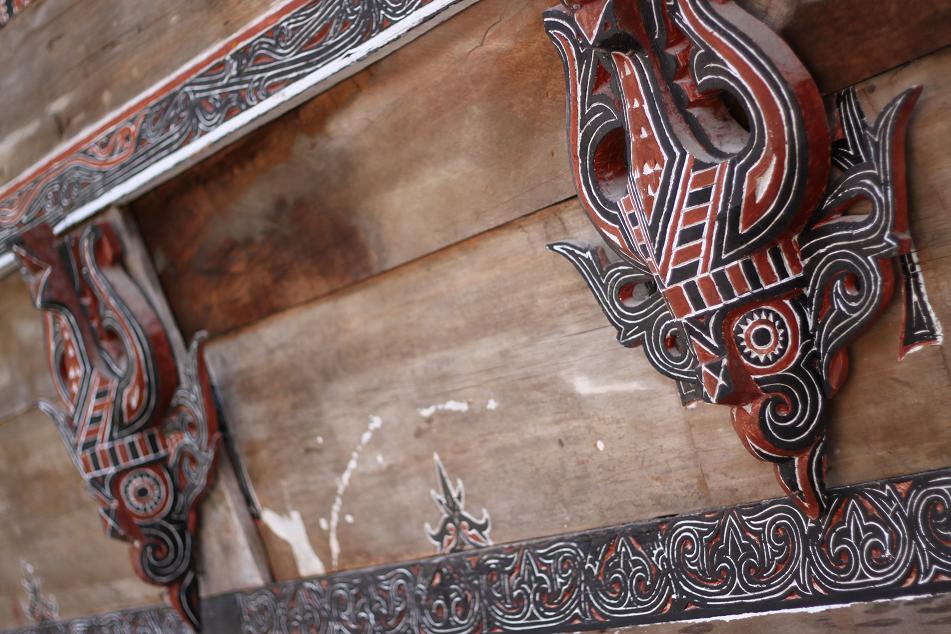
The Carvings of Singa, A Mystical Guard of Batak Houses
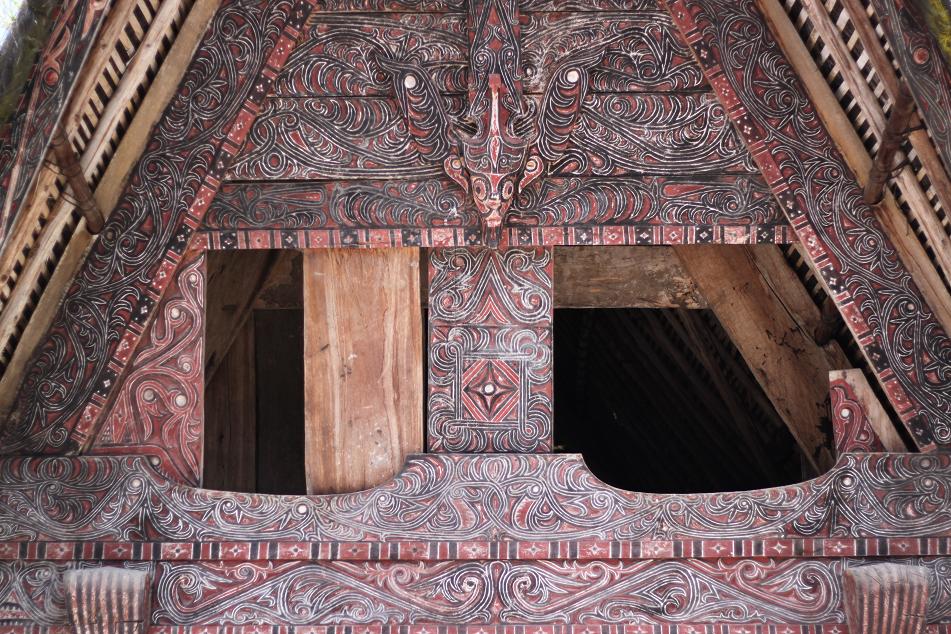
Other Intricate Decoration
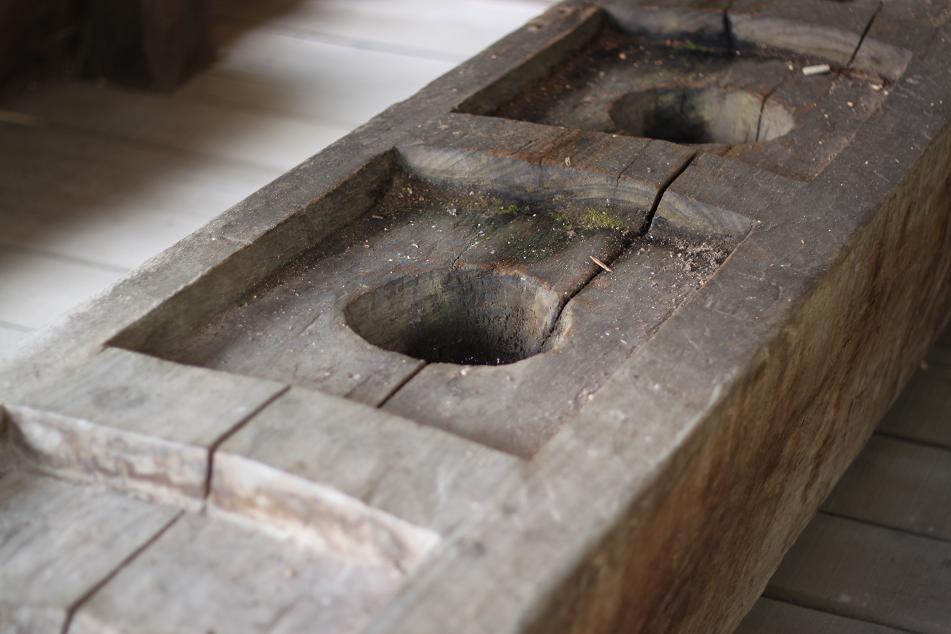
Losung, A Wooden Mortar Where Rice is Ground
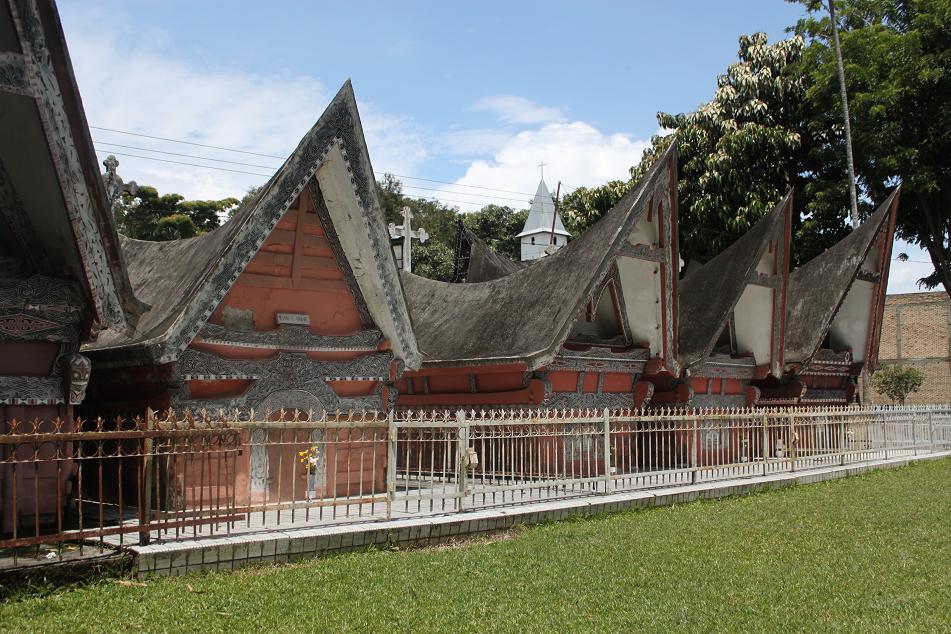
The Tombs of Local Rulers
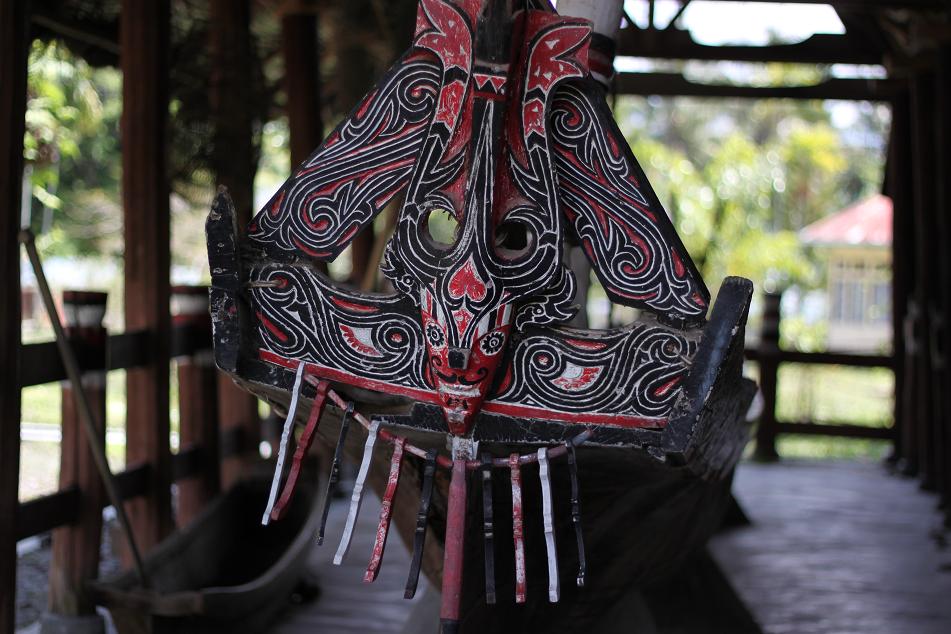
The Royal Barge
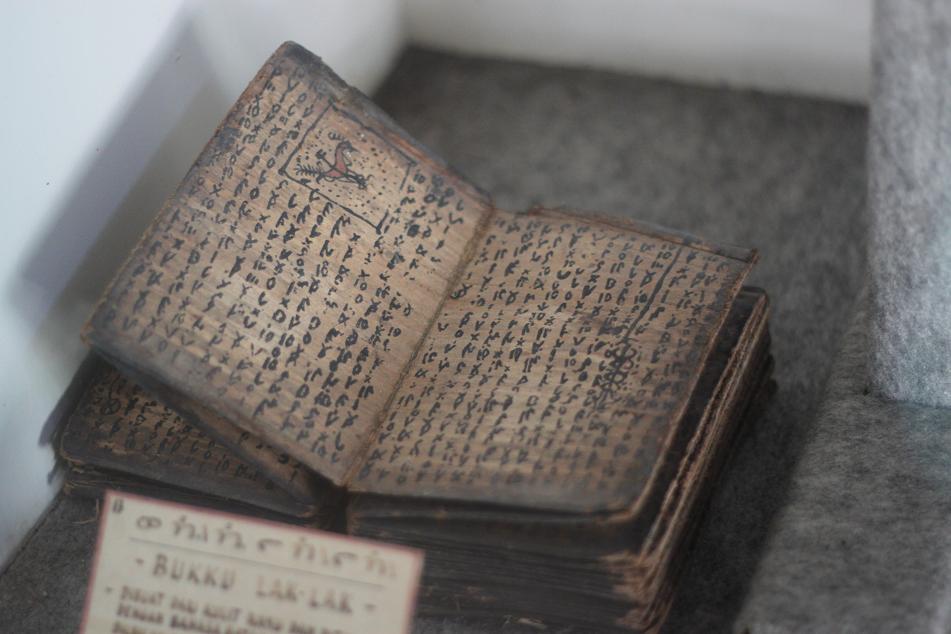
An Ancient Batak Script
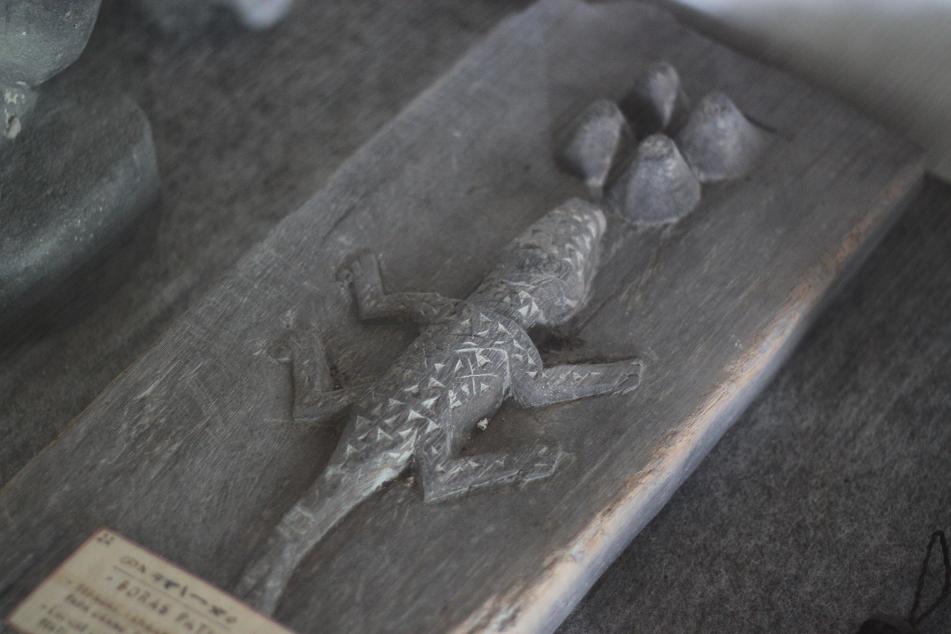
Lizard and Breasts
Related Posts: The Intriguing Culture of Samosir Island, The Legend of Samosir’s First Settlers, The King, The Missionary and The Trial Stone

 What an Amazing World!
Pingback: The Intriguing Culture of Samosir Island « What an Amazing World!
Pingback: The Legend of Samosir’s First Settlers « What an Amazing World!
Pingback: The King, The Missionary and The Trial Stone « What an Amazing World!
A very interesting post. I like to know both about the dances and the houses, and as you say; let’s hope somebody bring these rich traditions on to the next generations…
LikeLike
The whole performance is called Mangalahat Horbo (in Batak language which means ceremony to butcher a water buffalo and play the drum). However I haven’t found any article about this in English. But if you’re interested in the architecture, there’s a good Wikipedia entry which explains various Batak architecture: http://en.wikipedia.org/wiki/Batak_architecture
Thanks for reading!
LikeLike
seems liek even the pigeons are dancing…!
LikeLike
They’re more interested in picking up the seeds which were thrown away throughout the performance 🙂
LikeLike
I did wonder about those corrugated iron roofs in the earlier posts… it looks quite different in the original thatch! You got a great capture on the smashed egg, judging from the bits flying through the air it seems like it may have been cooked before the ceremony!
You were right when you said the Bataks had distinct facial features, they appear very different from the Javanese people I’ve seen.
LikeLike
Ah you noticed the iron roofs! Personally, I prefer the thatched one. But for locals it is much more practical using the iron roofs as they are much more durable. Actually the egg was not cooked — my friend got the picture of the exact moment when the yolk and the egg white burst.
So now you can tell if someone is a Batak person or not 🙂
LikeLike
Reblogged this on So? and commented:
This is an amazing cultural display. faces and places that are fast passing away. I love this and will really hope we as humankind would preserve these and more for the next generation.
LikeLike
Thanks for the reblog! Well, I hope by showing everyone about this unique culture (and others around the globe) will raise awareness to preserve mankind’s invaluable heritage.
LikeLike
I especially liked the picture of the smashed egg as well! Perfect timing!
LikeLike
Thanks Jacob!
LikeLike
Fabulous pictures! Very colorful post.
LikeLike
Thanks Nicole! You might notice that in Batak culture red, white and black are the most widely used colors. My next posts will be on Medan — the provincial capital — which has more of green and yellow color accent.
LikeLike
Cool! You are making me really want to go to Indonesia. SO much in the world to see! Have you ever been to the US before? I wonder if you’d find it boring. Maybe I’m just used to it. There is a lot of natural beauty but the culture is nothing like other places I’ve been.
LikeLike
Nicole, I’ve only written just a tiny bit of Indonesian cultures 🙂 After traveling to a few countries around Asia this May, I’ll do another trip within Indonesia. But this time I’ll head east. I hope I can get some nice photographs of that place which can make you drool even more..haha..
Nope, I haven’t been to the US before. In fact, I haven’t been to any country in the western hemisphere. But I really want to see NYC, San Francisco and Grand Canyon to name some.
LikeLike
Great post! Lol at the uninvited guests! Don’t you notice how they just tend to show up at every major event? 😀
LikeLike
Apparently not only address that these guys can find, but also foods! 🙂
LikeLike
Nice shots … Fortunately cultures like this are still well preserved ! Thanks for sharing …
LikeLike
Thanks! I do hope many years from now people still preserve such ancient yet unique cultures.
LikeLike
Thrilling, exciting & colorful! Amazing portrayal of an ancient culture! Thanks.
LikeLike
Thanks for your lovely comment! I’m glad you enjoyed it.
LikeLike
Love the intricate decorations and color scheme, which doesn’t look like the typical red, black and white. And you also gotta love all the traditional symbols of fertility in various cultures!
LikeLike
I’m sure that fertility has become an important aspect in many cultures, and symbolized in some of the most interesting ways! Which culture do you think has the most intriguing fertility symbol?
LikeLike
🙂 I’m no expert on fertility symbols, but recall that India had some real interesting ones…not surprising. Nepal too.
LikeLike
Hmm, I’ve read about this temple in India which is dubbed as Kamasutra temple. I wonder if that’s what you mean.
LikeLike
I didn’t see that one but do vaguely remember all sorts of body parts symbols in various temples (sorry…but they all blend in together now!)
LikeLike
Love the old thatched houses so much more than the newer ones. The duller colours of the decorations are more pleasing as well. And that shot of the egg is just brilliant! What a wonderful series Bama!
LikeLike
I agree with you. But the thing is the newer ones are much more practical to build, so I cannot really blame on the people. Luckily they still preserve the original ones so that we (and their young generation) can see and learn about the traditional architectural values. Thanks for your lovely compliment Madhu! I still have lots of stories to write! 🙂
LikeLike
Pingback: Batak: From Cannibalism to Christianity | What an Amazing World!