
The lok lak I had in 2011
In July 2011, when I was in Cambodia during a week-long whirlwind backpacking trip across three Southeast Asian countries, I took a photo of the dish above. Called lok lak, it was touted as the country’s national dish and it happened to be the only “local” food I had when I was there. I remember concluding how it was a rather simple dish, and I even dared to think that it was how Khmer cuisine really tasted like.
My younger, less well-traveled self couldn’t have been more wrong.
11 years since that extremely short trip, I returned to Cambodia with James. This time, I arrived with a palate that had been acquainted with flavors different from what I grew up having. No more KFC and pizzas as “safe” options. Today, I view food as a window into other cultures. The first bite is like that knock on the door to enter a stranger’s house. And oftentimes, once I am inside, I find out what an amazing, beautiful, and intricate house it is. In many communities, food is in fact a love language which feels like a warm hug if you let yourself be vulnerable and curious.
Right from the beginning of our stay in Siem Reap, James and I immediately dived into the unfamiliar world of Khmer cuisine. Strangely, as we had our first ever fish amok for dinner, the taste reminded me of some Central Javanese dishes my mom used to cook at home. There was a gentle sweetness to it with a savory and herbaceous undertone, layered on top of the rich yet comforting flavor coconut milk never fails to bring. There were certainly herbs and spices in it, but that night I could only think of galangal as one of those ingredients.
Our local food exploration continued the next day at Pou, a restaurant just around the corner from where we stayed. It was here where we were introduced to modern Khmer cooking, as interpreted by the talented Mengly Mork, a young chef who had trained at one of the internationally-branded hotels in the city before venturing out on his own. He turns traditional recipes into beautifully-presented contemporary dishes while staying true to their roots. I love noodles – any kind of it – and naturally I was drawn to that section on the menu. Num banh chok was my choice, largely because of its intriguing description as fermented rice noodles served with “smashed fish curry”. As it turned out, the light fermentation gave the main carb of the dish a soft, but not mushy texture. Mixed well with the thick sauce made from freshwater fish, and eaten with thinly sliced banana blossom and yellow vegetable hummingbird (Sesbania grandiflora) flowers, together they created a symphony of flavors in my mouth. The chili on the side added a nice kick which was surprisingly quite potent even for me, who grew up having hot peppers.

The fish amok we had at Tevy’s Place on our first night in Siem Reap
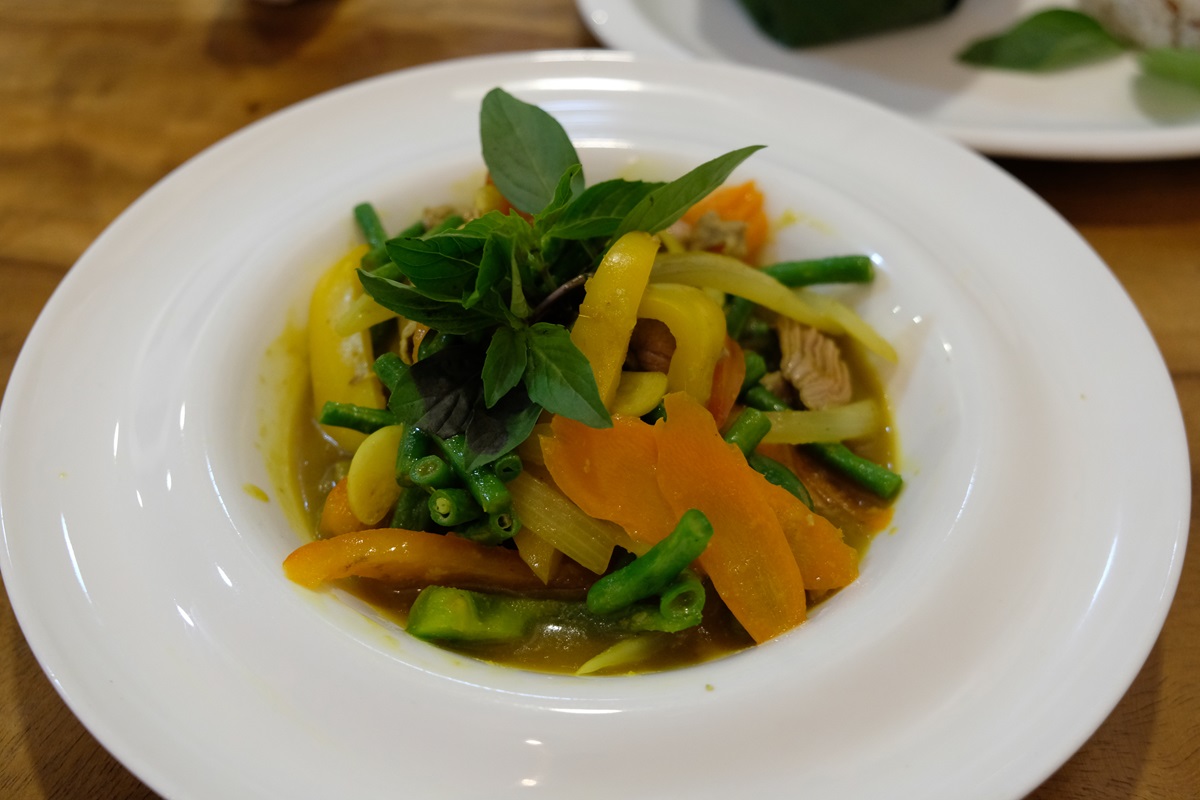
Beef cha kroeung, Tevy’s Place
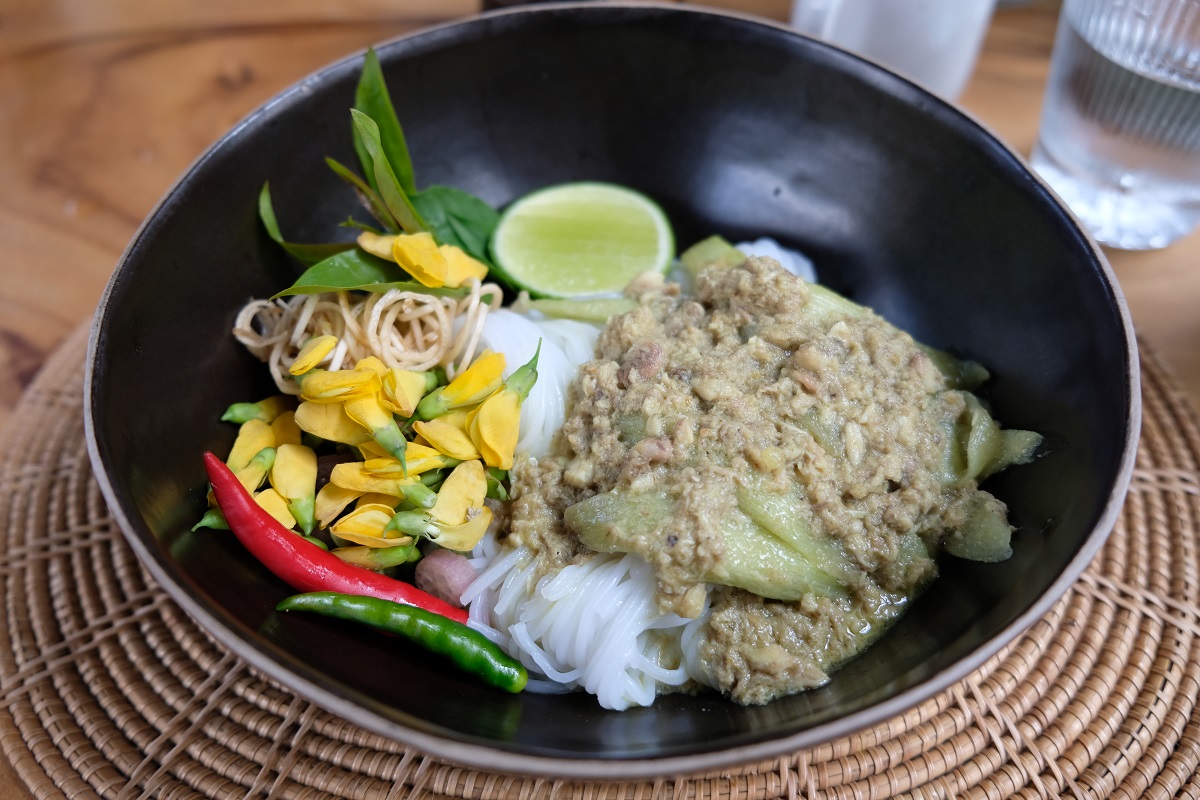
Num banh chok with smashed fish curry for breakfast, Pou

Braised duck breast in a sweet-spicy sauce, Pou
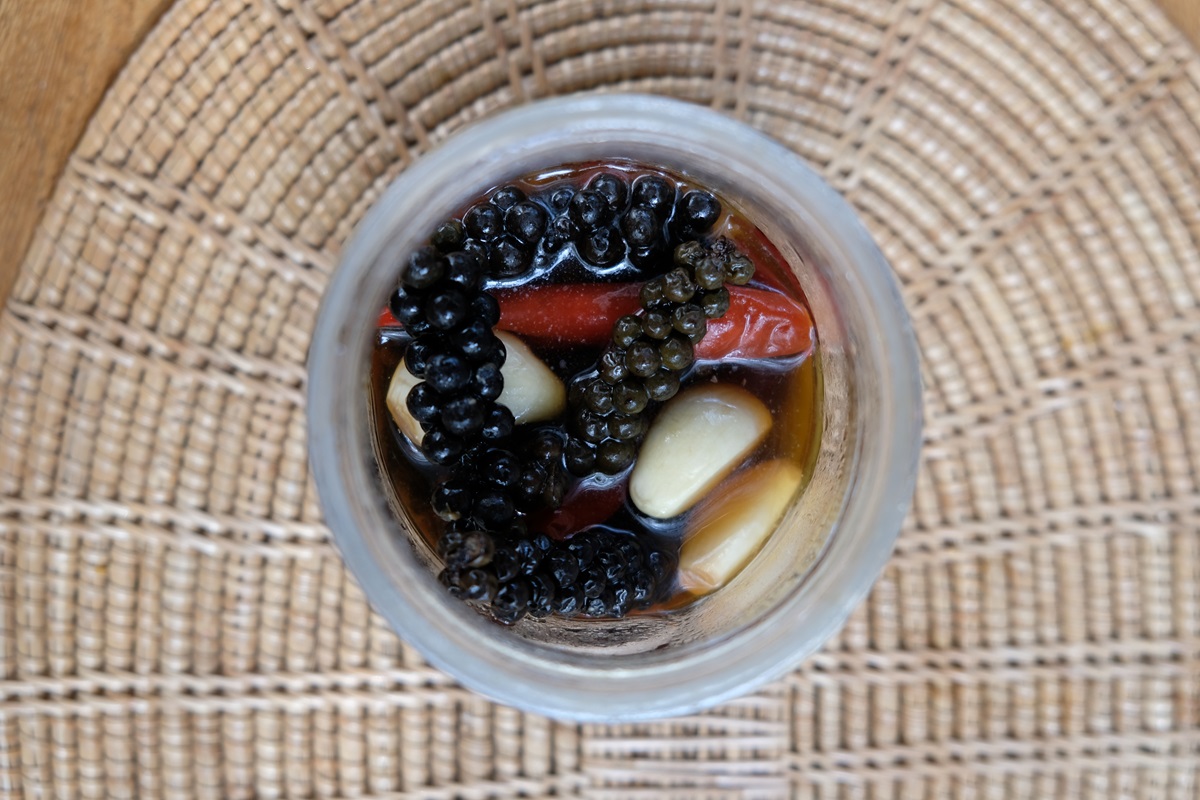
A vinegary condiment at Pou with Cambodian black pepper, garlic, and chili
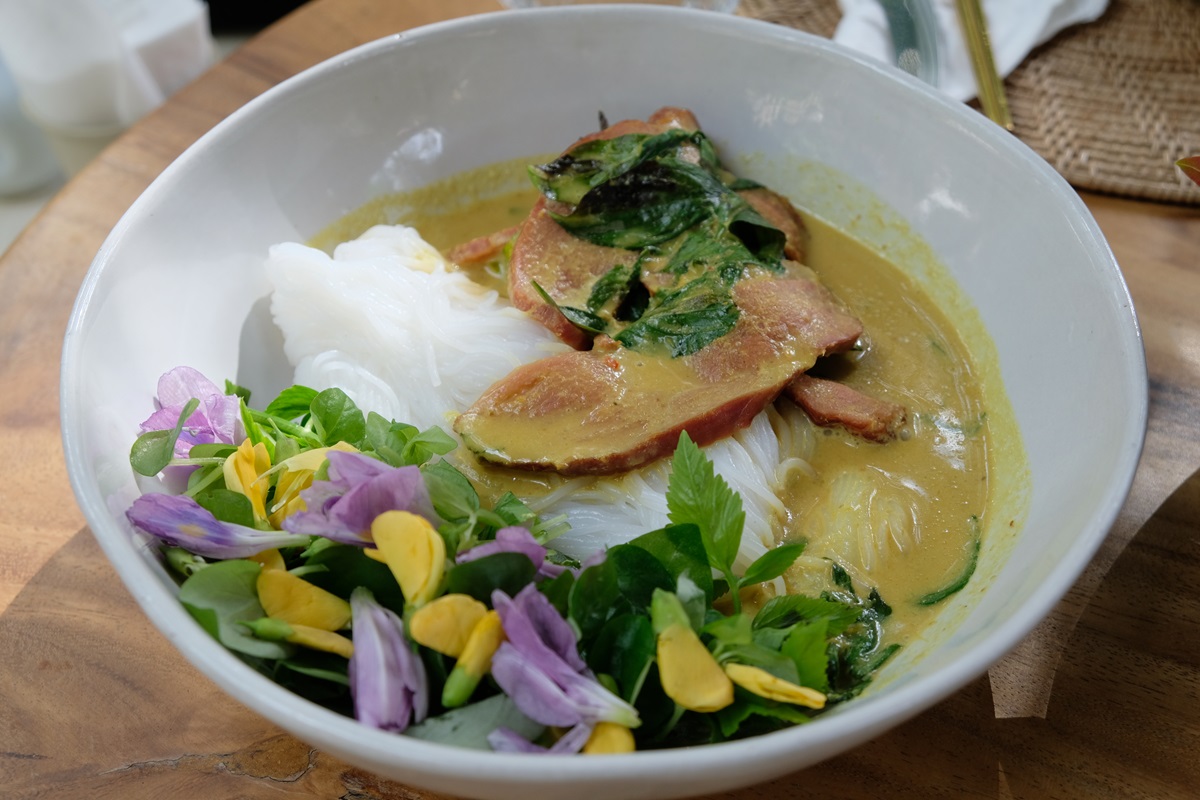
Num banh chok and roasted duck breast in green curry, Pou
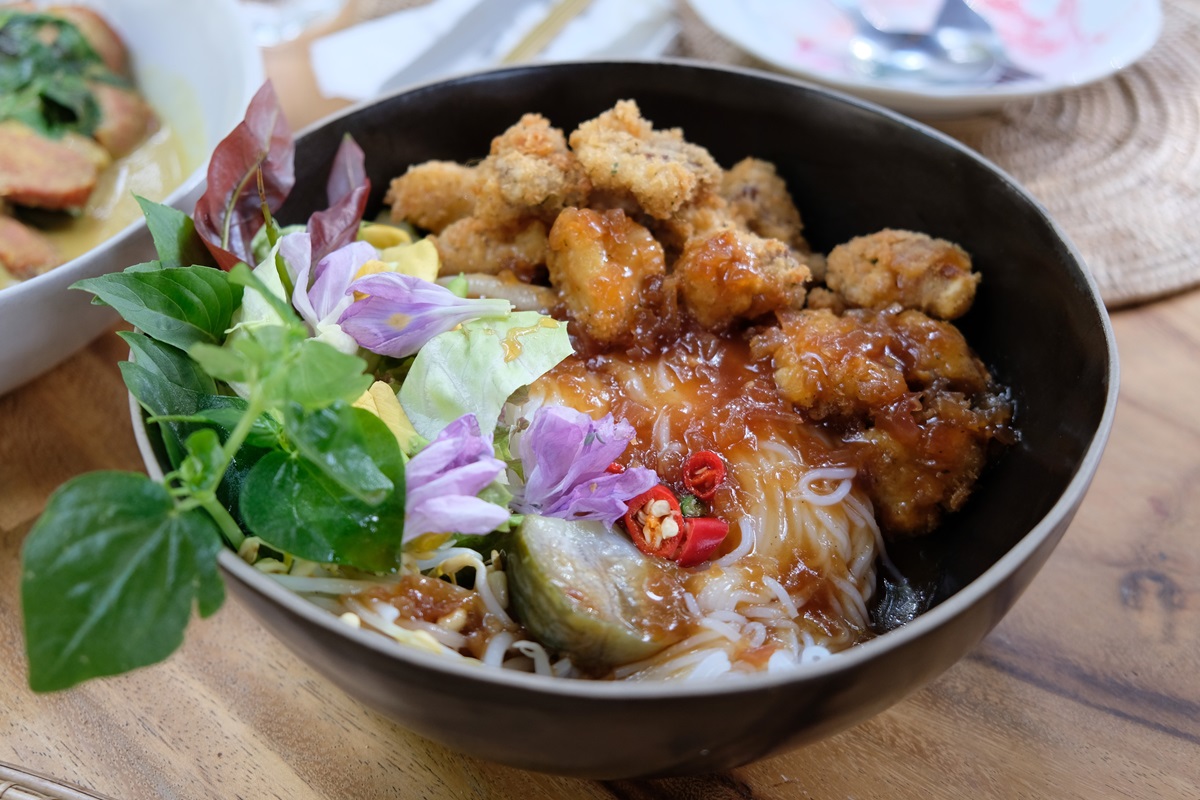
The same kind of lightly fermented noodles with fried catfish pieces in tamarind sauce, Pou

Pou’s version of lok lak
We were impressed with our first meal at Pou, for not only was it delicious, but also because it opened up our palate to a flavor-and-texture profile we were never exposed to before. However, we made sure to visit other places as well to see their takes on delightfully surprising Khmer food. For lunch on our second day in the city, we headed to Jomno, one of the highly-rated restaurants in Siem Reap according to online sources. We tried some local dishes with different proteins: from Battambang-style sausage served with banana blossom salad to grilled chicken with bright yellow korko stew and river prawn larb (minced salad). If anything, everything we had for this lunch further affirmed the wide variety of tastes in Cambodian cuisine. It was so much more complex than the flavors of the lok lak I had eleven years earlier.
This complexity can be attributed to kroeung, a broad term that describes a spice blend which often forms the base for many Khmer dishes. When I learned about it, I couldn’t help but draw another similarity between Cambodian and Indonesian cuisines where we use bumbu, our version of kroeung. Both kroeung and bumbu share a lot of ingredients in common, including garlic, shallot, chili, lemongrass, galangal, fingerroot, and sand ginger, among many other spices, herbs, and rhizomes. Of course, variations exist, depending on the region. But the concept is basically the same. Bumbu is so essential in Indonesian cooking it was hard for my late mom to grasp the idea that Cantonese cooking doesn’t really use bumbu when she asked James about the recipes of some common dishes in Hong Kong – ginger, scallion, garlic, and soy sauce usually do the trick.
On the subsequent days of our stay in Siem Reap, we found ourselves returning to Pou multiple times. Unsurprising, given our very satisfying first meals there and also due to its proximity to our accommodation. We made sure to have some more num banh chok, although with different toppings, including roasted duck breast in green curry and fried redtail catfish in tamarind sauce. However, they also had intriguing dishes on the menu we made sure to try. Red tree ants in a soup? Bee larvae inside the honeycomb? To me these unusual ingredients gave the impression of being more authentic and honest than the tarantulas that have been sensationally put on show by many foreigners in Cambodia on their social media accounts. There was, however, another reason for our repeated visits to this particular restaurant: we were curious about its cooking class. Before deciding to sign ourselves up, we wanted to make sure that the food was good and genuine – not the kind that has been toned down to suit international tourists’ palates.
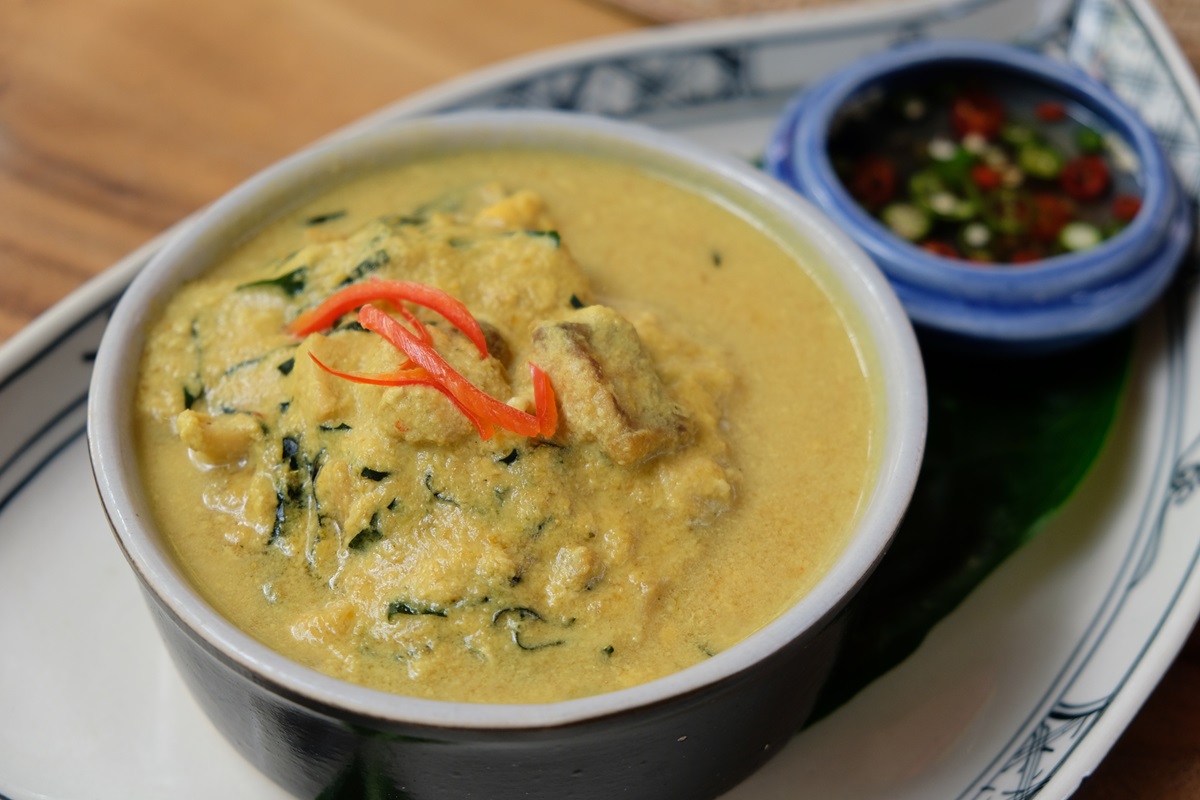
The most delicious fish amok I have ever tasted, Pou

Dried freshwater fish at Psah Kraom market

Judging from the number of fish vendors at the market, it is probably the most popular protein for locals

Another grilled fish vendor
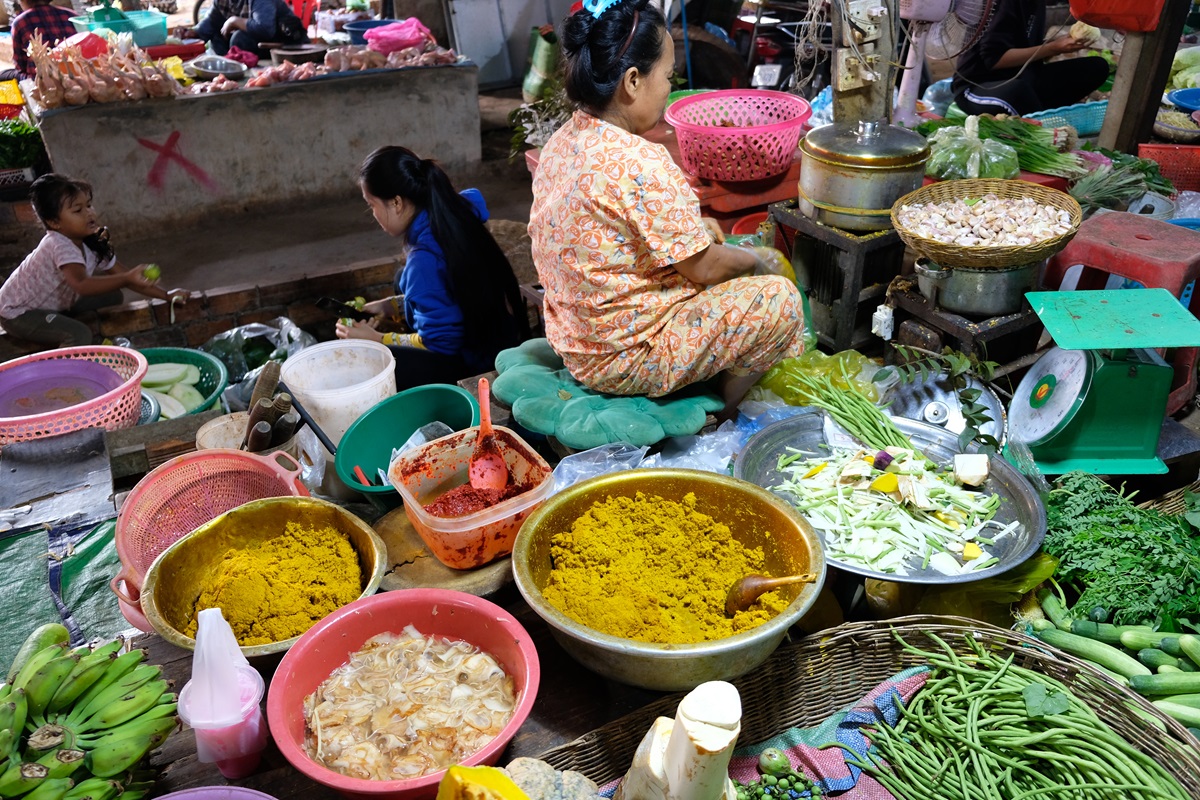
Yellow and red kroeung ready to be sold in smaller amounts
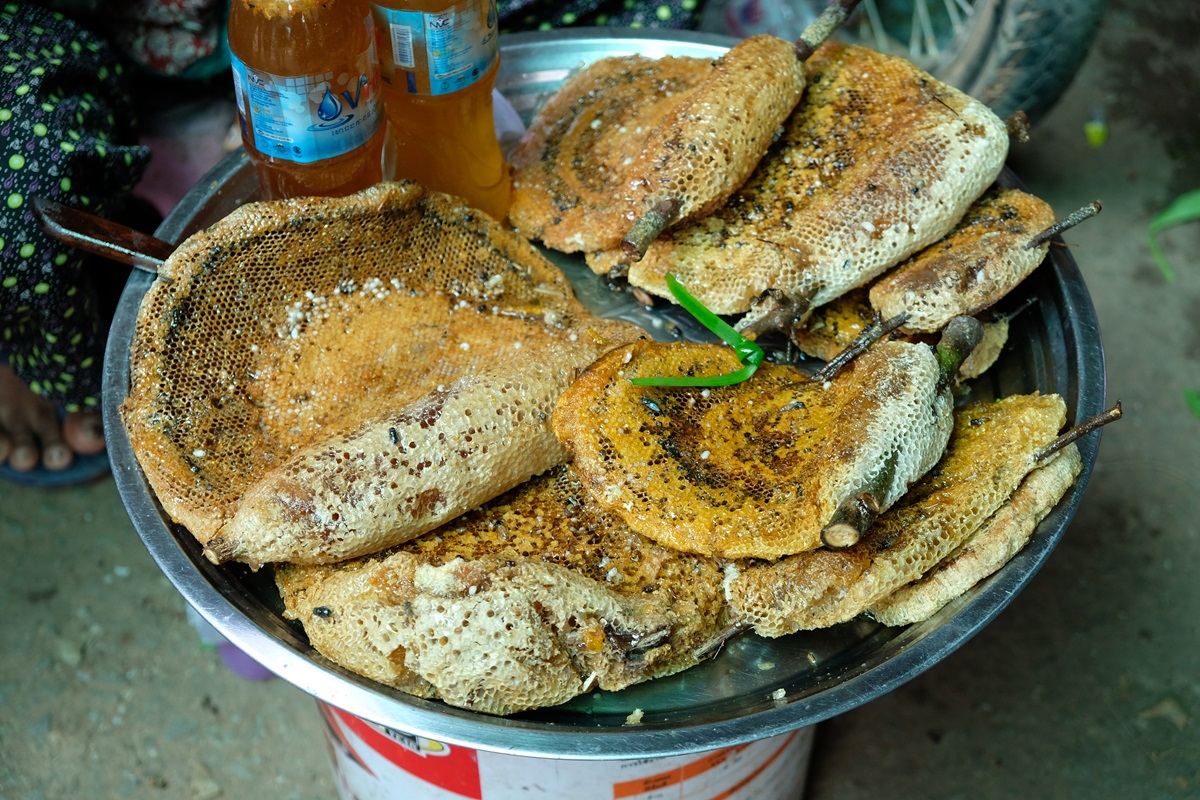
Raw honeycombs with bee larvae inside

Pou’s take on the local delicacy which was interesting, in a good way

Beef soup with red tree ants and krasang fruit (Feroniella lucida) which together give the dish its sour flavor
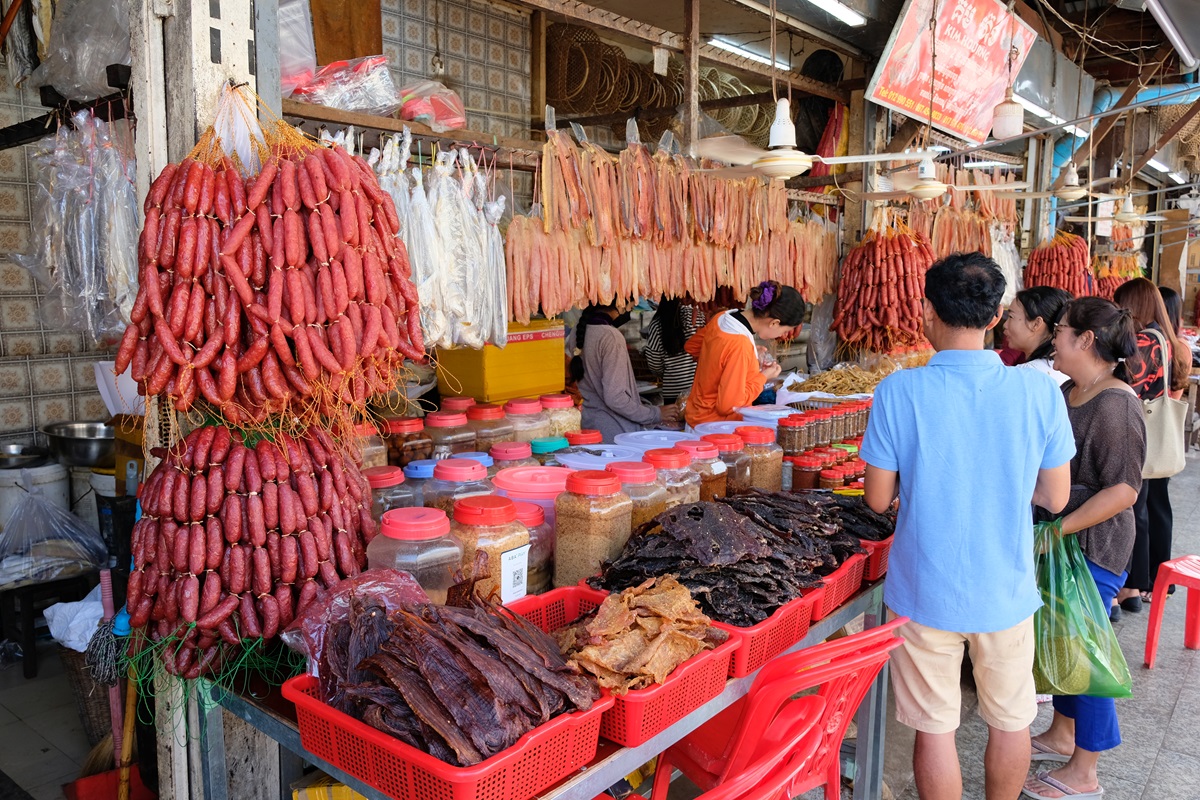
Sausages for sale at Siem Reap’s Old Market
On a rather overcast morning, we were joined by a German-Iranian couple from Frankfurt for a half-day excursion to a traditional market which was then followed by the cooking class back at Pou. Led by Chef Mengly himself, we took a remork (the Cambodian version of a tuk-tuk) and headed to Psah Kraom market. At first glance, it appeared very similar to the traditional markets in Indonesia, although I can imagine it must have been a world away from the ones found in Germany. But on closer inspection, there were items even I wasn’t familiar with. Some of the fish species were different from what I’m more used to, as were a few herbs and vegetables. At some vendors, I noticed large amounts of ground spice paste which was either yellow or red. That was kroeung.
When we were back at Pou, an open-air section of the restaurant was already transformed into our cooking corner. Small bowls, cutting boards, knives, portable stoves, and other utensils were laid out on top of a long table hewn from timber. While each of us had our own tools to make a ginger-infused milk pudding, a prawn and pomelo salad, and a fish amok, the ambiance was a lot warmer and more communal than other cooking classes I had taken in the past. Maybe it was because of the way we were seated which was very close to one another. But I think the good conversations we had with the other two participants earlier that morning tremendously helped to create an easy camaraderie among us.
I already liked the fish amok we had on our first night in Siem Reap. But Chef Mengly’s rendition tasted even better with a lot more depth in flavor. Through this cooking class, I found out that galangal is indeed used in the recipe, just like what I had suspected. If you closed your eyes and took a spoonful of this dish without knowing what it was, you would immediately know it’s Southeast Asian. Centuries of trade relations among nations in the region has allowed commercial goods, including spices and herbs, to move across borders and find their way into people’s homes. In fact, lok lak, that stir-fry beef I had in Cambodia in 2011, is a Khmer adaptation of a Vietnamese dish called bò lúc lắc. Thai and Lao influences can also be found in some of the local dishes we had in Siem Reap, including the river prawn larb we had in Jomno.
Thanks to its geographical position in Mainland Southeast Asia, Cambodia naturally acts as a confluence of flavors where distinct characters of regional dishes meet the Khmer’s own way of cooking where balance among each component of a delicacy is key. However, if there is one ingredient this country does better than the others it’s probably Kampot pepper. Named after a province in the southern part of the kingdom, this prized type of pepper is a certified geographical indication product that has made its way to the global market. With the existence of restaurants like Pou, Jomno, and Mahob (which we went to on our last day in the city to try their delicious prahok ktis) where Khmer cuisine takes center stage, it’s not unreasonable to feel optimistic for the future of Cambodian food. It might eventually follow the trail the country’s pepper has blazed, and one day Cambodia will not only be known for its magnificent ancient temples, but also for its delectable cuisine that truly deserves more attention and appreciation.

Battambang-style sausage with banana blossom salad, Jomno

Larb of river prawn, pork, and diced green beans in lime vinaigrette, Jomno

A modern version of korko stew with grilled chicken, Jomno

Kulen Mountain pork sausage with Kampot pepper sauce served with red tree ants, Pou
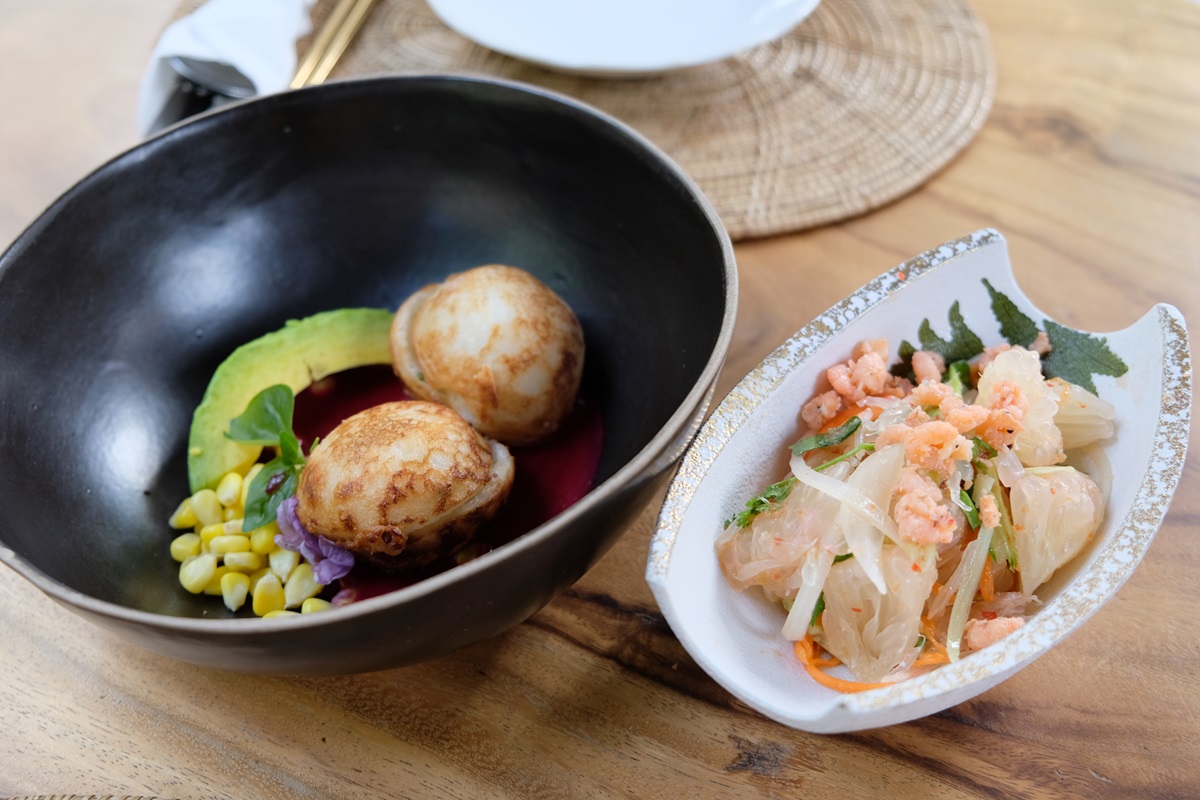
Left: Chef Mengly’s take on num kruk pancakes; Right: pomelo and shrimp salad – both at Pou
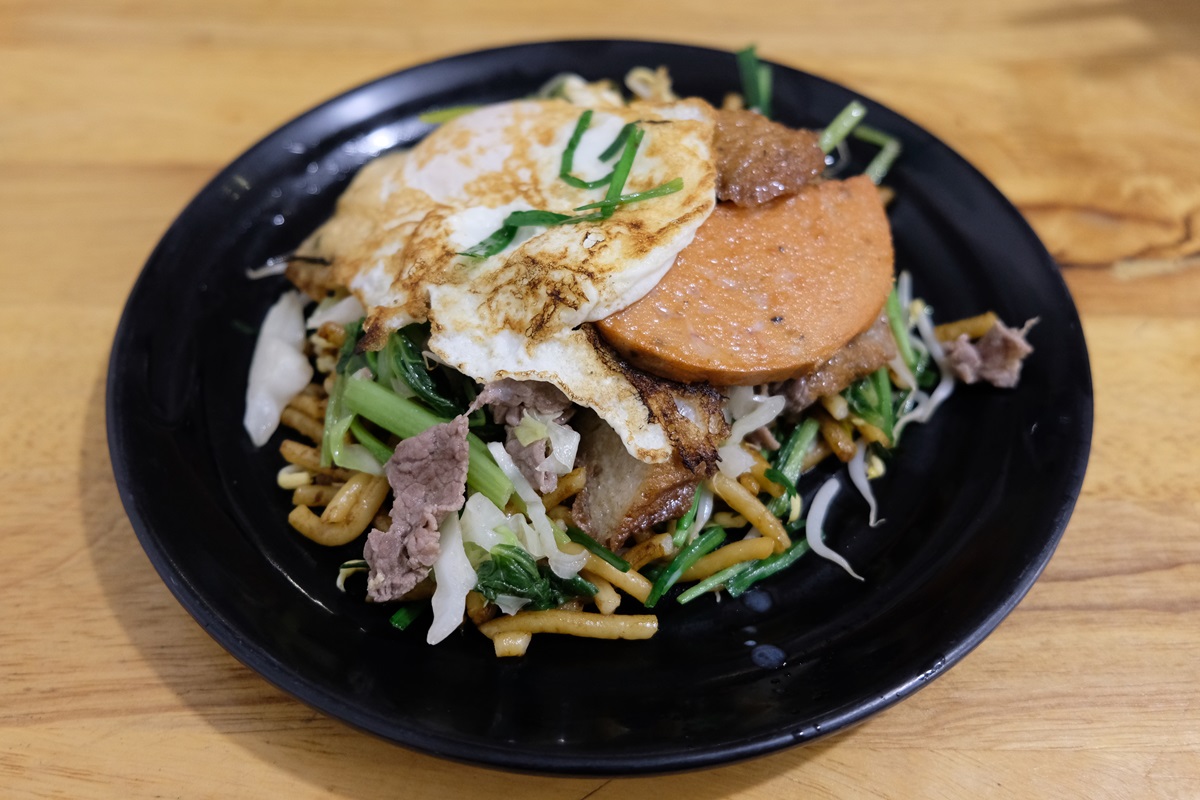
Simple yet satisfying stir-fried noodles at a local eatery just around the corner from where we stayed
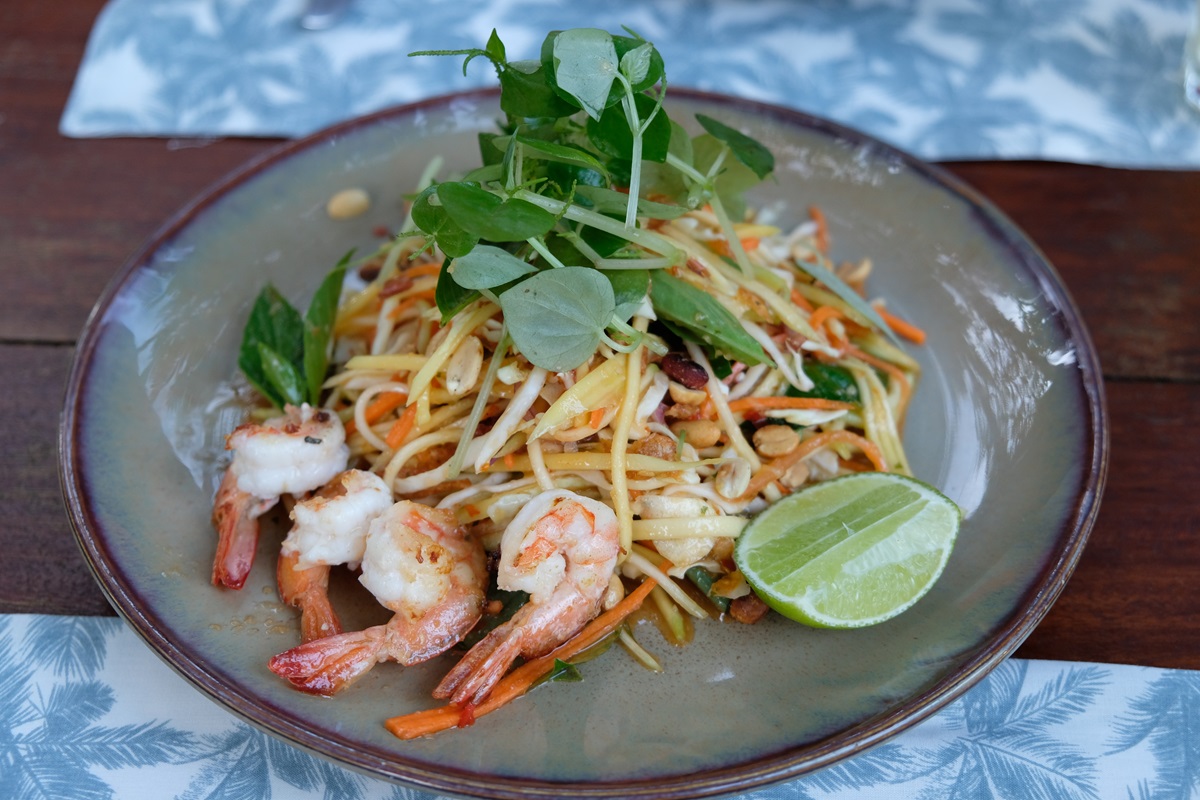
A green mango and river prawn salad, Mahob
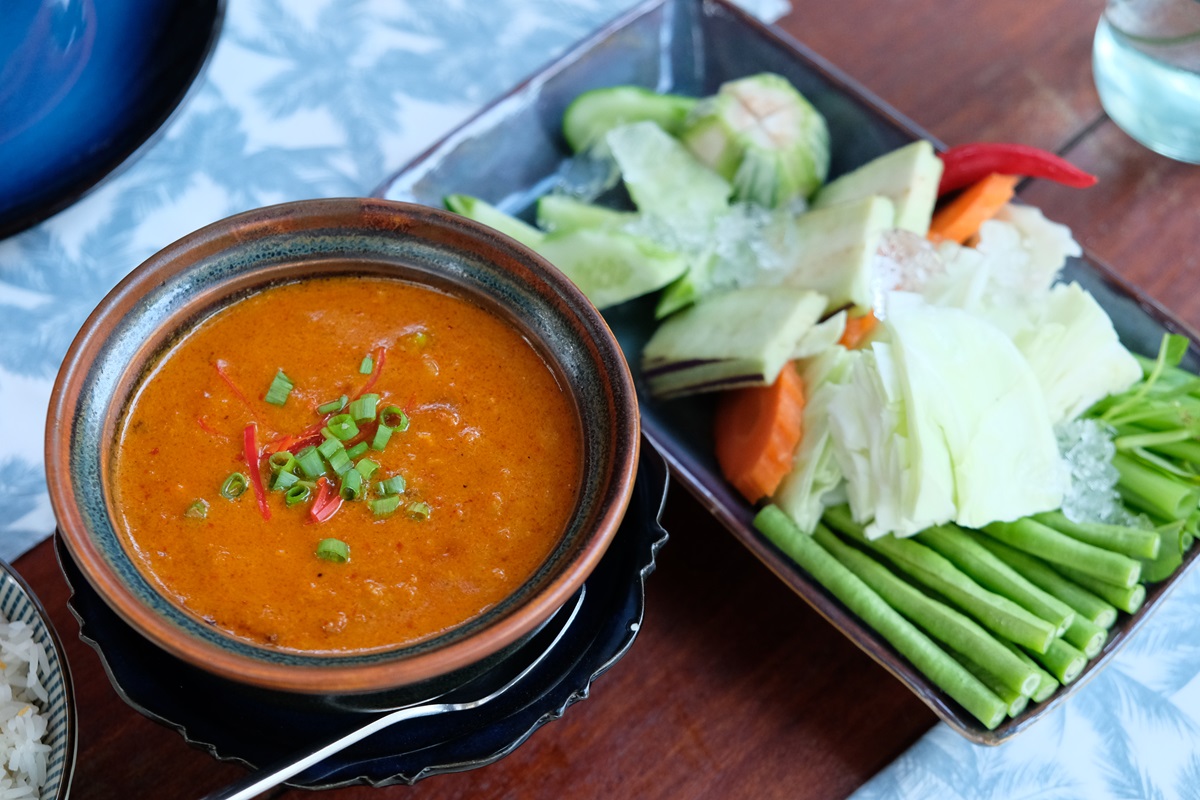
Prahok ktis, a dipping sauce made from prahok (fermented fish paste), minced pork, and roasted pea eggplants in a coconut gravy, Mahob
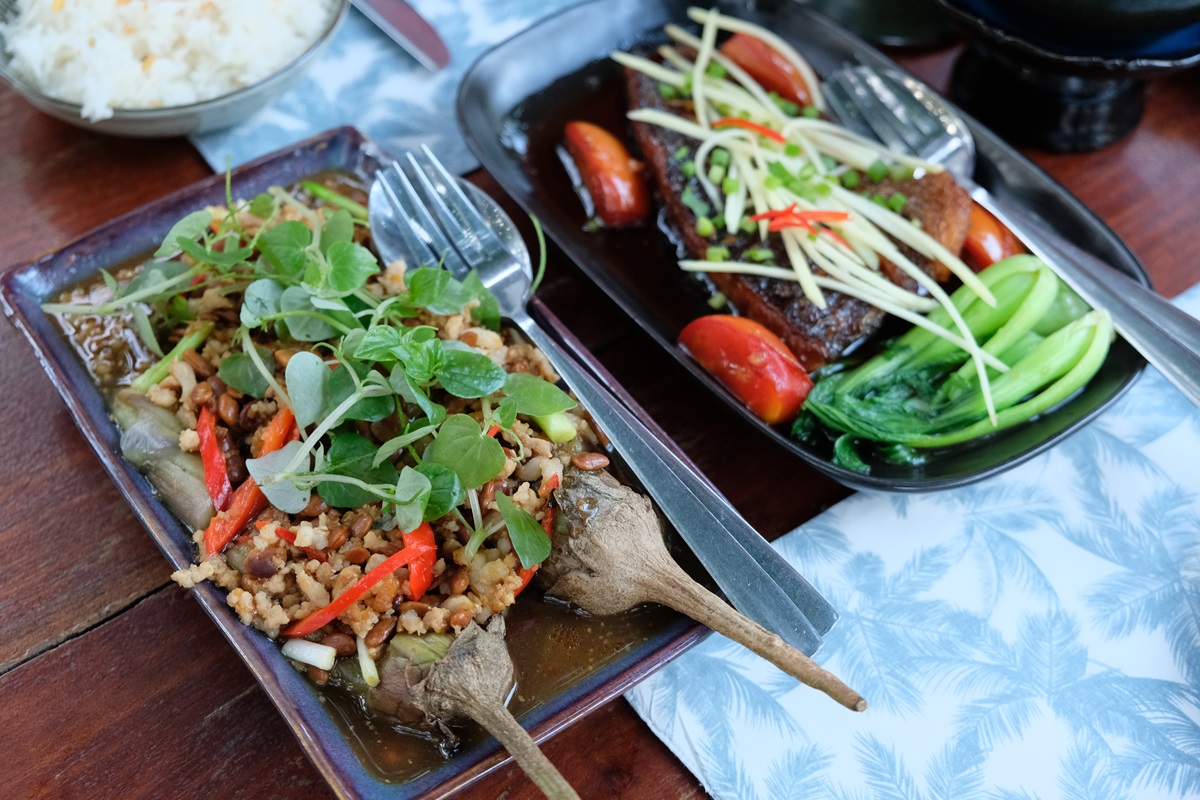
The other dishes we had at Mahob for our last dinner in Siem Reap

 What an Amazing World!
Oh wow! I should go back to Siem Reap again.
LikeLiked by 1 person
You really should, Edwin. And when you do, make sure to visit Banteay Srei as well.
LikeLiked by 1 person
I’ve not had Cambodian food before, but based on your photos, everything looks so fresh and mouth-watering! You certainly ate well during the return visit, and it makes me want to visit Cambodia sooner than later…or, at the very least, try Cambodian cuisine closer to home!
LikeLiked by 1 person
If you can find a Khmer restaurant in the city where you live, I suggest you to try it. You might enjoy Khmer food if you like Southeast Asian cuisine. But of course, it would be much better if you could taste them in Cambodia!
LikeLiked by 1 person
This will be my go-to resource for Cambodian food when I start seriously planning my trip to Siem Riep. Wonderfully detailed post, as always. And lovely food photography.
LikeLiked by 1 person
I.J., I know you like trying different dishes when you travel, and I have a feeling you would appreciate Khmer food when you travel to Cambodia. I guess it’s time to really start planning a trip!
LikeLiked by 1 person
Soon, I hope
LikeLiked by 1 person
Great photography Bama!
LikeLiked by 1 person
Much appreciated, Anna!
LikeLiked by 1 person
Although a lot of those flavours sound amazing, I don’t eat meat so I can’t get very excited about the dishes. I have had fish amok and remember liking the spices. I have never heard of fingerroot before. What is it? Maggie
LikeLiked by 1 person
Actually there was a restaurant in Siem Reap that served Khmer vegetarian dishes, but we didn’t get to try their food. I believe the same spices and herbs that are usually present in Khmer dishes would work well too with vegan- and vegetarian-friendly sources of protein.
Fingerroot is a long and thin rhizome that gives a dish a distinct aroma. It’s hard to describe its flavor, but I would say it’s more on the herbaceous side with a hint of ‘sweetness’.
LikeLike
Sounds interesting. I’ve never heard of it.
LikeLiked by 1 person
Hooray, a thoroughly detailed and sumptuous food post! 😊🤗😋
What an amazing trek of the senses, Bama. All the meals you experienced looked so delicious. I can taste and smell them from those beautiful photographed dishes you shared. Love the curries and the abundance of fish meals. And what a treat that you and James enjoyed a tour and cooking class. I would love to do that one day.
I agree with you that our younger selves don’t quite appreciate ingredients the way we would today. I spend a lot of time watching cooking reels and recently learned that banana blossoms was such a thing. Seems so wasteful on our part of the world to not make them available. And I want to try cooking with galangal one day.
On a related note, I recently read that Indonesia is expected to be the 4th largest economy in the world by 2075. You’re all doing something right and interesting over there!
LikeLiked by 1 person
Ha! You’ve been waiting for this, haven’t you? 😆
Tasting all the dishes we had on our trip to Cambodia in December 2022 made me realize how much I missed from my first trip there in 2011.
I guess as we age, we do tend to appreciate the little things better. Speaking of galangal, I wonder if it’s also used in Filipino cooking. In Indonesia, we add it and salam leaves (Indonesian bayleaf) to a lot of dishes to make them more aromatic.
I deal with a lot of foreign companies at work, and many people I spoke to did mention about how they perceive Indonesia as a very attractive place to do business. But as far as I know, we are not an outlier in the region. Vietnam and the Philippines seem to be doing quite well too compared to places like Thailand.
LikeLiked by 1 person
I don’t recall much galangal in Filipino cooking but I’ll have to pay attention.
Yes I think it was a World Economic Forum report. Vietnam and Philippines are also on the rise too based on their projections!
LikeLiked by 1 person
We’ll see if that will actually come true — although by 2075 we’ll be almost 100 years old!
LikeLiked by 1 person
this food looks amazing and delicious
LikeLiked by 1 person
They certainly were, Beth. If only we had a Cambodian restaurant here in Jakarta. If you find one in your part of the world, you should give it a try!
LikeLiked by 1 person
will do!
LikeLiked by 1 person
Yum! Definitely one of the highlights of travel.
LikeLiked by 1 person
Absolutely! Back in 2011, I didn’t know what I was missing for not exploring the local flavors in Siem Reap.
LikeLiked by 1 person
That was the same as my youngest daughter when we travelled through Java to Bali. As soon as we arrived on the tiny island, she was over the moon to see a KFC!
LikeLiked by 1 person
I hope she can enjoy different world cuisines better now. 😀
LikeLiked by 1 person
She does
LikeLiked by 1 person
It’s kind of funny to look back at how we used to travel when we were younger, along with our first impressions of a place, culture or cuisine. Glad you were able to return to Cambodia and try more adventurous dishes and appreciate the different flavours. Your local food exploration looks delicious and the dishes all look beautifully presented (and photographed)!
LikeLiked by 1 person
Looking back at my early years of traveling more regularly reminds me of moments where my current self can only wonder, what was I thinking back then?
It certainly helped that when I went to Cambodia the second time, the culinary scene in the country (or at least in Siem Reap) seemed to have evolved for the better. Now Khmer food is no longer sitting in the background, waiting to be ‘found’.
LikeLiked by 1 person
The food looks good though I don’t eat fish…but there seems to be lots of things I would be interesting in trying. You are right that food is a window into a culture though sometimes the food is a bit underwhelming; too bland, too spicy or without taste but it is still important to try. (Suzanne)
LikeLiked by 1 person
We might not always like the dishes we have in other countries, but I learned that in many cultures the locals would appreciate it if we are willing to accept the food they offer. Sometimes making the connection is more important than enjoying the meal itself, although it certainly would be a bonus if the thing we eat turns out really nice.
LikeLike
And you won’t know if like something if you don’t try it…
LikeLiked by 1 person
Exactly!
LikeLike
Those look great! We have a restaurant here in Copenhagen called Khmer Cuisine, I like their fish curry and meatball noodles, perhaps can’t be compared to the real ones in Cambodia, but the place in Copenhagen serve good and hearty comfort food.
LikeLiked by 1 person
I wonder if the fish curry you like is in fact fish amok. It’s really great that you have such diversity in the food scene in Copenhagen! Any good Indonesian restaurant over there?
LikeLiked by 1 person
Yes! We have three now, before there were none. One is a really good one that I frequently visit
LikeLiked by 1 person
I often wonder how the food at Indonesian restaurants abroad (especially those not in Asia) tastes like. It’s great that there is a good one in Copenhagen.
LikeLiked by 1 person
Bama, now I have posted a blog about Indonesian food in Copenhagen, inspired by your question 🙂
LikeLiked by 1 person
Ha! It’s really great to see how Indonesian food ‘finally’ gets the attention it deserves abroad.
LikeLiked by 1 person
You guys are so adventurous with food! Most of this sounds delicious, and the cooking class sounds like a lot of fun.
Alison
LikeLiked by 1 person
I can ‘blame’ James for that. He’s a true foodie, and he can be genuinely excited talking about food!
LikeLiked by 1 person
I find that local cuisine gives us an enormous insight into the local culture, as it sheds light on the region’s indigenous crops, and cooking techniques and even reflects the history of the area. It looks like you went all out in order to sample Cambodian cuisine. When I hear ‘Cambodian food’? what I envision is some sort of vaguely Southeast Asian curry, a noodle dish or maybe some fragrant soup. Yep, I have to be honest – it’s fair to say that I know very little about this overlooked Asian cuisine. Question – do they have any vegetarian dishes, too? Thanks for sharing, and have a good day 🙂 Aiva xx
LikeLiked by 1 person
The same thing happens to Middle Eastern restaurants in Jakarta. Many Indonesians are not aware of the diversity of cuisines from that region. Due to the fact that most Indonesians of Arab descent have connections to Yemen, it’s the food from this country that a lot of people here associate with when they think of the culinary tradition from that part of the world. Because of this, Iranian, Moroccan, and Jordanian restaurants in the city also serve Yemeni dishes.
When we were in Siem Reap, there was a vegan restaurant serving Khmer food which we didn’t have time to visit. Maybe next time!
LikeLiked by 1 person
I love this! “Today, I view food as a window into other cultures. The first bite is like that knock on the door to enter a stranger’s house. And oftentimes, once I am inside, I find out what an amazing, beautiful, and intricate house it is. In many communities, food is in fact a love language which feels like a warm hug if you let yourself be vulnerable and curious.”
I think you captured how food can be a conduit for creating bonds and understanding. There are still some dishes I’m really hesitant to try. I still can’t get over my last food poisoning experience (at Singapore of all places). But these dishes look so tempting to try. Although the raw honeycomb with the larvae inside raises questions of sustainability which I need to read up on.
Great writing. I hope you’re doing well.
LikeLiked by 1 person
I remember you mentioned about your food poisoning in Singapore. But do you remember what dish it was that wreaked havoc on your stomach?
You raised a valid concern regarding the sustainability of eating raw honeycomb. I also need to look up on that. However, usually when the consumption of something like this is limited to the local community (as opposed to being overly commercialized), the pressure humans put on the environment can still somewhat be managed. But someone needs to conduct a proper study, indeed.
Thanks Matt.
LikeLike
It was either an ice drink or a chicken dish.
LikeLiked by 1 person
I hope that bad experience won’t deter you from trying Southeast Asian food. I guess what happened in Singapore was you happened to be at the wrong place and at the wrong time.
LikeLike
My dad was telling me just last night that he has no recollection of trying anything Cambodian – not even fish amok or beef lok lak – during his multiple business trips to Phnom Penh over the years. I’m thankful we had the time to explore and savor the flavors of Khmer cuisine during our week in Siem Reap. We may not have access to the meaty redtail catfish from Tonle Sap here in Jakarta, but I guess fillets of patin or gourami will work as good substitutes. After buying a real steamer and finding fresh noni leaves at a traditional market, we’d be all set to recreate fish amok at home!
LikeLiked by 1 person
It’s either Khmer food was not as widely available at restaurants back then as it is now, or your dad was just unlucky. You know, you’re right about patin. Due to its silky smooth texture, I can imagine how replacing redtail catfish with the former — which can easily be found at supermarkets — can actually work to make fish amok. I have to admit it is one of my favorite Khmer dishes because its flavor profile reminds me of home.
LikeLiked by 1 person
When I read the title of this post, I knew you had a good time eating your way through Siem Reap. And your post did not disappoint 😄 Sometimes when we are young, we are young. But now we are all a bit older and wiser, we appreciate each moment even more. Looks liked quite a few tasty meat dishes there, from breakfast to lunch to dinner.
Interesting to learn that kroeung is the equivalent of bumbu. It has been a while since I was in Jakarta but I can still remember the taste of bumbu. It is very distinct!That is wonderful you got to experience a cooking class cooking local food in a local environment. And you got to make a fish amok! It’s lovely for the class to let all of you make three dishes. Quite the experience to cook like a local and eat like a local. Really enjoyed this post, Bama. Hope you are doing well
LikeLiked by 1 person
As you can imagine, we surely did eat well in Siem Reap. If only there was a Cambodian restaurant in Jakarta. I wonder if you ever come across Khmer cuisine in Australia. Given their cosmopolitan nature, I won’t be surprised if some big cities Down Under have establishments serving the traditional food from this Southeast Asian country.
The cooking class was fun! I would definitely do that again in a heartbeat.
LikeLike
There are actually a few Cambodian restaurants in Melbourne. I haven’t actually tried them though 😄 The food scene in metro Australian areas tends to be quite diverse and multicultural. Lots of good food and good eating to be had. Hope you get to visit one day, Bama 😊
LikeLiked by 1 person
It’s great that you have several places to choose from to try Khmer food. When I went to Melbourne I tried Ethiopian, Lebanese, and Greek dishes, among others. I loved all of them!
LikeLiked by 1 person
You’ve certainly come a long way being bold in what you are willing to try since your first visit, especially as I look at all the ingredients in the dishes you describe, Bama.
I love to join cooking classes when I travel, as like you say, it is a wonderful way to explore and get to know a culture. Your words in the quote below is perhaps the most powerful I’ve ever heard to describe this relationship between food and culture.
“The first bite is like that knock on the door to enter a stranger’s house. And oftentimes, once I am inside, I find out what an amazing, beautiful, and intricate house it is. In many communities, food is in fact a love language which feels like a warm hug if you let yourself be vulnerable and curious.”
LikeLiked by 1 person
Looking back, there really shouldn’t have been any excuse for me not to try the local food in Cambodia since many of those dishes share similar ingredients with what I ate when I was growing up.
But cooking class? That’s certainly something I never really thought about until I started traveling with James. I wish I had spent more time at the kitchen with my mom when she was still alive. That could’ve been a really great cooking class.
Thanks Jolandi. In many cultures, food really is an avenue to building connections with the locals.
LikeLiked by 1 person
This is awesome. Great photography on the food dishes. Yum o Yum!! Thank you, Bama!
LikeLiked by 1 person
Oh both of you will really enjoy Cambodian food, I think. I hope you’ll get to try them one day!
LikeLike
Oh my, this made me so hungry! I have never tried Cambodian food and it looks and sounds absolutely delicious – I also love how they sometimes use flowers to decorate the dishes! I am just not sure of how I’ll handle the spices ahah!
LikeLiked by 1 person
In general, although we do use a lot of spices here in Southeast Asia, it’s nowhere near as the amount of spices used in Indian cooking. I would say in this part of the world we take a more balanced approach to how much spices and herbs we put into a dish. But of course, I’m biased. 😄
LikeLiked by 1 person
This is mouthwatering! NOT a good thing to see when I’m off for parts that lack such delicious food!
LikeLiked by 1 person
Now I’m curious about where you’re going next!
LikeLike
Mealie meal lands – called nshima or pap or sadza depending on the country in sub Saharan Africa but basically all the same. Tasteless mass of sticky boiled maizemeal. Kind of takes the place of sticky rice in SEA.
LikeLiked by 1 person
I had to google what mealie meal is. It sounds similar with fufu and ugali. Interesting!
LikeLike
This all looks so delicious! Completely agree with you about “food as a window into other cultures”!
LikeLiked by 1 person
Rebecca! OMG it’s been ages! I hope you’re doing well. I believe we really should expose our palates to different flavors of the world. That’s already halfway to understanding others.
LikeLiked by 1 person
So long! I always read your posts by email but I just realised I haven’t been commenting!
LikeLiked by 1 person
At one point I noticed that your blog was no longer active, or it still is? Anyway, it’s always nice to see familiar faces here.
LikeLike
Nope, always been active! Just hasn’t got a lot of love at times when work has been busy 🙂
LikeLiked by 1 person
I have tried bee larvae (not so bad but I’m allergic to them) but I didn’t know that you can use red ants for cooking 🙂 I am curious about how you processed them. Just mix with the fruits and then put them all into the soup. Does it have the smell of formaldehyde?
LikeLiked by 1 person
At least you have tried them! In my experience, only some ants have that strong formaldehyde odor, and luckily the ones added to those dishes we had in Siem Reap didn’t smell anything. They only added some sourness to the dish. In terms of processing, I got the impression that you just simply add them to the pan while cooking. But I could be wrong.
LikeLiked by 1 person