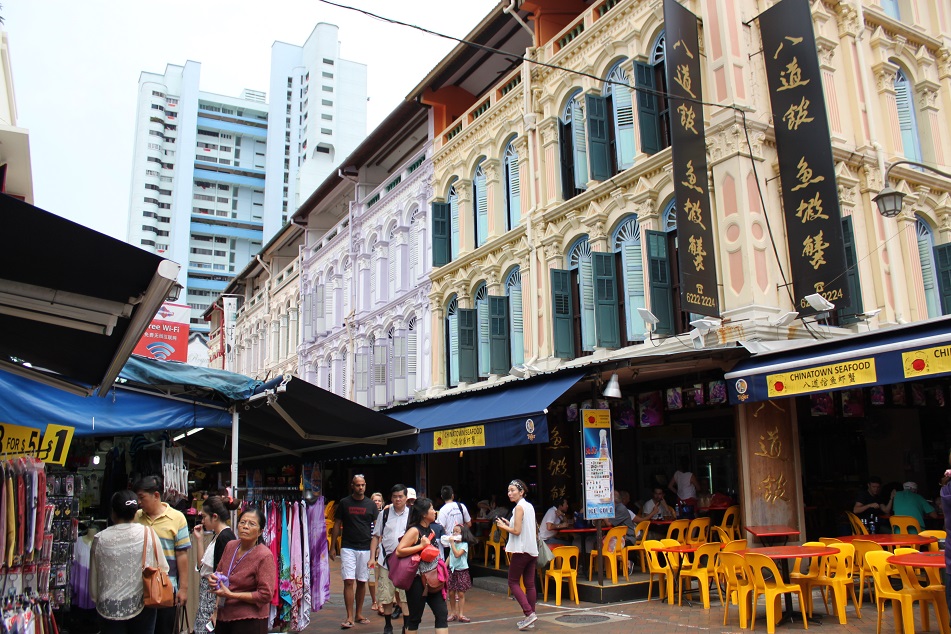
The Ever-Bustling Chinatown
Multi-tiered pastel-colored shophouses lined the narrow alleys of Singapore’s Chinatown. Every turn revealed a lively street culinary scene with food carts and restaurants serving a wide array of Chinese dishes, occupying the muggy pedestrian-only walkways crisscrossing under bright red and yellow lanterns. Curiously, at one turn colorful figurines slowly emerged from a walled compound as we walked closer. The unmistakably Dravidian architecture of Sri Mariamman temple seemed to be out of place in the otherwise Oriental-themed neighborhood.
On the other hand, tucked amid mosques and Hindu temples in a neighborhood where the air was infused by the fragrance of spices, a two-floored house stood conspicuously with a riot of colors adorning its exterior walls. In 1900 a Chinese businessman, Tan Teng Niah, built his imposing house in an area where Indian textile traders dominated the view. The house was a testament to his successful confectionery business.
Singapore’s ethnic-based residential division was the brainchild of Sir Stamford Raffles himself during the booming period of the nascent British colony, carefully planned with the help of a committee led by Lieutenant Philip Jackson, hence the name: Jackson Plan. In 1822 the master plan was formulated and soon afterwards Singapore was laid out in British-style grid lanes and districts with European, Chinese, Indian and Malay neighborhoods stretched along the southern coastline.
In the years that followed the boundaries of the racially segregated kampong, the Malay word for ‘village’, gradually dissolved as people from different ethnicity began to settle outside their respective neighborhood. In 1827 a Tamil Hindu temple was constructed in Chinatown, then a few decades later the Buddhist temple of Leong San See added a multicultural dimension to Little India.
To the east of Chinatown and Little India, a more laid back neighborhood was hidden behind modern highrises and wide avenues. We walked pass Turkish, Middle Eastern, Malay and Indonesian restaurants along palm tree-lined streets leading to the landmark of this Muslim-dominated district: the golden domed Sultan Mosque. Not far from it stood the former palace of Sultan Hussein Shah of Johor, today’s Malay Heritage Centre showcasing Malay culture and traditions shared by many people in Singapore, Malaysia and Indonesia.
When it comes to food Chinatown is many travelers’ place of choice who are curious about Asian dishes. Meanwhile Kampong Glam attracts Muslim tourists looking for halal food, and Little India is where more adventurous visitors look for spice-infused Indian cuisines. The racial segregation has long been abandoned, but its legacy remains palpable today in Singapore’s Chinatown, Little India and Kampong Glam, each alluring modern-day visitors with its own charm.
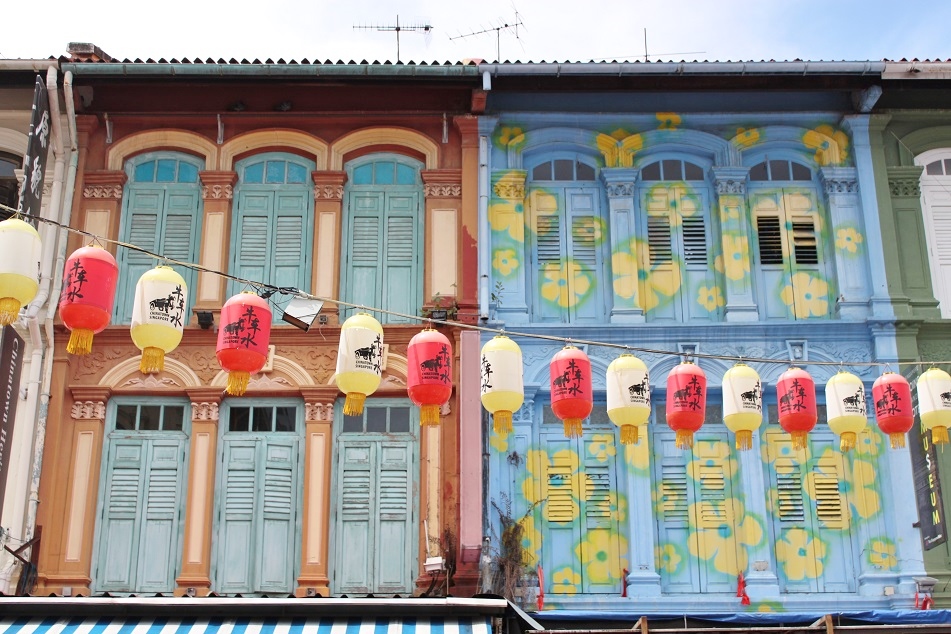
Colorful Chinese Shophouses
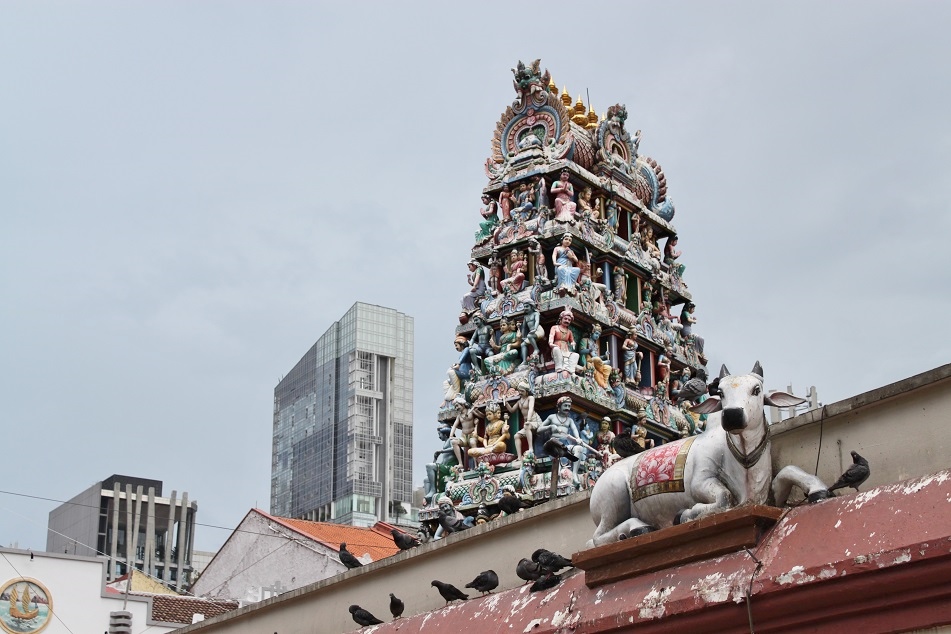
Sri Mariamman Temple, A Tamil Hindu Temple in the Middle of Chinatown

Abdul Gafoor Mosque, Erected by Indian Muslim Immigrants

Small Minarets Decorating the Mosque
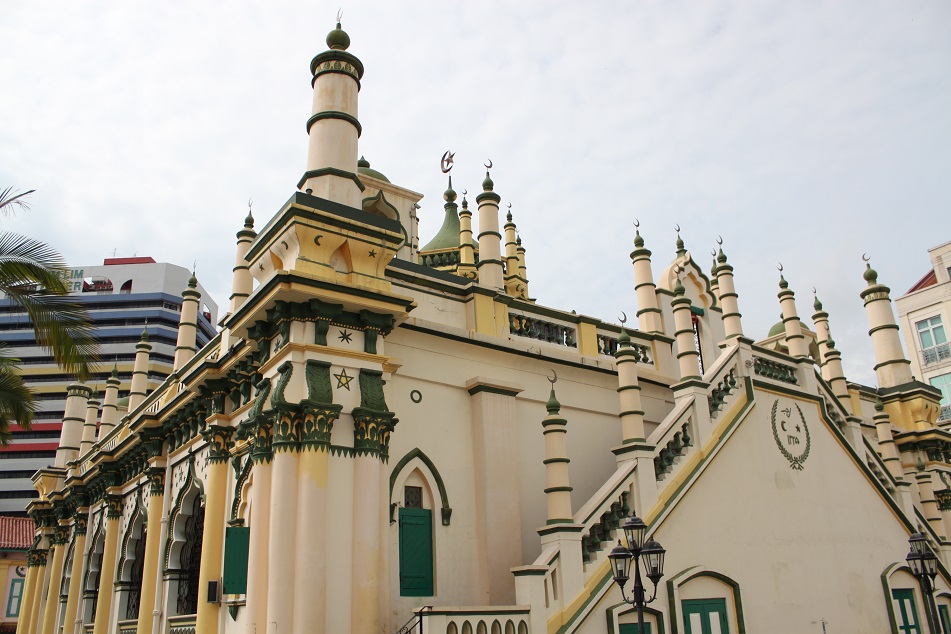
A Peek to the Rear Side

Tan Teng Niah’s Ostentatious Residence
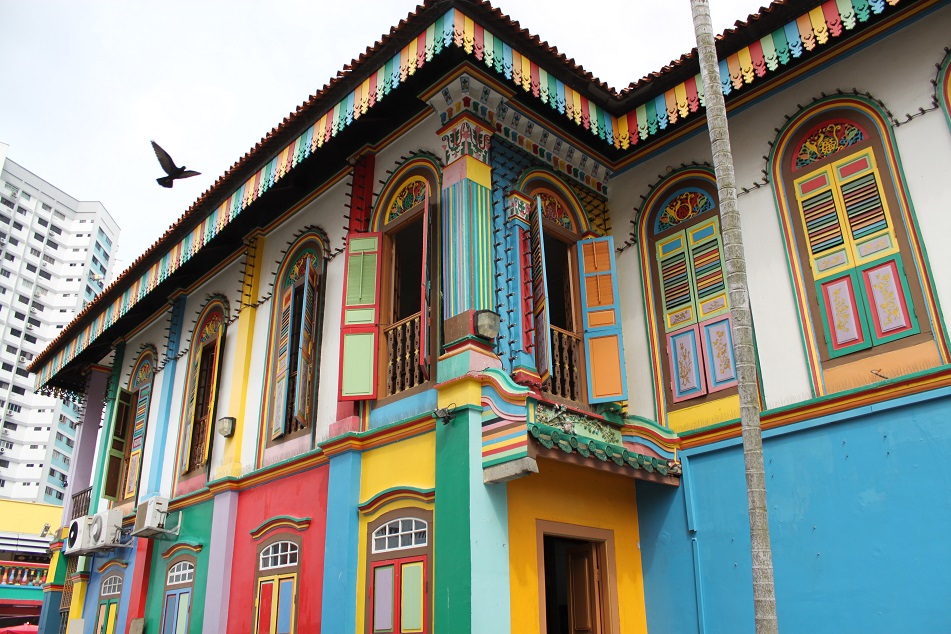
A Riot of Colors
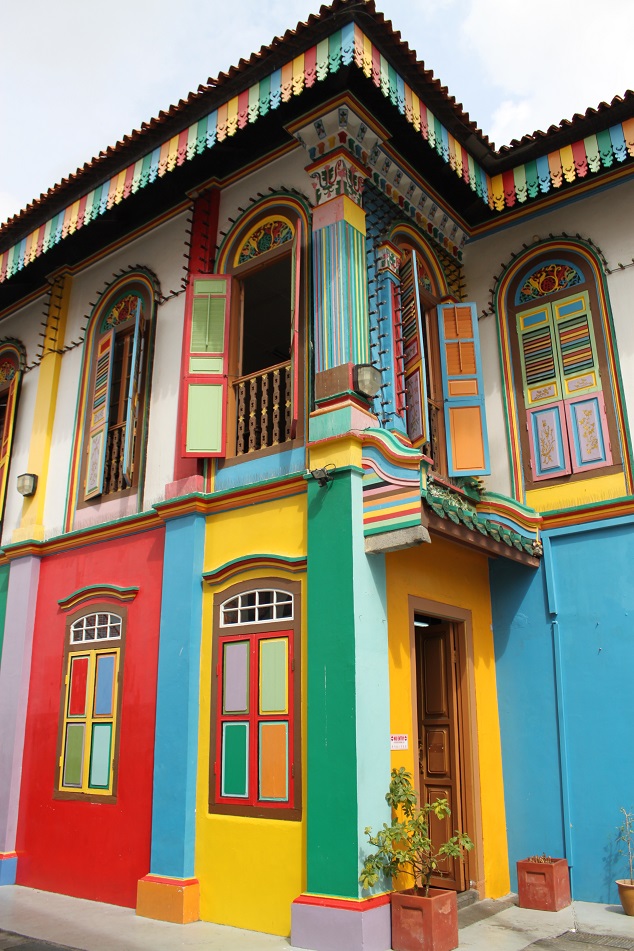
The Most Eye-Catching Residence in Little India

Sultan Mosque from the Old Palace Plaza

Palm Tree-Lined Street at Kampong Glam
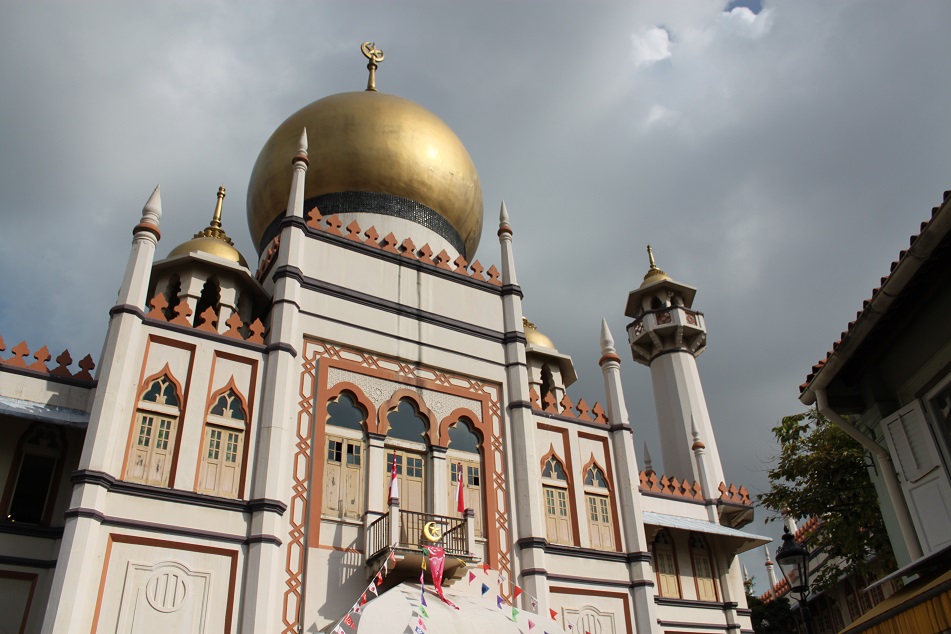
Sultan Mosque, Up Close

 What an Amazing World!
Brilliant – elegant and professional images – strong and historical presentation!
LikeLike
Thank you, Mihran, as always.
LikeLike
Gorgeous!! I only managed to spend 24 hours in SIngapore in 2012 when I extended a layover in Singapore. Wish I could have stayed longer and explored more of the city. The mosque is absolutely fantastic!! Amazing photos.
LikeLike
Most people go to Singapore only for transit. But if you gave yourself two or three days you would have seen its true charm: grand colonial buildings and eclectic mix of cultures. There’s always next time. 🙂 Thank you, Ana.
LikeLiked by 1 person
Great photos and simple coverage of our history! Im Singaporean and so proud of our interracial heritage 🙂 Lovely post x
LikeLike
Hi Melissa. I can imagine how proud you are of your country’s interracial heritage — it also produced some of the best Peranakan dishes in the region. Thank you for reading.
LikeLike
Thank you for the travel inspiration! Planning a stop over in singapore on my way to the maldives soon!
LikeLike
My pleasure! Have a nice stopover in Singapore! (I hope the weather is good when you come).
LikeLike
A beautiful post, Bama! The original European quarter seems to be the only ethnic neighbourhood where that cross-cultural pollination didn’t take the same form. Despite Singapore’s diverse roots, it is strangely devoid of mosques and Buddhist/Taoist/Hindu temples.
LikeLike
Makasih banyak, James. Maybe because they came to Singapore to colonize it, while the Chinese and Indians came solely to trade. Interesting observation on the lack of worship buildings in Singapore — probably it’s the legacy of the ‘segregation’ itself where mosques and temples were concentrated only in certain areas.
LikeLike
Your photos of the architecture of Singapore are spectacular – every one tells a story. I especially like the third one down which shows the Hindu Temple and the modern block building. They definitely inspire the viewer to see more!
LikeLike
Thank you, Marilyn. Beyond the archetypal modern skyline of Singapore lie unique neighborhoods which make Singapore a multicultural society as it is today. I hope you’ll travel to this part of the world one day! 🙂
LikeLike
Wow those are some really beautiful buildings, nice colors and architecture. The images themselves have a sort of immersive feel about them that makes you want to be there.
LikeLike
Thanks Richie. Singapore has a lot of photogenic ethnic quarters, indeed.
LikeLiked by 1 person
Bama this is spectacular. I did not know about the different cultural neighborhoods. The photos are astounding as always and I love the term ‘riot of colors’.
LikeLike
Sue, thank you! I’m glad you enjoyed this post. Probably Singapore’s multiculturalism is one of the best things about the country. Sadly many people come to the city only for shopping and miss those colorful neighborhoods altogether. Actually ‘riot of colors’ is a term James invented — I think I read it in one of his posts. 🙂
LikeLiked by 1 person
I am so happy you showed me this part of Singapore! Well whether it be James or you I think it is a wonderful phrase. 🙂
LikeLiked by 1 person
The color and architecture are a true feast for the eyes.
LikeLike
They truly are! I was pleasantly surprised to see these parts of Singapore, often overlooked by most tourists.
LikeLike
So colorful! So interesting! It’s something that I didn’t know about Singapore, thanks for sharing! 🙂
LikeLike
And thanks for reading, Geri. Singapore really should promote its multicultural neighborhoods more — they’ve already done enough marketing for their glitzy shopping malls, theme parks, and everything modern they have.
LikeLike
I went there in October and really loved it! I’ve written a couple of my stories up on the blog. So much more than just a stop over 🙂
LikeLike
So much more than just a stopover, indeed. I found some of the city’s best dishes in such neighborhoods. So basically you went about one month after I did. 🙂
LikeLike
One thing that I found interesting about Singapore is that for a very small country, it has a wide cultural diversity. It’s interesting to learn that they were once geographically segregated and that they eventually meshed into each other’s villages. I think its a good display of cultural acceptance. Interesting post, Bama, and I enjoyed your beautiful and colorful photos.
LikeLike
Its strategic location at one of the world’s most important trade routes helped Singapore to become such a unique melting pot. Even though it is predominantly Chinese, I can tell that it has done serious efforts to maintain its multiculturalism — in a world where difference often causes problems, sadly. Thank you, Marisol! I think you and Keith would enjoy exploring this side of Singapore.
LikeLike
You touch on the beauty of Singapore ~ and that is the great diversity of its people, culture and food… I am always aware of the battle between HK and Singapore (and love HK), but Singapore was the first city that really captured my imagination with its history and incredible beauty. I hope to return to check out these different neighborhoods at one point ~ and those delicious food stalls as well. Cheers!
LikeLike
Ahh the eternal rivalry between HK and Singapore. 🙂 I remember telling myself how much better and more picturesque Victoria Harbor is compared to Marina Bay. But when James came to Singapore he was quite impressed with how diverse it was. So for natural landscapes HK clearly is the winner, but for multiculturalism Singapore takes the trophy — HK might not like this as it brands itself Asia’s world city. When you come to Singapore, make some time to explore Joo Chiat as well. It has the best laksa in town! Thanks for reading, Randall.
LikeLike
It is a real rivalry and I was happy I was able to write politely about it 🙂 I like your analysis and agree that for multiculturalism Singapore has a lot to offer… Joo Chiat, sounds perfect! Thanks Bama ~
LikeLike
I used to think that the rivalry was more from Singapore side. But last year I read an article on SCMP comparing life qualities between the two cities. The rivalry couldn’t have been more palpable than that, but you did put it quite politely. 🙂 My pleasure, Randall.
LikeLike
Love the colors!
LikeLike
Feast for the eyes they really are!
LikeLiked by 1 person
Stunning pictures, and you explained the history behind it all so beautifully. I didn’t realise the extent of the segregation in Singapore, that was interesting to read more about!
LikeLike
Fortunately the segregation now is anything but history. Those colorful Chinese, Indian and Malay buildings give the city its unique charm. Thank you, Jess.
LikeLike
lovely color!
LikeLike
Mira, I believe those neighborhoods would become even more festive during religious festivals! Something to look forward to.
LikeLike
Thank you ! You have captured some lovely sights of my country! Its always nice and refreshing to see it from a traveller’s perspective.
LikeLike
My pleasure, Afni. Despite its small size, Singapore has a lot to offer — those cultural neighborhoods are definitely something not to be missed!
LikeLike
Nice to see that you have been visiting the cultural aspects of Singapore. Forget about Orchard Rd and MBS. This is the real Singapore.
LikeLike
Actually I also went to MBS, just because… But I enjoyed Singapore’s colonial buildings and ethnic neighborhoods more.
LikeLike
Great post! I love your pictures, it looks like an amazing place!
LikeLike
Thank you, Sarah. Despite its size, Singapore has so many things to offer.
LikeLiked by 1 person
Being a multi-racial society, there are many cultural background in Singapore. I found it very interesting. It’s like visiting many countries at once. Oh! I also love the food 😀
LikeLike
Singapore is like Asia in one tiny island. 🙂 Have you tried katong laksa in Singapore? Hands down it was the best laksa ever!
LikeLike
heard a lot about katong laksa tapi belum pernah cobain. Gahhh, jadi makin penasaran. Where’s the best place to try it? Abisnya tiap ke Singapore, selalu hunting rojak tiap hari. Love rojak so much :p
LikeLike
The one and only 328 Katong Laksa. Ada di deket Joo Chiat. Even Gordon Ramsay couldn’t make a better laksa! Here’s a preview for you: https://harindabama.com/2014/11/02/the-people-who-stayed/
Nah, rojak malah blm pernah coba. Rojak yang recommended di mana ya?
LikeLike
Thanks for giving us a look into this diverse city. I always think of Singapore as a bit boring and too clean, but this makes me want to visit, especially if I can eat Indian food for lunch and Chinese food for dinner.
LikeLike
True, Singapore can be boring. But if you love food, especially Asian food, you’ll find reasons not to get bored of the city. Oh and it has really nice colonial buildings, and of course, those multiracial neighborhoods.
LikeLike
Gorgeous. Especially loved the eye catching residence.
LikeLike
Thanks Deboshree. That residence was cleverly painted in such vibrant colors to make it stand out among the already colorful neighborhood.
LikeLike
Lovely photos! I have never been to Singapore but it looks amazing.
LikeLike
Thank you, Jessi. When you plan a trip to Singapore, make sure to also include those lovely neighborhoods in the places you visit.
LikeLiked by 1 person
saya belum lihat kak yg Masjid Abdul Gafoor, klo indonesia dibuat bgs kayak singapura ja ya
LikeLike
Masjid Abdul Gafoor itu tempatnya agak nyempil di salah satu sudut Little India. Kalo ngejarnya ke Singapura sih agak kejauhan menurut saya.. dibuat lebih bersih aja, Indonesia akan sangat mendingan kok.
LikeLike
iya bener bgt bg bama
LikeLike
Reblogged this on mapsworldwide blog.
LikeLike
this is simply beautiful . i would love to visit these places some day , these are really amazing pics , nice work .
LikeLike
Thank you for your kind comment. Hopefully you’ll explore Singapore real soon!
LikeLiked by 1 person
Don’t mention it , i hope so as well !
LikeLike
Wonderful read Bama. The eclectic mix of cultures and architectural styles make for interesting visuals. James and you have collectively managed to change my perception of Singapore as a sterile uninteresting destination.
LikeLike
Thank you, Madhu. Singapore can be a really interesting destination only if you visit the right places. Grand colonial buildings and colorful multiracial neighborhoods are some of the best things the city-state has to offer.
LikeLike
This looks beautiful, I’d love to go to Singapore one day.
LikeLike
Hopefully you’ll go there sooner than later!
LikeLike
I only had 36hrs in Singapore, but I tried to make the most of it – rushed around for a quick visit of each of the districts you mentioned, as well as visiting the zoo and the botanical gardens. It was exhausting and I sampled so much different food along the way.
Beautiful pictures in your post. You’ve reminded me that I’d really like to go back and see more of the city
LikeLike
Hi Emma. From the sound of it, despite the exhaustion, those were 36 hours well-spent. What was your favorite dish in the city? Did you try Katong Laksa?
Thanks, Emma. The next time you travel to Singapore, you know what to expect and how many days you would need. 🙂
LikeLike
I don’t remember all the names of the things I tried. But I had a great coconut based curry noodle soup dish (which I think was laksa) and kaya toast!
I also finally found out where chicken satay is from – it’s one of my favourite foods and is sold in both Chinese and Thai restaurants in England but after weeks in both these countries I didn’t come across any. Finding it in Singapore made me very happy.
LikeLike
It might have been laksa, indeed.
As for satay, based on the resources I found on the internet it is actually from Indonesia. But the diaspora of Javanese and Sumatran people in Malaysia and Singapore helped introduce the dish to the locals. Today it can be found easily in both restaurants and street vendors in all the three countries.
LikeLike
Thanks for the brief history lesson. I’ve been living away from Singapore for awhile now and your post reminded me of how beautiful my hometown is!
LikeLike
You’re welcome, Sherilyn. I can see why this post did that to you — this part of Singapore is definitely one of the most interesting things the city has to offer! Thanks for reading.
LikeLiked by 1 person
I have visited Singapore many times and been to these places lots. After reading this I have a new-found appreciation for these special parts of Singapore and I cant wait to revisit them with all this new knowledge of the history behind these magnificent structures.
Cheers.
LikeLike
I’m glad this post inspires you to revisit Singapore, particularly its multiethnic neighborhoods, because that is an aspect of the city-state’s cultural landscape many often overlook.
LikeLiked by 1 person
Pingback: The Red Dot: A Matter of Being Too Perfect | What an Amazing World!