
A corner of the Kalan Mosque, also known as the Friday Mosque
Imagine being a 12th-century ruler who controls an important city on the Silk Road. You would want to build something great to impress not only your neighbors, but also those coming from places farther afield, wouldn’t you? After all, they have travelled weeks and months to get to the other side of the world, seeing all sorts of wonders along their journey. Anything ordinary would have been easily forgettable. That was exactly what Mohammad Arslan Khan did in Bukhara: the Karakhanid ruler commissioned a mosque with a tall minaret that would one day leave a deep impression on one of the most fearsome conquerors the world has ever seen.
Iterations of this minaret had been built and rebuilt for centuries, possibly from as early as the eighth century CE when Islam reached Central Asia. While this architectural feature was largely absent in early mosques, the need for giving the call to prayer to a wider audience eventually led to the incorporation of minarets at more and more mosques. The impressive monument called the Kalyan Minaret in Bukhara was erected in 1127, built in brick to a height of 45.6 meters. The architect, a genius called Buko, not only carefully designed the structure, but also took precautions before construction work started. The foundations were dug to a depth of at least 10 meters, then filled with mortar and left to settle for two years. The shaft itself was designed in a way that added lateral stability as a measure to protect against earthquakes. He clearly went the extra mile to carry out Arslan Khan’s vision of building a minaret that would last much longer than its direct predecessor which burned down due to its wooden elements.
But what does the name Kalyan (also spelled Kalan and Kalon) refer to? You might ask.
The word means “great” or “greatness” in Tajik, a branch of the Persian language spoken by the Tajik people who form the majority of Bukhara’s population despite being situated far from the borders between Uzbekistan and Tajikistan. This is a result of the carving out of internal borders within the Soviet Union in the 1920s, creating administrative units known as “Soviet Socialist Republics” or SSR. The Soviets decided that Bukhara and Samarkand (another city with a significant number of Tajiks) would become part of the Uzbek SSR, while what is now the country of Tajikistan was for five years an “autonomous republic” under Tashkent. Imagine being part of the Tajik community in Bukhara who had to constantly adjust to the new realities around them where borders were arbitrarily drawn and redrawn by those in power!
In the 13th century, long before the creation of the Soviet Union which covered a sixth of Earth’s land surface, Bukhara received guests it did not wish to welcome. Unlike merchants who procured commodities from both ends of the known world and traded them with the people they met along the way as well as with those back home, these particular guests came with only one intention: conquest. Hailing from the vast steppes of what is now Mongolia, the invading forces of horsemen led by the infamous Genghis Khan left utter destruction in the cities they subjugated along their seemingly unstoppable march to the west. Bukhara was no exception.
Like many parts of the city, the mosque near the Kalyan Minaret was not spared. Curiously, however, the great Mongol conqueror decided to leave the minaret relatively unscathed as he was purportedly impressed by the towering monument standing before him – if only the same thing happened to other structures that had otherwise been burned and completely razed by his army.
Then in the 16th century, a relative of the city’s ruler ordered the rebuilding of the mosque as well as the construction of a madrasah (an educational institution) in the direct vicinity of the Kalyan Minaret. First, the Friday Mosque was reinstated in 1515, and two decades later Mir-i Arab Madrasah was inaugurated. Together, the three monuments form the Po-i-Kalyan complex that is now at the heart of modern-day Bukhara’s religious life as well as tourism industry.

The remains of Shahristan, the central part of early medieval Bukhara
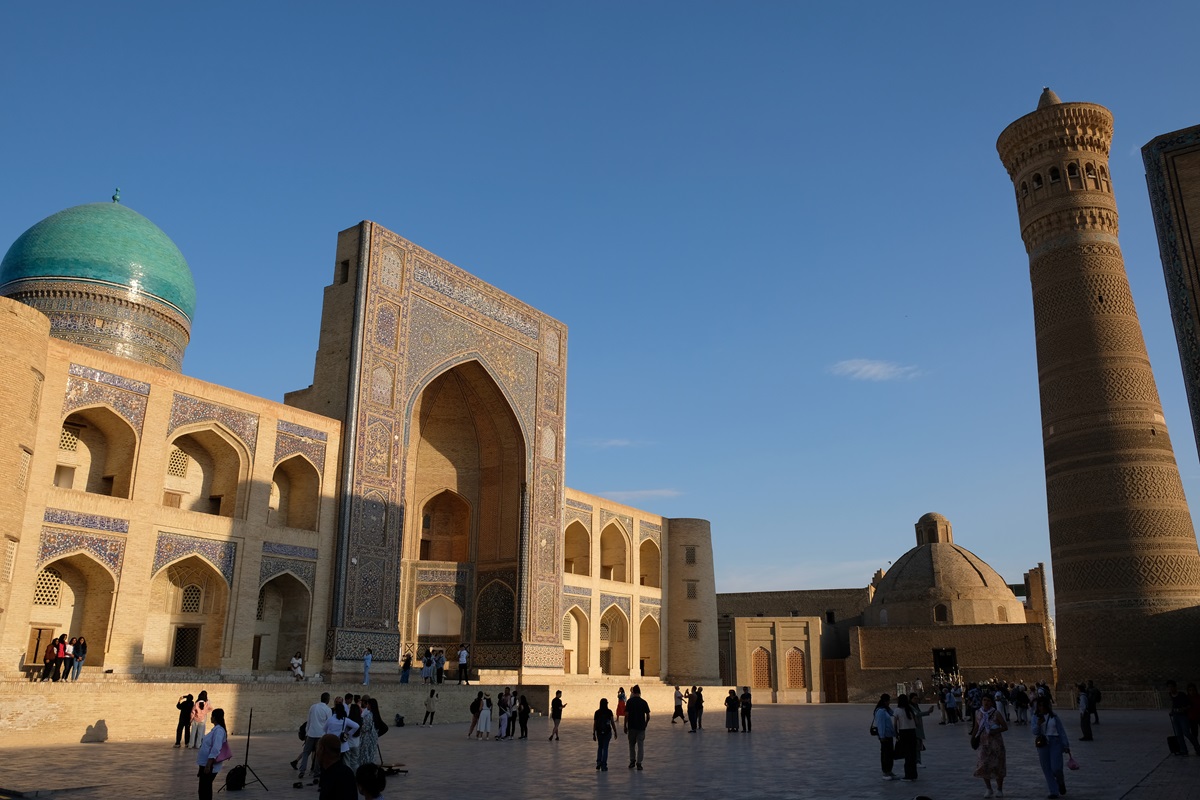
Arriving at Po-i-Kalyan in the afternoon

The 16th-century Mir-i Arab Madrasah

The madrasah was so beautiful in the soft afternoon light
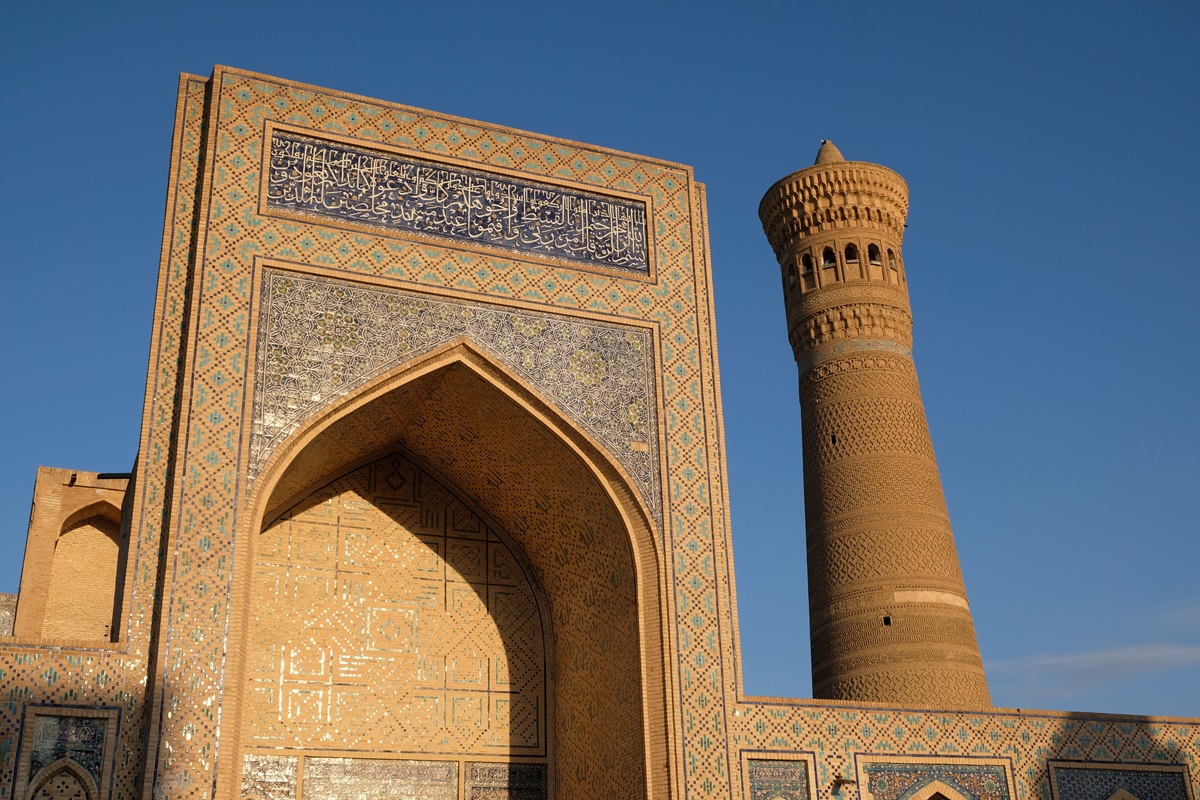
The Kalyan Minaret viewed from inside the mosque

The Kalan Mosque was said to be the third largest in Central Asia during its heyday

To me, there is something ethereal and peaceful about this scene

The mosque’s mihrab, a niche indicating the qibla (the direction of Mecca)

A closer look at the magnificent minaret

Local girls hanging out outside the madrasah
Unsurprisingly, we visited this compound several times during our stay in this city. One afternoon, after stepping inside the 16th-century mosque and looking out through the gate which framed my views of the madrasah, I was immediately reminded of the cover of a book I had read more than a decade earlier about an Indonesian journalist’s adventure in Central Asia which really piqued my interest in this part of the world. Being able to see what the author saw, from the same vantage point, truly was special.
At its height, this mosque was said to be the third largest in Central Asia, after the Bibi-Khanym Mosque in Samarkand and the Great Mosque of Herat, Afghanistan. The open-air courtyard did feel spacious, and it afforded us not only nice vistas of the minaret, but also of the turquoise domes of the madrasah which gleamed in the soft afternoon light when we visited the mosque. It felt very peaceful, a far cry from the tumultuous eras this place of worship has witnessed over the centuries. The Mir-i Arab Madrasah on the other side of the square, however, was only partially open to visitors since it still very much functions as a religious school today. In fact, during the Soviet era when religions were suppressed, this madrasah was among the very few that were allowed to remain open, elevating it as one of the most consequential Islamic centers of learning in the region.
Back in the central square of Po-i-Kalyan, I probably spent more time than what my neck could handle looking up and marveling at the beautifully-decorated Kalyan Minaret. Over the course of centuries, its function was not only limited to calling people to prayer, but it also served as a watchtower and even an execution site where convicts were thrown from its top. Buko would have been horrified! In 1920, during the Bukhara Operation where the Red Army and antimonarchists in the city collaborated to overthrow the deeply unpopular emir, the minaret suffered significant damage thanks to heavy bombardments carried out by the Soviets which also destroyed the Ark of Bukhara. However, despite the visible scars, the nearly-eight-century-old Kalyan Minaret remained standing, a testament to the architect’s ingenuity when designing this structure.
It wasn’t until 1997, when the Soviet Union had already collapsed and Uzbekistan become an independent nation, that thorough reconstruction and restoration of the minaret were carried out. And today, as the country further opens up to the world, the minaret beckons to a steady stream of curious international visitors as opposed to camel caravans like it did in the past. Around its base were a crowd of fascinated onlookers as well as locals with smartphones on their hands ready to capture that magical moment when the lights around the minaret were turned on as the sun set in the west. Bukhara without the Kalyan Minaret would have been Paris without the Eiffel Tower or London without Big Ben: it’s unimaginable.

The incredibly detailed decorations on the pishtaq (main gateway) of the Mir-i Arab Madrasah
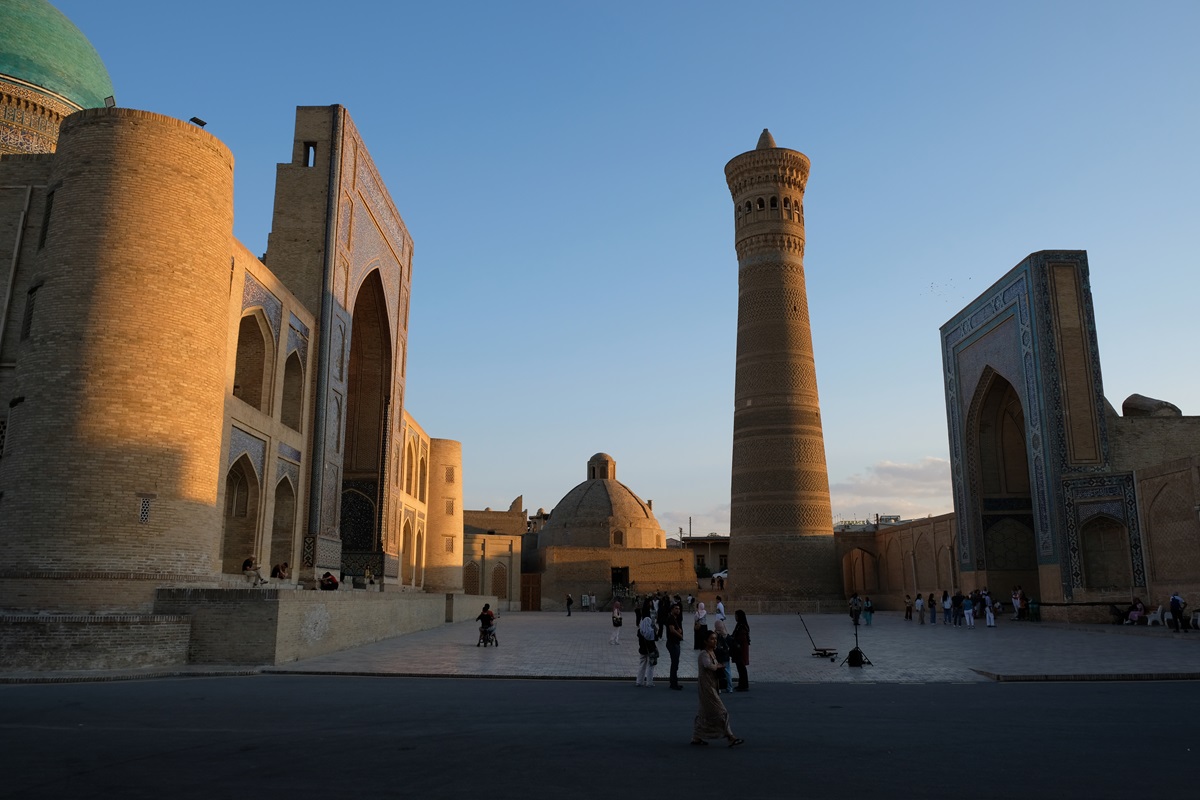
Po-i-Kalan before dusk

The same square seen in different light

The Kalyan Minaret is so emblematic to Bukhara it is hard to imagine the city without it
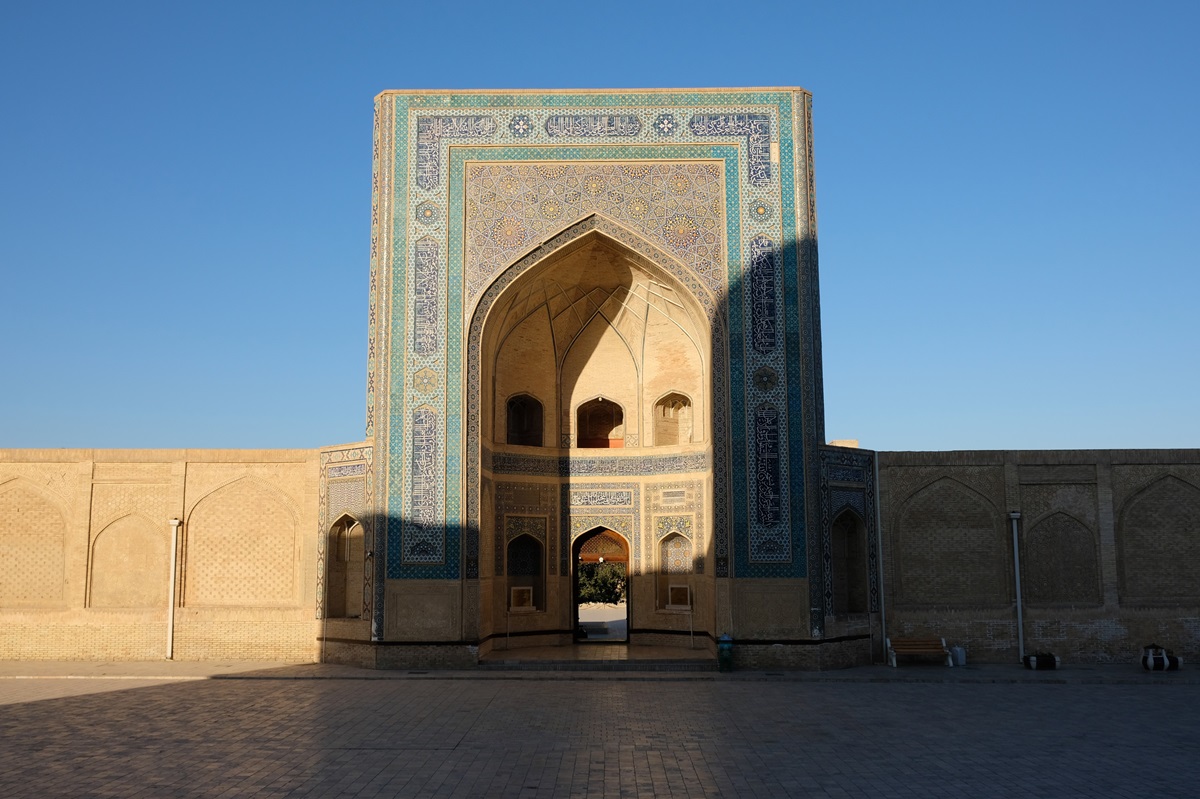
The entrance to the Kalan Mosque

We returned to the Mir-i Arab Madrasah when the square was much quieter

A peaceful morning at Po-i-Kalyan
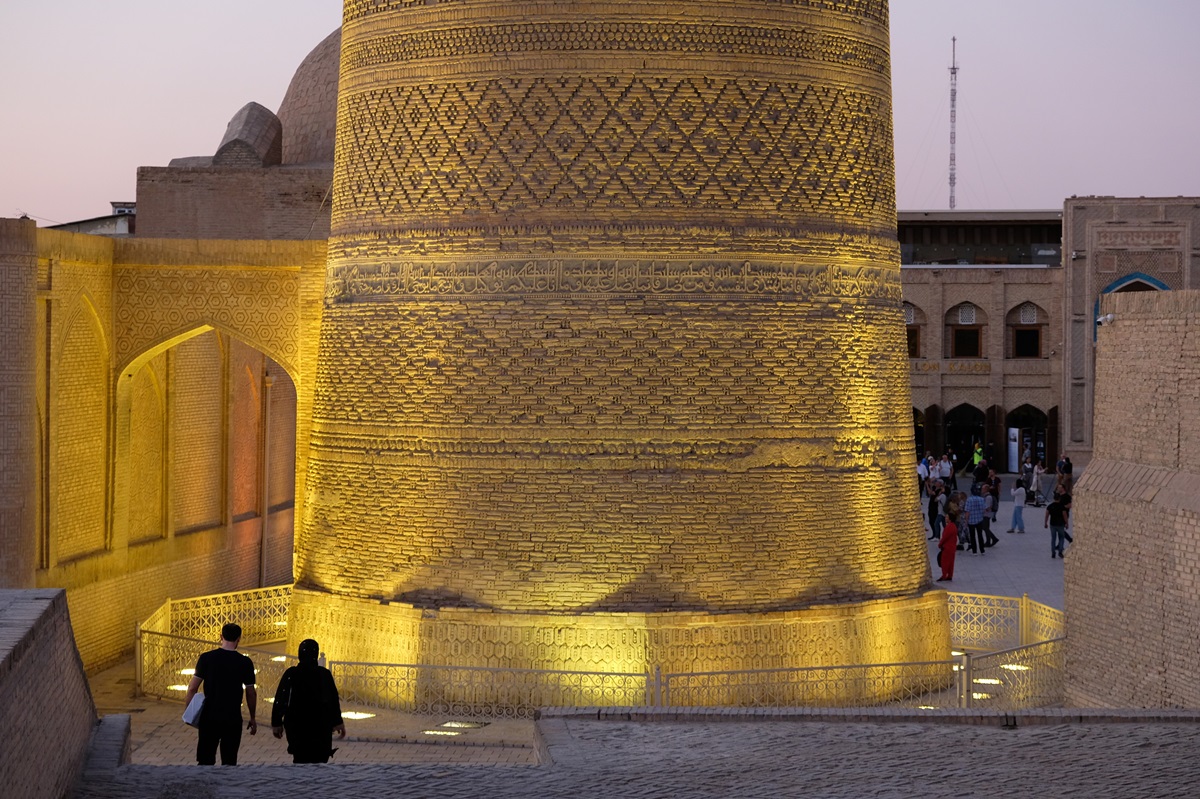
The lights helped accentuate the minaret’s decorative elements

The minaret and the mosque at dusk
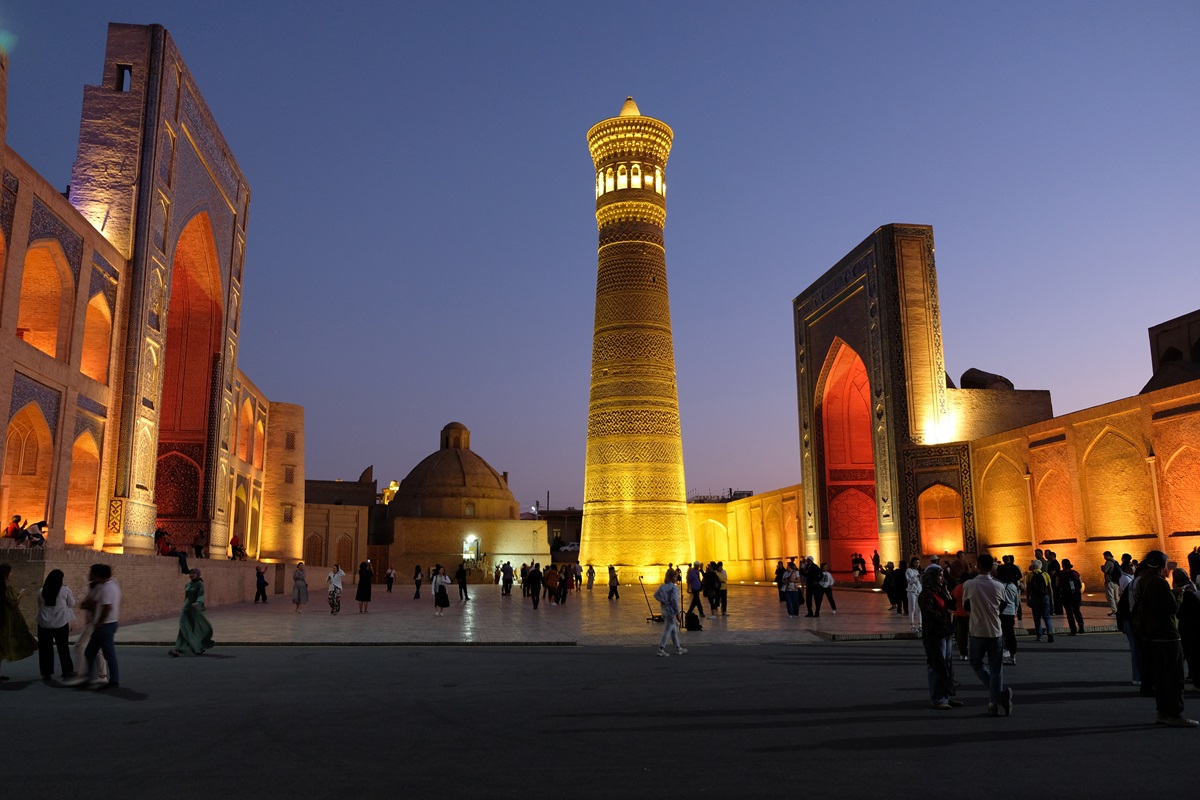
A sight to remember

 What an Amazing World!
Certainly a sight to remember! The Kalan Mosque and Minaret are stunning, and I constantly see them in photos whenever I look up Uzbekistan– they are definitely emblematic of the country as a whole! Uzbekistan has had a long history with multiple changes of hands throughout the centuries, so it’s remarkable that it’s kept a lot of its distinct culture today, all the while incorporating others from its past. Truly a cultural melting pot! Thanks for sharing more of your time here, Bama 🙂
LikeLiked by 1 person
Those centuries-old structures looked even more magical at sunset, and Bukhara’s high latitude meant that we got to see them with those blue and purple skies much longer than we would at places closer to the equator. This particular ancient Silk Road city truly was beautiful.
LikeLiked by 1 person
Did you see the Zoroastrian motifs in the brickwork? That whole square is a jewel, I couldn’t stop coming back time and again and again… we even found a little bar that overlooked the square, I wonder if it’s still there. Ah, this post brought me back!
LikeLiked by 1 person
I understand what you mean with the Zoroastrian motifs, which are a nice reminder of Bukhara’s long-gone past. I remember a place right across the square that seemed like a bar (or a restaurant). I wonder if it’s the same place with the one you’re referring to. The ring light at the square was a bit distracting though.
LikeLike
Oh this post bought back the sweetest of memories! I came here in the afternoon to catch the same glorious sunset photos too, but misjudged time and came way too early. My feet were killing me from all the walking so just sat to the side and spent a few hours there. Some local kids saw me, and slowly crept over. I ended up spending an hour with them showing them photos on my phone of my daughter, kangaroos, the beach and whatever random stuff I had on my phone. The kids were giggling and we had such a great time! The next afternoon I came back to the same spot with some Aussie chocolates I had packed for any possible gifts for guides etc. They enjoyed them so much. I promised them I’d come back one day… so I have to return to that very spot soon!!!
LikeLiked by 1 person
That’s really sweet of you, Anna. Those kids will forever remember the chocolates you gave them — and the kangaroo photos. That makes me think I should probably pack Indonesian chocolates or other little gifts the next time I travel. Giving them to guides or local kids sounds like a great idea.
LikeLiked by 1 person
Yes I’ve done that often. Aussie sweets or little toys to bring along if you ever meet kids or the children of guides etc. They love it!
LikeLiked by 1 person
It was beautiful – such images.
LikeLiked by 1 person
Much appreciated, David.
LikeLike
Your photos are stunning as always! Your description of its deep foundations, quake-resistant design, and the way it’s withstood centuries—even Genghis Khan’s wrath—is amazing. What an incredible place; it’s clear why the minaret isn’t just a religious symbol but a powerful emblem of Bukhara’s resilience and heritage.
LikeLiked by 2 people
Thank you, Hannah. The minaret was incredible in person, but my appreciation grew even deeper as I learned more about its history and the adversities it had to endure.
LikeLike
The work that is displayed on the minaret and mosque are breataking to see in the photographs. But it must be incredibly beautiful in person!
LikeLiked by 1 person
Indeed. And thinking of what the minaret has withstood for centuries makes it even more impressive.
LikeLike
I see you went back to see the minaret at least as many times as we did, if not more. It’s difficult to take your eyes off it isn’t it? Gorgeous pictures Bama, thanks for the revisit. Maggie
LikeLiked by 1 person
We were really lucky with the weather in Bukhara. That’s why we kept going back to the minaret to see how it looked at different times of day. Also, since our hotel is located to the northwest of the Ark, every time we went to the center of the old town we always walked past Po-i-Kalyan.
LikeLiked by 1 person
It’s incredible to hear about all the planning, preparation and detail that went into building the mosque and tall minaret. Your pictures are beautiful with the soft afternoon sun. The tile work, colour, and design are just magnificent. And I love how it looks different, yet still impressive in the evening when all the buildings are illuminated.
LikeLiked by 1 person
Buko the architect sounds like a true visionary. Without his attention to detail, this minaret would probably have been in ruins now. This square was really beautiful day and night, and it’s one of the most photogenic corners of the historic center of Bukhara.
LikeLiked by 1 person
Beautiful series and so well documented (as usual!). The posts you have been publishing on your trip to Uzbekistan have been very inspiring and I know we need to plan a trip there sometimes soon. (Suzanne)
LikeLiked by 1 person
Thank you, Suzanne. There are still a lot of posts from my trip to Uzbekistan that I haven’t published. But I’m taking it slowly. I think you should go there soon while those Silk Road cities are not overwhelmed by mass tourism yet.
LikeLike
Such beautiful photos, Bama! Mosques such as this are made to last the test of time and be a legacy of an empire long gone. I can see why they built this to make an impression on those visiting from afar.
I love that you had the wisdom to visit and experience its beauty at different times of the day. The golden hour light against the tiles in particular are lovely.
Uzbekistan has never been on my travel radar but thanks to you, it’s a place I’d love to visit and experience in person one day!
LikeLiked by 1 person
Much appreciated, Ab. If I had been a ruler of a city on the Silk Road, I think I would’ve commissioned beautiful buildings as well — and parks, lots of them!
Uzbekistan was really photogenic, and Bukhara especially was very atmospheric. It also helped that the skies were always blue when we were there.
I hope you’ll get to Uzbekistan one day!
LikeLiked by 1 person
The leaders who built these beautiful buildings definitely had foresight to build not just for the present but for their legacy.
LikeLiked by 1 person
Absolutely!
LikeLiked by 1 person
Stunning
LikeLiked by 1 person
It’s stunning both in photos and in person.
LikeLiked by 1 person
I can see why you were mesmerized and went back more than once. I even read your post more than once! The strength and longevity of this minaret are only surpassed by its beauty, especially that turquoise tile color! The history is mind-boggling, too.
LikeLiked by 1 person
This is a kind of place I imagine you’ll also be drawn to, Lex. This ensemble of centuries-old structures was very beautiful, especially at dusk. And it was a great place for people watching too — one particular man wearing the iconic white Kyrgyz hat caught my attention the most.
LikeLiked by 1 person
What a remarkable and layered history, Bama. I absolutely love how you went back multiple times to visit and photograph the Kalyan Minaret. What a feat of engineering it is, and with foundations 10 metres deep! Incredible. Buko was a genius to design a tower that still stands as if it was built not that long ago.
LikeLiked by 1 person
There are so many things to admire about this place. When you do go to Uzbekistan, I think you’ll be tempted to visit Po-i- Kalyan multiple times too, Jolandi. It’s incredible to think that the minaret had withstood earthquakes and bombardments.
LikeLiked by 1 person
Indeed, Bama. I suspect you are right in that I would want to visit it multiple times. 🥰
LikeLiked by 1 person
I want to trek the Silk Road after reading this post of yours, Bama! 😂. Granted, unlike in my younger years, when the word “trek” meant a true trek of some discomfort, these days I will very likely have many more comforts 😇.
You write of such a compelling journey through time! The Kalyan Minaret’s construction, enduring spirit, and evolving symbolism is fascinating, and I can imagine arriving to such a sight/site so long ago. Bukhara sounds like such an interesting place; its resilience echoes through the layers of its architecture. Your photos capture both the grandeur and the tranquility of the past and present. The cloudless skies seem to accentuate all the details, and I especially like your “The minaret and the mosque at dusk” shot with the crescent moon framed so well. A beautiful post, Bama. You’ve given me yet another reason to travel to Uzbekistan.
LikeLiked by 2 people
Despite all the modern comforts you can have, trekking the Silk Road would still be such an epic journey, Randall!
I think the minaret (and the historic center of Bukhara in general) will inspire anyone with a penchant for history, architecture, or beauty. We have to thank people like Buko for putting so much time and effort in ensuring that what they built would stand the test of time.
The crescent moon is often associated with Islam, and it was very fitting that when we were there at dusk, it was right above the mosque.
LikeLike
The multitude of perspectives and photographs seem to reveal your fascination with this building, both for its architectural qualities and its religious significance. It sounds that you imagine yourself rather well as a 12th-century ruler.
LikeLiked by 1 person
It was hard not to be captivated by this minaret. The beautiful architecture of the mosque and the madrasah only added to the charm of this part of Bukhara.
LikeLiked by 1 person
Something would be visibly missing in Bukhara if the Kalyan Minaret didn’t exist. It really is the symbol of the city — it’s something of a miracle that it survived so many wars and tribulations, including Genghis Khan’s invasion and the hugely destructive Soviet bombardment. That it remains standing even after all these centuries is a testament to the genius of Buko.
I’m thankful we had enough time to revisit Po-i-Kalyan several times and take in the tower’s beauty at different times of day: early in the morning, at golden hour in the late afternoon, and at dusk when the floodlights were switched on. And it was special to see the minaret once again lit up at night after that long drive through the desert from Khiva.
LikeLiked by 1 person
Ahh yes, I almost forgot that moment when we saw the Kalyan Minaret again after the long drive from Khiva. It was particularly nice to see a familiar sight after having to deal with that driver who kept looking at his phone while driving at high speed and who suddenly began telling us to leave good reviews on Google toward the end of the journey.
Bukhara really is my favorite place in Uzbekistan.
LikeLiked by 1 person
This is truly a beautiful and magnificent mosque. I’ve heard of Bukhara and while it might not be as famous as Samarkand, I’m glad to see it also has beautiful sights.
LikeLiked by 1 person
The historical sites in Samarkand were very impressive, but I ended up falling in love with Bukhara. If you plan to visit Uzbekistan one day, make sure you’ll have enough time to go to Bukhara as well.
LikeLiked by 1 person
I’ll make sure to visit both Samarkand and Bukhara. As with your post on Uxmal, I’m glad to find out about a less well-known destination near a more famous one.
LikeLiked by 1 person