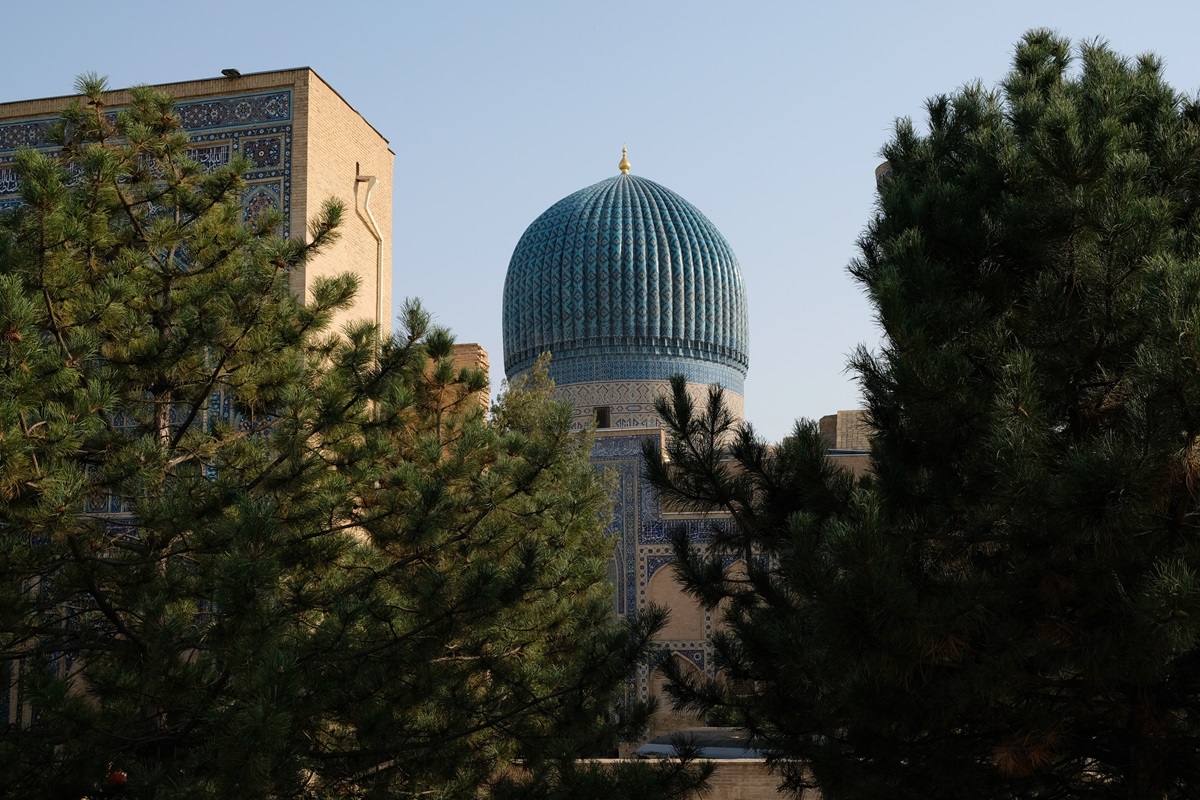
Taking a peek at Gur-i Amir’s ribbed dome
Conquerors must be among the most divisive figures in human history. They are often regarded as heroes by the people they represent, whose territory grows following victorious military campaigns. But on the other hand, the conquered see them either as an evil force or as liberators from much more cruel rulers. We all know well how countless triumphant conquerors have been immortalized in people’s memory through all sorts of mediums, from oral stories to inscriptions and great monuments. Among them, Genghis Khan undoubtedly ranks as one of the most illustrious, for he managed to unite different Mongol tribes and build a land-based empire that would at one point become the largest of its kind the world has ever seen.
While conquests are inherently violent, they have also proved to open new doors for commercial opportunities and promote wider cultural exchanges, as well as become a source of inspiration. More than a century after the demise of the great Mongol leader in 1227, a boy was born into a Turco-Mongol society in Transoxiana, a term coined in the fourth century BCE by another extraordinary conqueror in history, Alexander the Great, to describe a region in Central Asia. Named Timur, which means “iron” in the Chagatai language (an extinct Turkic language once widely spoken in this part of the world), the boy would eventually get exposed to stories of Genghis Khan which inspired him to be a conqueror himself.
Claiming to share the same ancestor with Genghis Khan, Timur gradually amassed support and influence by aligning himself with the right people, showing his prowess in battle, and astutely using his cultural and historical backgrounds to reinforce his legitimacy. He even went further to style himself as the awaited messiah descended from the prophetic line as he sought to be the leader of the Muslim world. Once he managed to assert control of Transoxiana, he embarked on decades of military campaigns to conquer lands beyond his core realm. Very much like what Genghis Khan had done more than 100 years earlier.
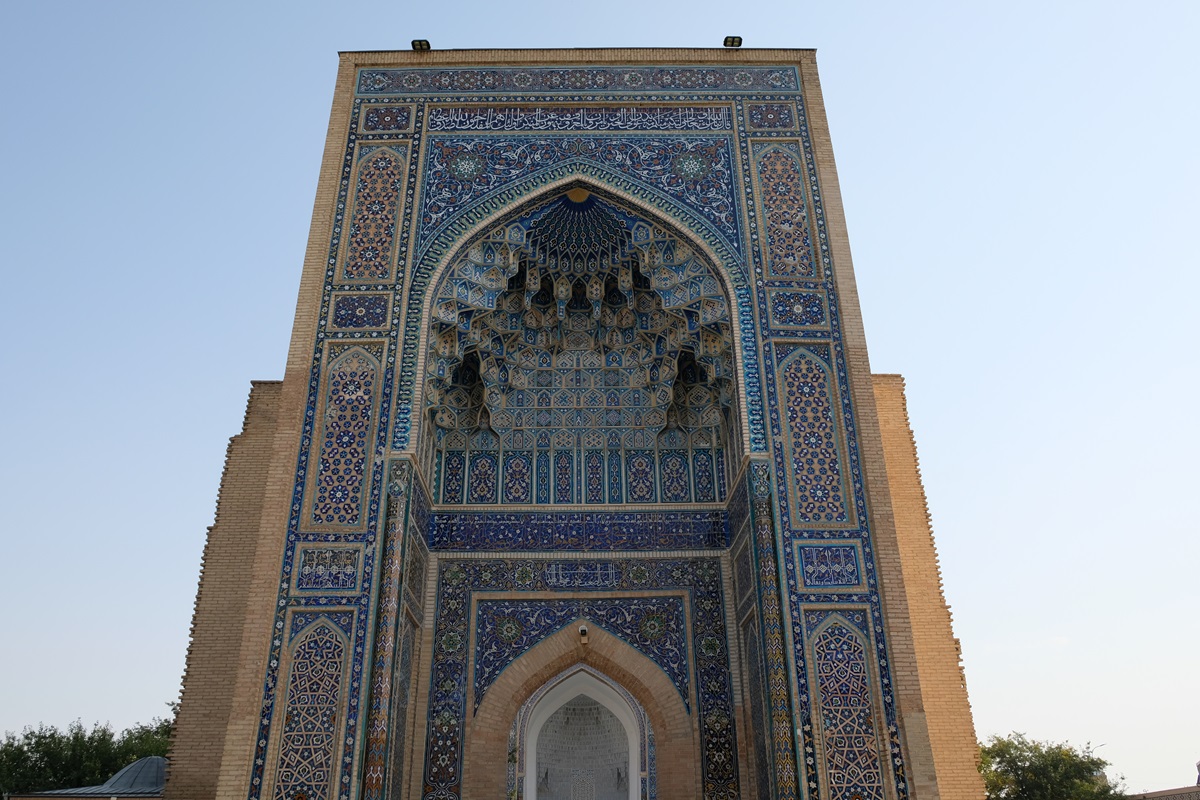
The pishtaq (main gateway in Timurid and Persian architecture) of the mausoleum complex

After a long period of decline, restoration of the complex only began in the 1970s
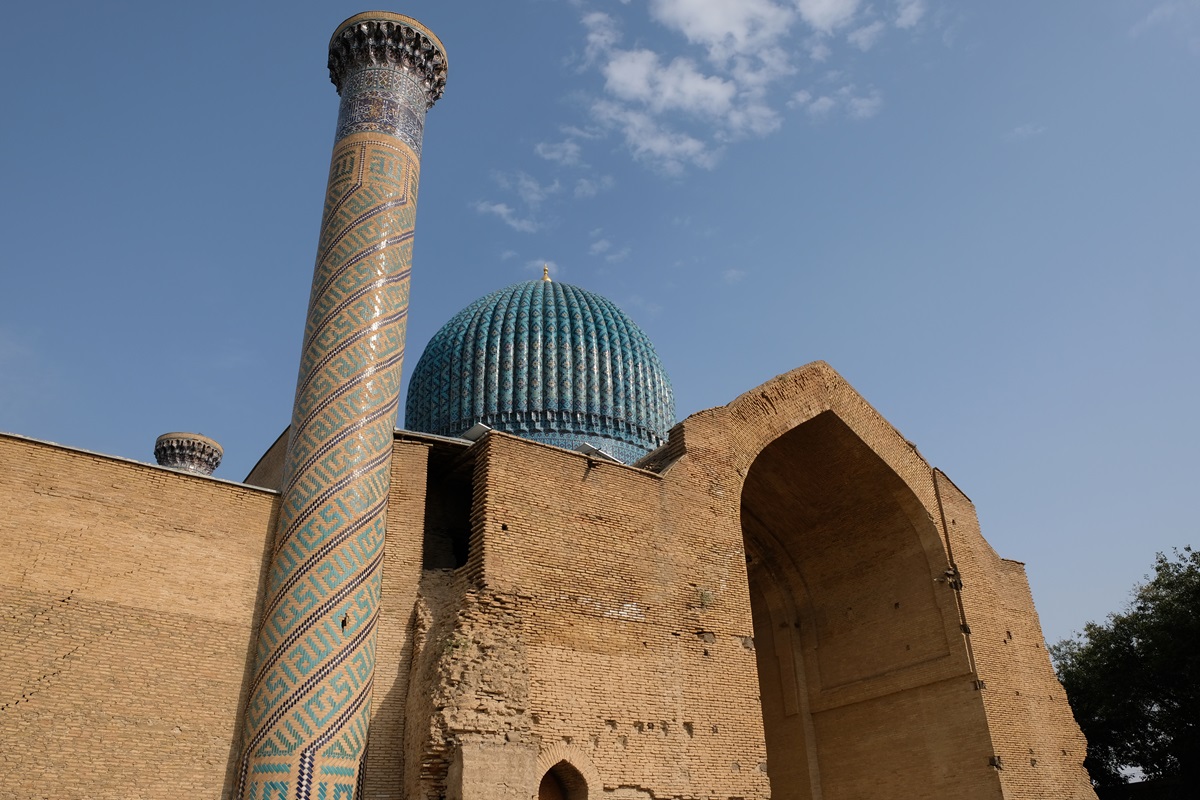
One of the architectural jewels of the Timurid Empire
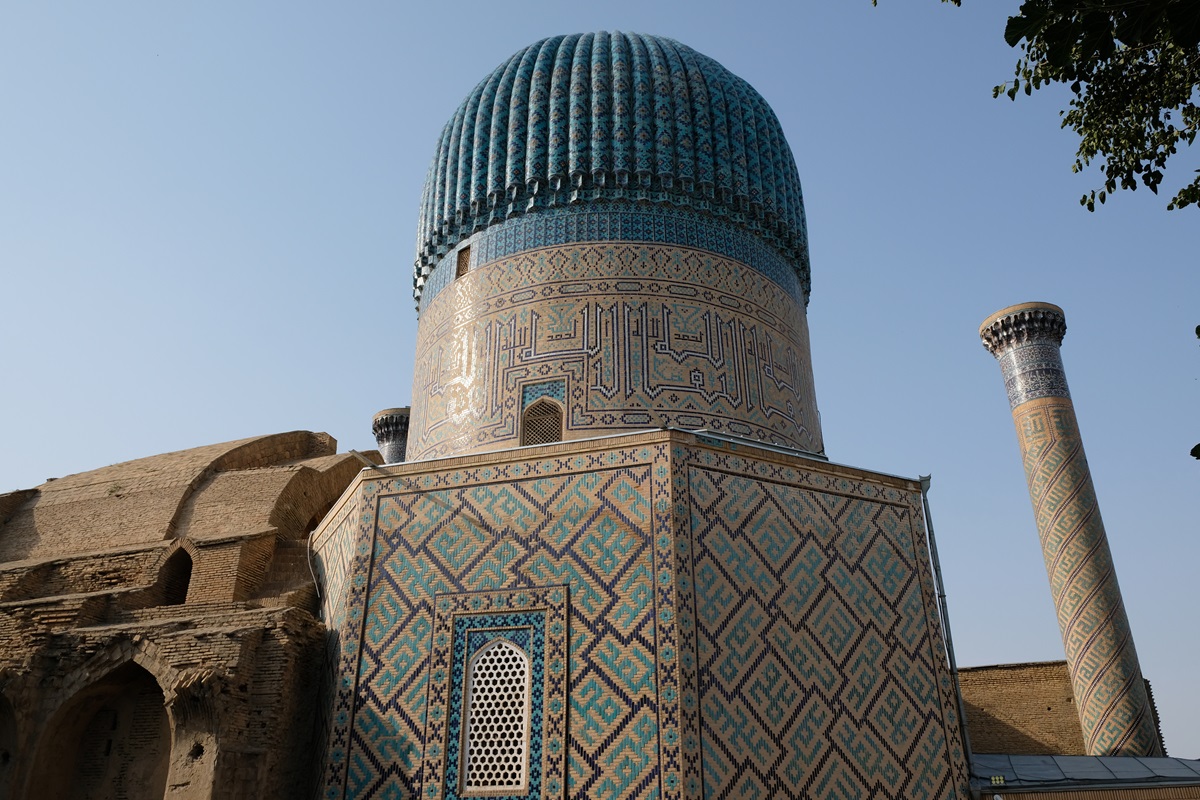
Beneath this ornate turquoise dome is the tombs of Timur and his descendants
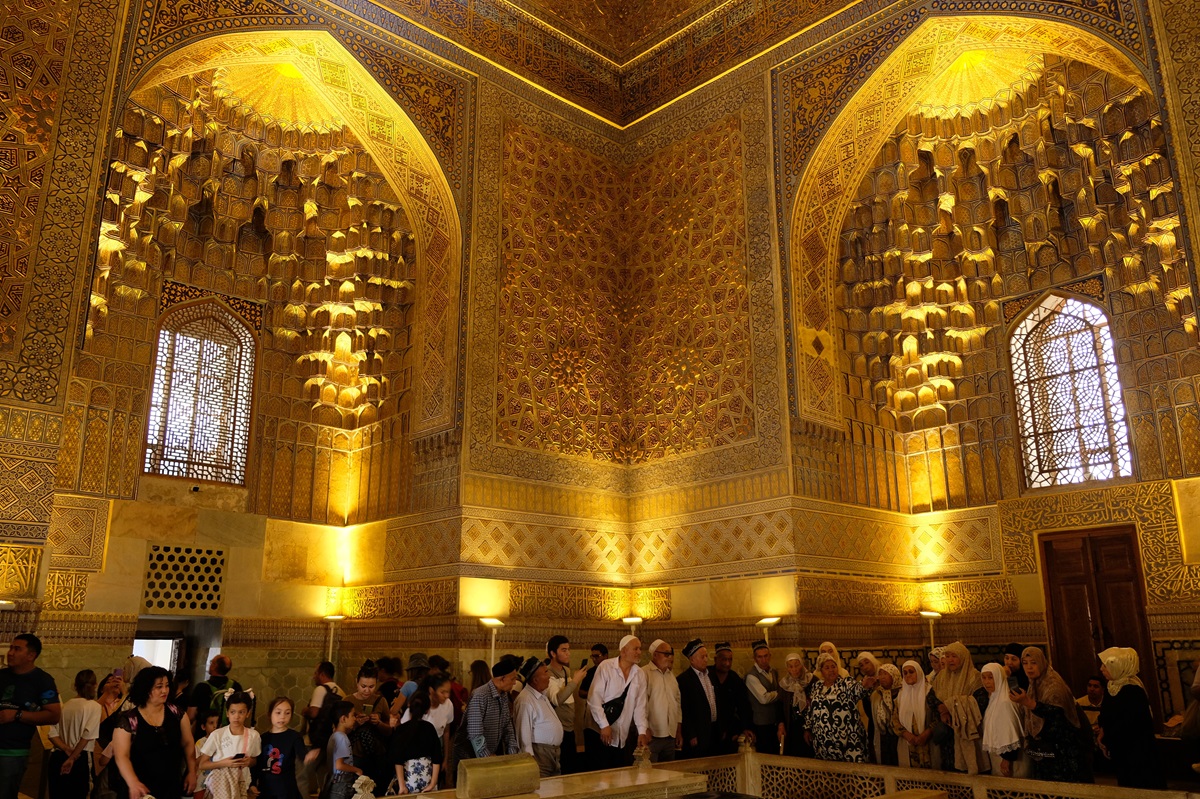
Pilgrims and tourists sharing the same space

The black tomb of Timur surrounded by other tombs

The Timurid rulers certainly knew how to impress
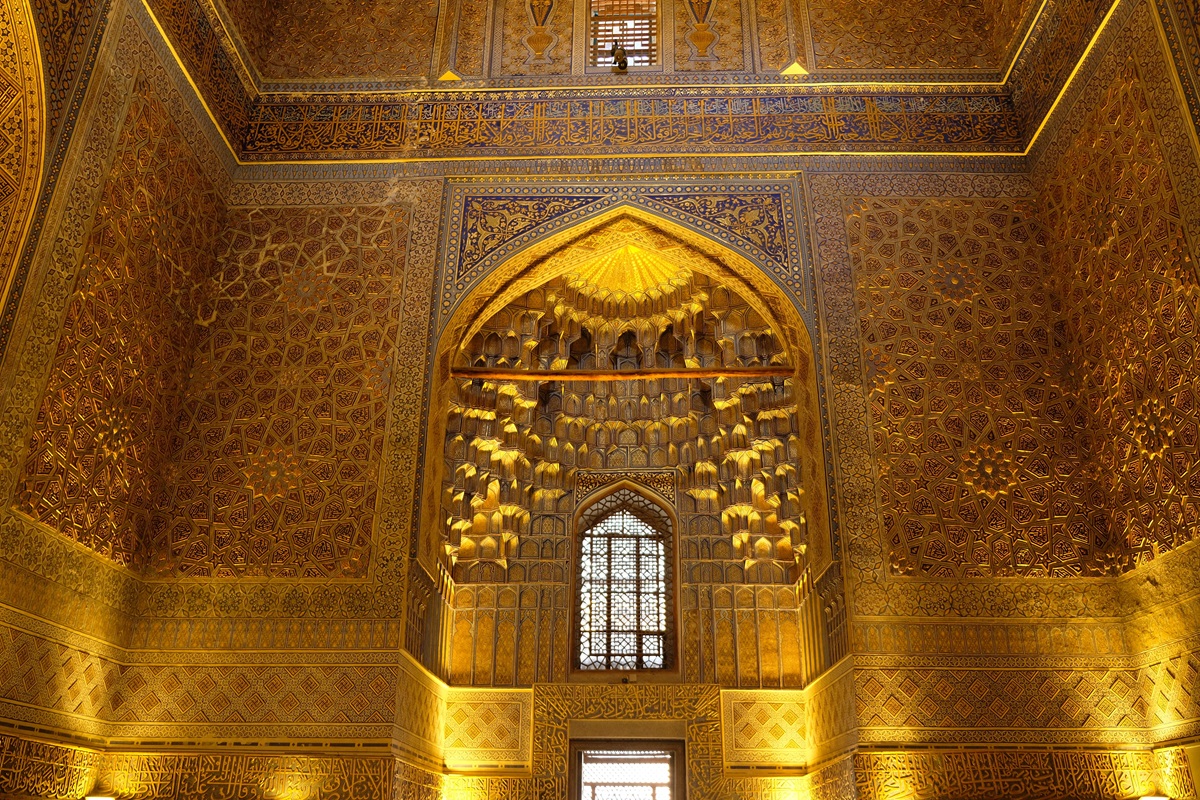
Can we still build things with such a level of intricacy today?
Timur’s army marched on and subjugated Persia and the Caucasus region, invaded Delhi, sacked Damascus and Aleppo, crushed Baghdad, and defeated the sultan of the Ottoman Empire near Ankara. The seemingly unstoppable conqueror then turned his attention to the east where the Ming dynasty reigned. In the year 1404, he began his campaign to attack the Chinese in winter, uncharacteristic for a man who usually preferred to fight battles in springtime. Then, in early 1405 the unfathomable happened. The great conqueror fell ill and died before even reaching the western border of China, ending what had appeared to be an unrelenting expansion of his territory.
His body was then buried in Samarkand, which in 1370 had been made the capital of the Timurid Empire by Timur himself. Despite his reputation as a ruthless conqueror, he showed a great interest in the arts, and this is the reason why his capital was then filled with beautiful and magnificent buildings. However, this was rather expected from a ruler who wanted to showcase his achievements and impress the world. Around two years before Timur’s death, a grand mausoleum was commissioned in the capital for the ruler’s heir apparent who suddenly passed. But he had probably never imagined that just a few years later he would also be interred in the same place. Dubbed Gur-i Amir, “Tomb of the King” in Persian, the complex would then also be the final resting place of Timur’s descendants.
Centuries after his time, Timur is now considered a national hero of modern-day Uzbekistan, the most populous country in Central Asia. His birthplace is now the city of Shahrisabz, some 90 kilometers to the south of Samarkand where a larger-than-life statue of him stands near his former Ak-Saray Palace – according to the images we saw on the internet as we didn’t have enough time to visit this city. However, this is not exclusive to his hometown as other likenesses of him can also be found at strategically-located parks in bigger cities like Tashkent and Samarkand. While he is undoubtedly a source of admiration for the Uzbek people, others are also fascinated by him, or at least by his tomb. When we arrived at Gur-i Amir one afternoon, a steady stream of visitors came and went. Underneath the ribbed dome was a cavernous space heavily embellished in intricate ornamentations fit for the rulers of such a great empire. In contrast, the tombs themselves were much simpler in shape and decoration, belying the lofty ambitions of the men buried in this place. One such case manifested as a monumental mosque at the heart of Samarkand where I will take you next.

What’s behind these wonderfully carved wooden doors?

Once you have walked through the pishtaq, don’t forget to turn around to marvel at this

Beautiful ceramic tiles

A final look at Gur-i Amir before we went to the nearby Ak-Saray Mausoleum (not to be confused with Timur’s Ak-Saray Palace in Shahrisabz)
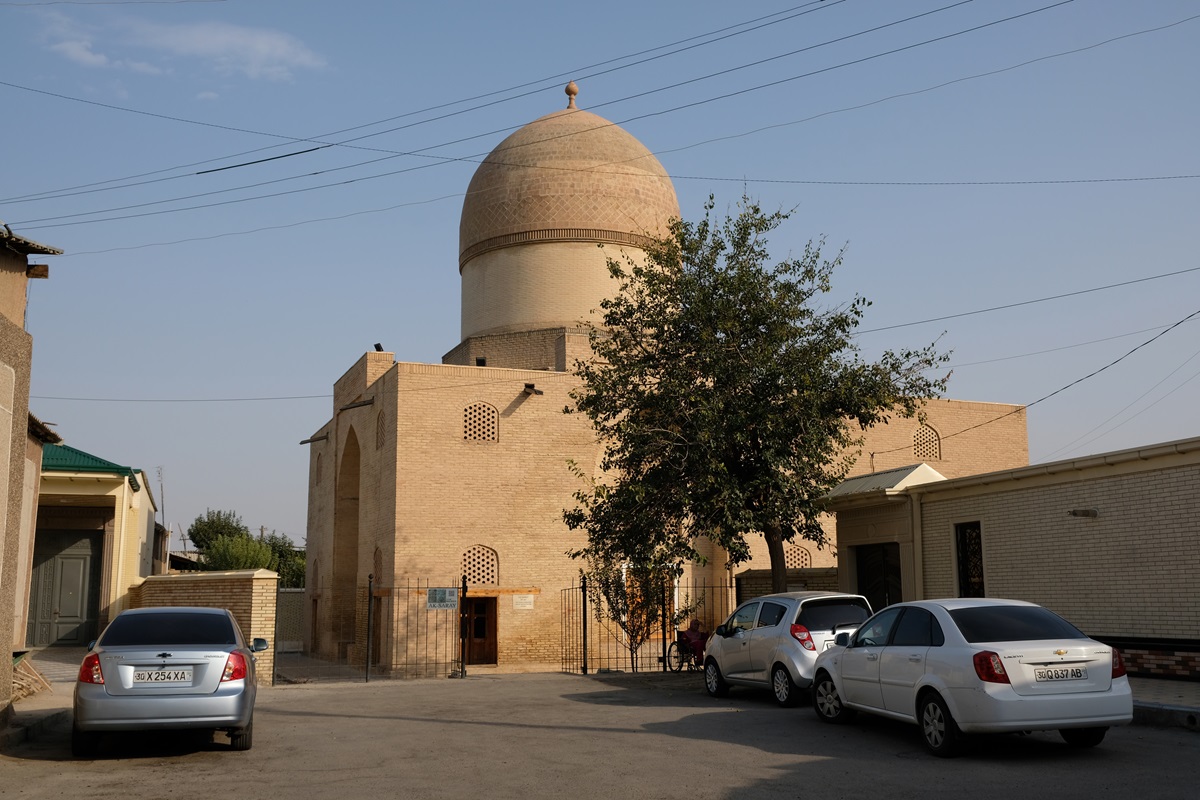
The much smaller 15th-century mausoleum looks austere from the outside

But on the inside, its ceilings were covered in stunning details
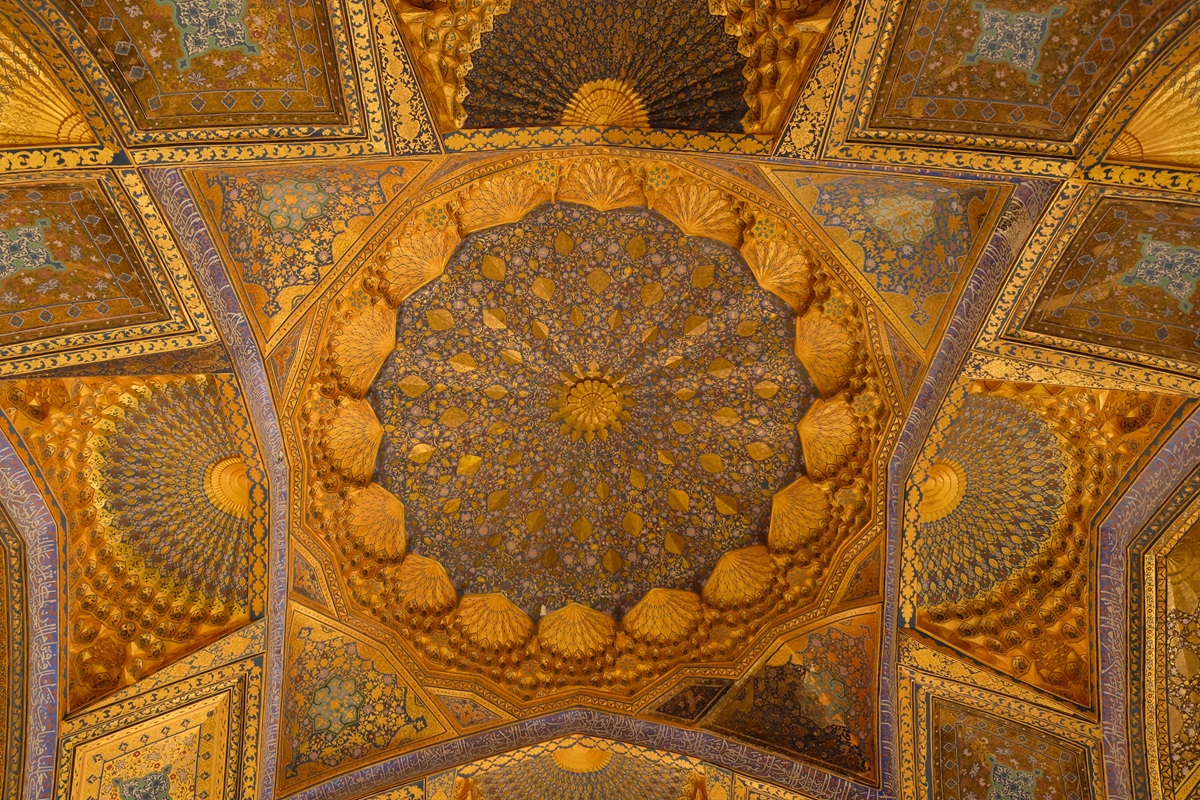
You will have to look up a lot in this place
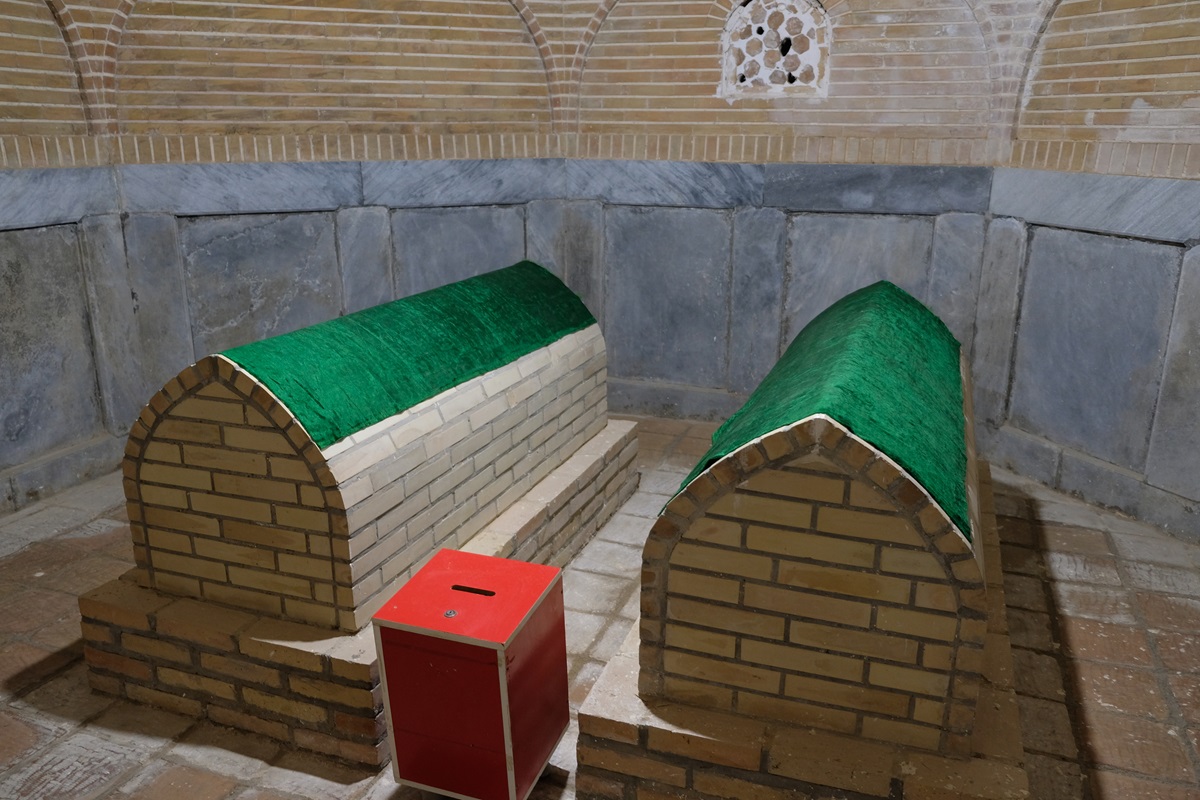
This mausoleum was built as Gur-i Amir was running out of space
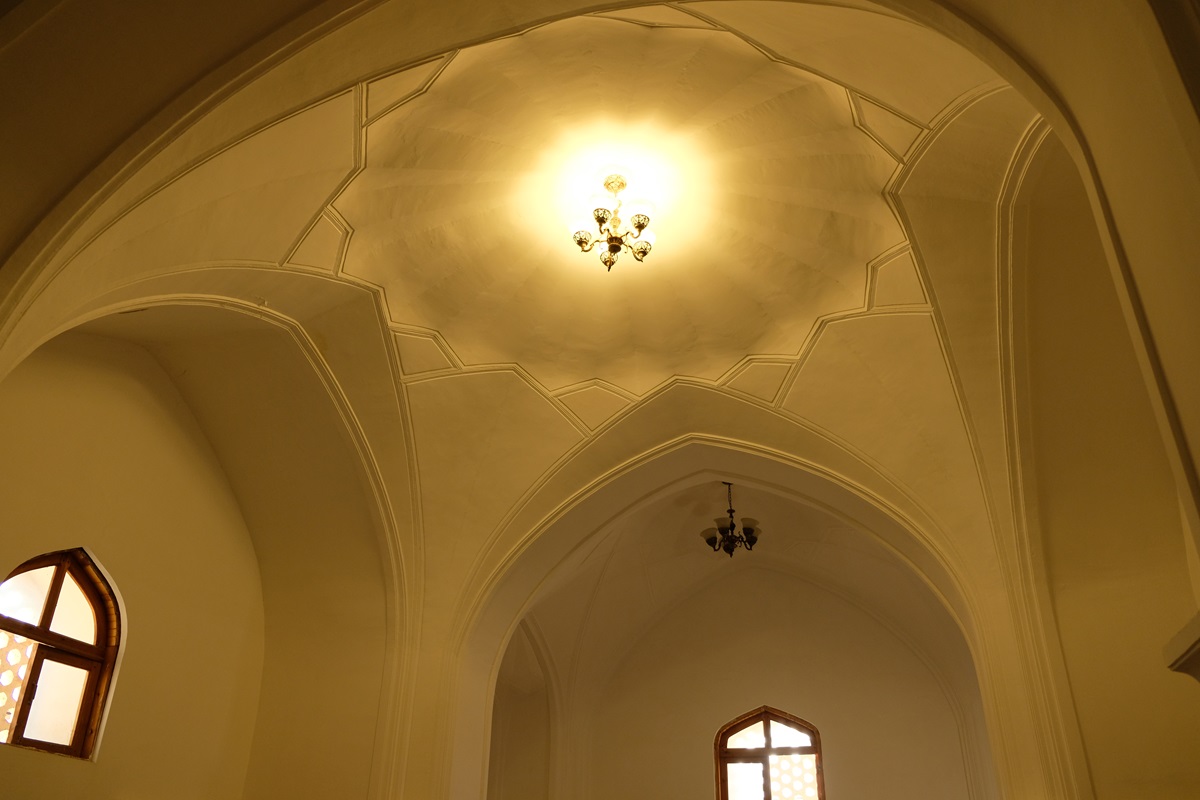
Though lacking ornamentation, this corner still looked beautiful to me

 What an Amazing World!
Oh, this brought back some memories! Looking forward to reading about your impressions on Bukhara and Khiva, Bama.
I remember that there was a massive Timur (which for some reason I still recall us in Europe calling Tamerlane back when I was growing up) statue in Tashkent, outside Hotel Uzbekistan. We heard the service there was shockingly bad, so we were en route to the bar to see if we could try some Uzbek champagne (yes, we wanted to suffer!) and there was a crowd of ladies stripping the statue of flowers.
One of them told us that it was Timur’s birthday, so the city authorities put flowers around his tomb, but that in the afternoon people could go there and help themselves… Seemed like a nice idea!
Fabrizio
LikeLiked by 1 person
When I started writing the stories from Uzbekistan, I looked up your old posts, Fabrizio. And I find the one on Bukhara particularly nostalgic since it is my favorite city in the country.
We did visit that statue of Timur in Tashkent, where some tourists were taking photos of themselves with him in the background. Looking at the imposing Hotel Uzbekistan, I was actually kind of curious about it. From the appearance, I could tell that it desperately needed some love. Coincidentally (or not), we have Hotel Indonesia here in Jakarta located next to a major roundabout in the city. It was built when the country was politically closer to the Soviet Union, but it’s now managed by Kempinski.
Did you write about that Uzbek champagne? Now that sounds… interesting.
LikeLike
Your post brings joy to my heart on a chilly overcast winter’s day in Portugal, Bama. What incredible architecture! The detail is awe-inspiring, and appeals to my sense of beauty. I am looking forward to each and every post you are planning to write about Uzbekistan. It is one of those destinations that I think always surprises and inspires.
LikeLiked by 1 person
Oh I know you would enjoy Uzbekistan, Jolandi. I hope you’ll get to see these magnificent centuries-old monuments yourself one day. I expected them to be beautiful, but in person they were far more impressive.
LikeLike
That is very good to know, Bama. I think I should prioritise a trip to Uzbekistan.
LikeLiked by 1 person
This is interesting. I’ve never heard of Timur until now.
LikeLiked by 1 person
I also wonder why none of the textbooks I learned at school mentioned his name. It makes me curious whether that’s also the case in other Southeast Asian countries.
LikeLiked by 1 person
Ok, I got it. The history books used his other name, Tamerlane.
LikeLiked by 1 person
What motivates someone to be a conqueror? Well, acquisition and adoration and all that, but why do some people have the drive to do it? I’ve heard of Timur but couldn’t have told you what he accomplished, Bama. The architecture is amazing, of course.
LikeLiked by 1 person
Even today, we still have world leaders with these tendencies. Others are not so interested in geographical expansion, only economic dominance. I think Timur is one of those consequential leaders whose legacies are often overlooked by those living far from Central Asia, including me.
LikeLike
Beautiful photos, Bama, and I appreciated learning more about Timur the Conqueror.
Reading your post was a thought provoking exercise in how history and society views conquerors. I agree that it depends on which side you are looking at and it does make me think of how much our view of history is influenced by the information we are taught in schools and through sources. A conflict will be viewed differently depending which side and what information you’re on. That’s why the Internet has made learning about history so interesting and more multi-faceted.
Looking at the beautiful mausoleum photos also struck me about how much these conquerors cared about their legacy and how they remembered by future generations based on the intricacy and detail upon which their final resting places are constructed.
So much of today’s progress is made possible due to the sacrifice and decisions made before us. It reminds me of the saying that we are all heroes or villains in someone else’s story.
LikeLiked by 2 people
Thank you, Ab. What you said is very true. While in the past historical accounts were often written from the viewpoint of the victors, today all sides can have their own stories. I find this a double-edged sword. On the one hand, this can reduce bias. But on the other hand, it can make it harder for most people to see what/who is wrong.
I think most great conquerors are driven by the same things, including how they will remembered by those who live long after their time. And to do this, they often build grandiose monuments. While I, for the most part, enjoy such historical structures, I can’t say the same about modern leaders who do exactly that, especially if it’s funded by taxpayers’ money!
LikeLiked by 1 person
I love that you provide so many details of the people and civilizations from where you have travelled. I had read all of this about Timur before we went, but you are able to write in a much more elegant way than most of the other posts out there. I’m so glad you got to see his tomb. Did you also go at night when it’s lit? Maggie
LikeLiked by 1 person
You’re too kind, Maggie. I’m usually very inspired when I write about great leaders like Timur, especially if they left monumental structures. We didn’t go back to Gur-i Amir at night. Instead, we spent most of our afternoons at the Registan, waiting for that magical moment when they turned on the lights at the three madrasas.
LikeLiked by 1 person
That was a good light display too 😊
LikeLiked by 1 person
Such a lovely place with great monuments. I do hope to get to this country sooner than later. Thanks for the information post. (Suzanne)
LikeLiked by 1 person
I really hope you’ll get to Uzbekistan soon. It’s always nice to visit a place before it gets too popular.
LikeLike
At last the posts I’ve been waiting for! Just to be amongst such stunning architecture must have been an emotional experience. I hope I can follow in your footsteps one day to this and your future posts on Uzbekistan.
LikeLiked by 1 person
It felt surreal sometimes standing in front of those centuries-old buildings that I had been dreaming of seeing for so many years. In my case, they looked even more magnificent in person. I hope you’ll visit Uzbekistan sooner than later, Mallee.
LikeLiked by 1 person
I’ve vaguely heard of Timur (often regarded as “Timur the Lame” in history textbooks I read in school), but I had no idea he was from Uzbekistan. Very fascinating to learn about him and how his legacy could’ve rivalled Genghis Khan (had he not died suddenly). It’s impressive just how far he conquered in Central to South Asia, and whether you love or hate him, he is to be respected for his success. Uzbekistan is now high on my list of places to visit, thanks to your posts! Thanks for sharing, Bama 🙂
LikeLiked by 1 person
One can only wonder what would have happened if he hadn’t died before reaching China. But such is history, and stories like this are the reason why we travel, aren’t they? I’m glad my posts on Uzbekistan inspire you to go there, Rebecca.
LikeLiked by 1 person
Interesting presentation. As this region of Asia has become more accessible in recent years, the names of Samarkand or Timur are coming up more often. Attracting more visitors and encouraging renovations, it’s a virtuous circle that we hope will continue.
LikeLiked by 1 person
It’s nice to see how Central Asia is embracing international visitors these days, although vestiges of the Soviet time were still palpable in some places. I hope the government can manage this without sacrificing the unique charm and character of each of the ancient Silk Road city.
LikeLiked by 1 person
Your posts are always such a joy Bama! So great to relive my trip through your eyes too!
LikeLiked by 1 person
Thanks Anna! I know that feeling. When I read your posts on Uzbekistan, I was ecstatic to ‘revisit’ the places I went to through your lens.
LikeLiked by 1 person
lol I better get a move on then! I still have a few more posts to write but it’s school holidays and I’m really lacking motivation lately! lol
LikeLiked by 1 person
I almost forgot it’s summer over there. Take your time, Anna.
LikeLike
Yes summer holidays and 8 weeks with the kid at home! Keeping us busy with activities like movies, beach etc.
LikeLiked by 1 person
Very interesting and informative post. The internal architecture is amazing!
LikeLiked by 1 person
I had seen photos of the interior of Gur-i Amir prior to this trip, but those intricate decorations looked even more impressive in person. Thank you for reading.
LikeLiked by 1 person
Your photos are absolutely beautiful – they capture the magnificent architecture brilliantly. Timur definitely sounds like an interesting character, who clearly expanded his empire and without whom we may not have the beauty of this region now in the same way.
LikeLiked by 1 person
Much appreciated, Hannah. It’s not surprising at all that he is a national hero in Uzbekistan. After all, he is one of the most consequential leaders in the nation’s history. And we, modern-day visitors, can thank him for having commissioned among the most magnificent monuments in Central Asia.
LikeLike
The tilework is so colourful, intricat and beautiful. We definitely don’t build things with that level of detail and design today.
LikeLiked by 1 person
Although modern designs are a lot more efficient and cheaper to make, I think we should never forget the intricate artworks our ancestors were able to create. I can imagine how nice it must have been to be an artist back then.
LikeLiked by 1 person
Your exploration of Timur’s legacy is compelling. His duality as a ruthless conqueror and a patron of the arts is striking. The architectural marvels of Samarkand, especially the Gur-i Amir, reflect this complexity. It’s intriguing how history immortalizes such figures, yet often overlooks the human cost of their ambitions. Your narrative captures this tension effectively.
LikeLiked by 1 person
Your comment sums up really well how conquerors are seen by different peoples across the globe. We, regular citizens, often forget that behind those magnificent monuments built in the past are stories from which we can learn many things not only about those who commissioned them, but also about ourselves as a human being.
LikeLike
It is fascinating to think about Timur’s contradictory faces, that he was both a ruthless conqueror in the lands his forces subjugated (often with scorched earth tactics) and yet a great patron of the arts. Chinese history might have been somewhat different had Timur lived to carry out his ambitions of invading Ming China, though I’m sure Emperor Yongle and his generals would have summoned a vast army to defend the borders and prevent Timur from reaching Beijing. Bama, thank you for writing this narrative and sharing your photos of Gur-i-Amir and the Ak-Saray Mausoleum — I really should start publishing more posts from Uzbekistan!
LikeLiked by 1 person
I tend to believe that with his formidable army Emperor Yongle would have most likely put up a good fight, something that would probably make Timur question the limits of his own ambition. But that’s one of the reasons why history is so fascinating. It teases us with so many what ifs, as if we could change what has happened in the past. But we can only learn.
LikeLiked by 1 person
Wow, I am in awe of the beautiful portal and trademark fluted azure dome of the Gur-e-Amir Mausoleum which marks the final resting place of Timur – the tilework and dome are particularly beautiful. I’ve always had a desire to explore Uzbekistan as it’s a true tapestry of cultures – and with it, architecture, history and cuisine. Where else can you immerse yourself in ancient history – dominated by its role in the Old Silk Route. A hub of culture and trade for more than two millennia, Uzbekistan is unlike anywhere else. I very much look forward to reading about your time in this wonderful country. Thanks for sharing, and have a good day 🙂 Aiva xx
LikeLiked by 1 person
Uzbekistan was amazing! It exceeded my expectations in many ways. The Old Silk Route is definitely a recurring theme one will come across time and again while exploring the country. I hope you’ll get to see this fascinating country in person one day, Aiva. I have a feeling you will enjoy it as much as I did.
LikeLiked by 1 person
🥰🥰🥰
LikeLiked by 1 person
Those pishtaq and golden ceilings are stunning, literally! The Uzbeks did an excellent job in restoring and preserving these masterpieces.
I think “divisive” is a perfect word to describe Timur. He was feared and loathed by many, but admired and even celebrated by others. An interesting example is India. Timur destroyed Delhi so people hated him (even now). But his descendants, the Mughals, were seen as great rulers. And many Mughal monuments also took inspiration from Timur’s 🙂
LikeLiked by 1 person
You would love Uzbekistan, and I can imagine you taking a lot of pictures there — although probably still not as many as what James and I took, as I learned in Cholon. 😄
Actually I’ve been curious about how Indians feel about Timur. But then this is probably a contentious issue over there, one that will remain divisive for the foreseeable future. Politics aside, you can’t deny that Timur and his descendants did build some of the most spectacular monuments the world has ever seen.
LikeLiked by 1 person
Amazing post and photos, Bama. That’s so good that you are visiting Uzbekistan and writing about all these historic places. Timurlane was indeed one of the most famous and successful conquerors. I think he was more fearsome than the Mongols because he defeated several mighty empires and sultanates in such a short time – the Arabs, Persia, Delhi, and the Ottomans. I think it’s a good thing he died before being able to invade Ming China, ha.
LikeLiked by 1 person
I have a long list of blog posts in my backlog now. 😅 And I’m taking one step at a time in writing them all. You made a good point about how Timur managed to conquer all those regions in such a short time. But China was just never meant to be. I truly can’t imagine how different China would have been had he successfully brought it under his rule.
LikeLiked by 1 person
That’s good, I look forward to seeing all these blog posts. China might have been different if Tamerlane had conquered it though China has often managed to “sinicize” its foreign conquerors like the Mongols and Manchurians.
LikeLiked by 1 person
You raised a really good point. It would be interesting to learn more about how the Mongols and the Manchurians adapted to their conquered land.
LikeLiked by 1 person
Both the Mongols and Manchurians were overthrown by the Chinese. As the latter had ruled from Beijing and adopted Chinese customs over the ensuing centuries while allowing many Chinese to move into their homeland, Manchuria became part of China (Japan invaded it in the 20th century and made it a pseudo-colony but China regained it after Japan surrendered). Their current population is very small and presumably they were never that numerous, which makes their rule of China quite impressive.
LikeLiked by 1 person