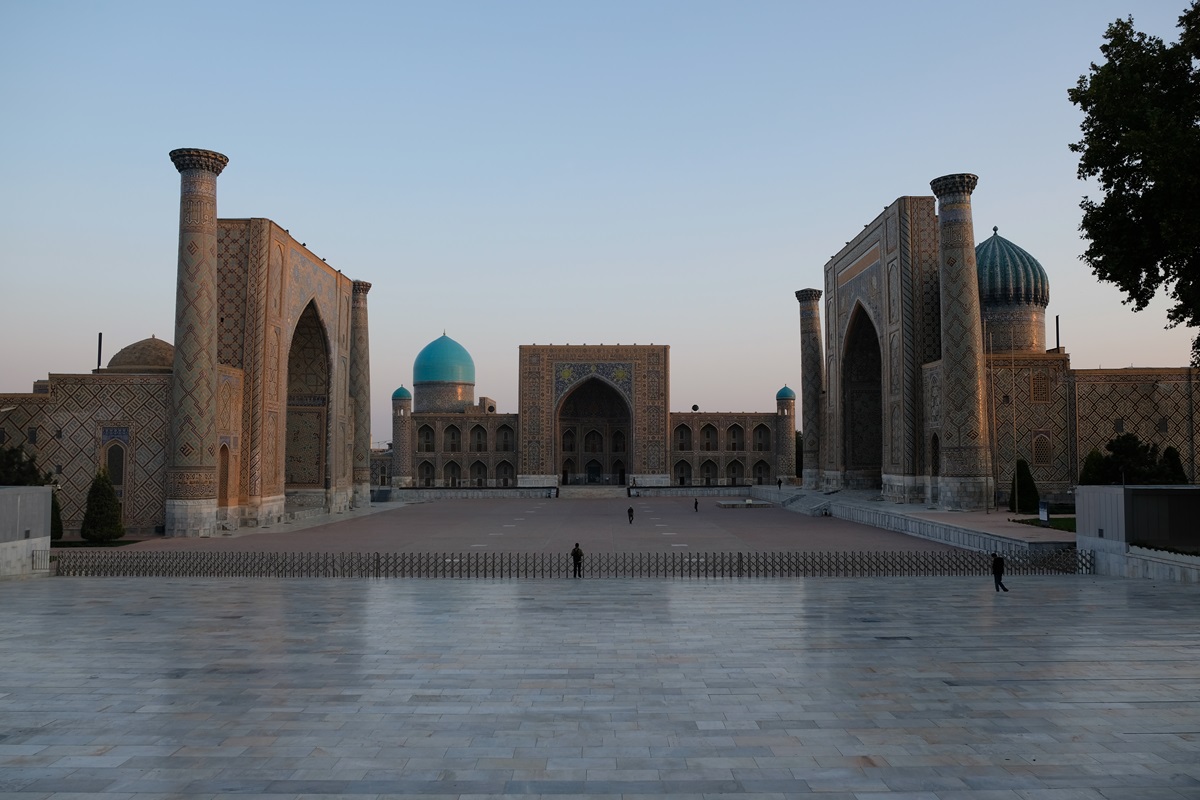
Early morning at the Registan
The taxi that took us from the train station weaved through the streets of Samarkand. We had just arrived from Tashkent on a two-hour journey now made possible thanks to the Afrosiyob, the first high-speed rail system in Central Asia which was named after an ancient site in Samarkand. It was only our second day in Uzbekistan after landing at the capital the night before. As I looked out of the Chevrolet car window (the US manufacturer dominates the domestic market in the country), I was mesmerized by the unfamiliarity yet curious about how different, or similar, life was like here compared to where I come from. Just before our taxi driver made the final turn to the street where our accommodation for the next few days was located, suddenly an ensemble of grand ancient structures emerged from behind the tall trees of a city park. The Registan with its three iconic madrasahs (Islamic educational institutions) was absolutely a head-turner.
During the time of the ancient Silk Road, the legendary trade routes that connected the East and the West in antiquity, Samarkand flourished as one of the most important stops. However, its location on the main course between Asia and Europe also meant that it was prone to attacks from foreign powers. Alexander the Great conquered the city (known by the ancient Greeks as Maracanda) in the fourth century BCE, and more than a thousand years later in the 13th century, it was Genghis Khan’s turn to sack the strategically important trading hub. When Timur managed to consolidate his control of Transoxiana and lands further away, he made Samarkand the capital of his empire.
Following the death of the great Uzbek conqueror, Shah Rukh – the youngest of Timur’s four sons – ascended the throne. In a departure from the way Timur ruled his dominion, the new leader put forward diplomacy, and nurtured the arts and sciences, while at the same time maintaining relative stability in his core realm. During his rule, the sultan’s son Ulugh Beg – who would succeed his father in the mid-15th century – commissioned a madrasah in the Registan in 1417, known today as the Ulugh Beg Madrasah. The institution grew to become an important intellectual center especially in astronomy and mathematics. And in an attempt to further cement the city’s status as a learning hub, and thanks to Ulugh Beg’s own passion for science, several years after the completion of the madrasah an impressive observatory was built some 4 kilometers to the northeast of the Registan square.
The Ulugh Beg Madrasah was the first to be built in the Registan, and it is today the first structure visitors will see upon entering the entire compound from the official gate in the west. Thanks to James who managed to find a relatively inexpensive yet quite comfortable accommodation a short walk away from the Registan, we took advantage of it by visiting the UNESCO World Heritage-listed group of monuments multiple times during our stay. Prior to this trip, I had seen many images of the Registan in some of the blogs I follow, and they really set my expectations quite high. However, when I finally stood in the middle of the Registan surrounded by those madrasahs, I couldn’t help but feel overwhelmed by the sheer scale of the structures and the intricate beauty that adorns them. This place looked even more magnificent in person.
To our left was the oldest of the three: the madrasah commissioned by Ulugh Beg himself. Having withstood the elements much longer than the other two, the structure immediately gave away its age. Its iwan (a vaulted space that is walled on three sides, a typical feature in Central Asian and Persian architecture) and one of its minarets were visibly leaning. Although the situation seemed concerning, I convinced myself that preventive measures must have been taken to ensure that the madrasah would remain standing for many more generations to come. As we stepped inside, we were welcomed by an open courtyard filled with trees. Since the madrasah is no longer used as a school, its hujras (studios once occupied by students who learned at the institution) have been turned into souvenir shops. Also inside the madrasah was a museum dedicated to Ulugh Beg’s achievements as well as wax figures depicting how a classroom would have probably looked like back in the day.
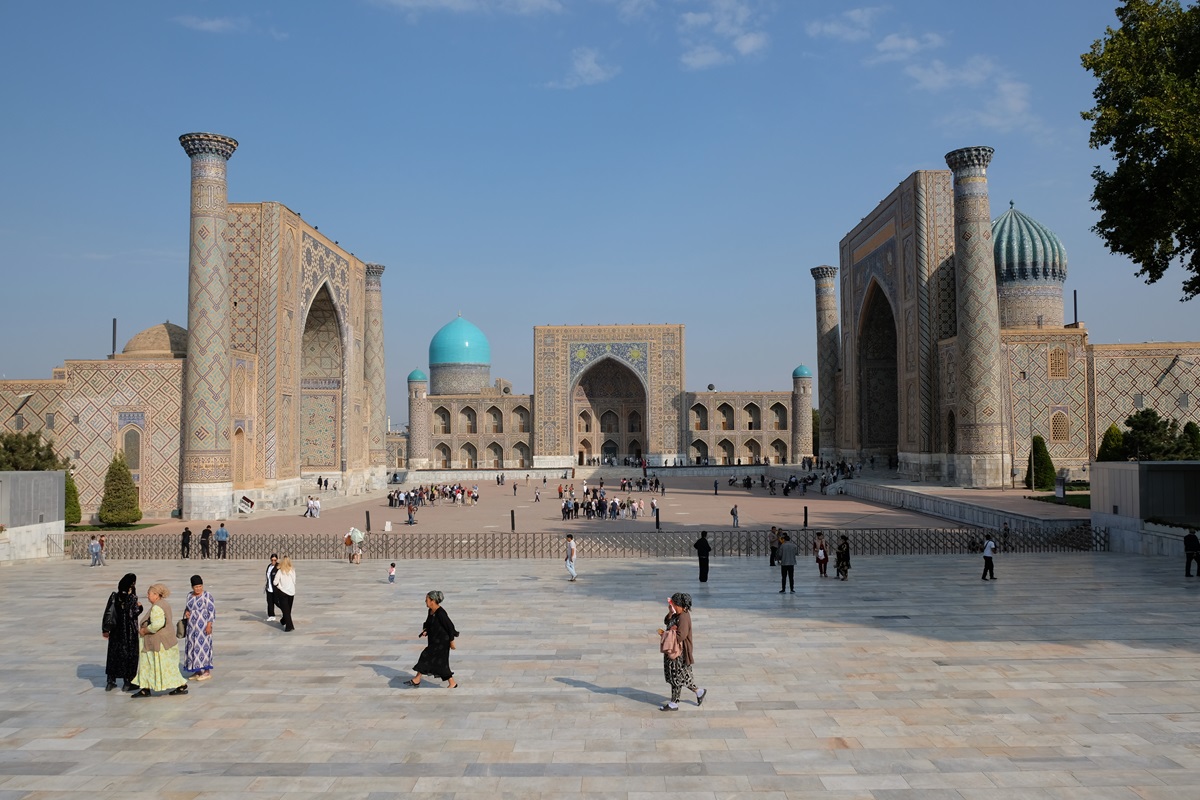
The most iconic of all of Uzbekistan’s heritage sites
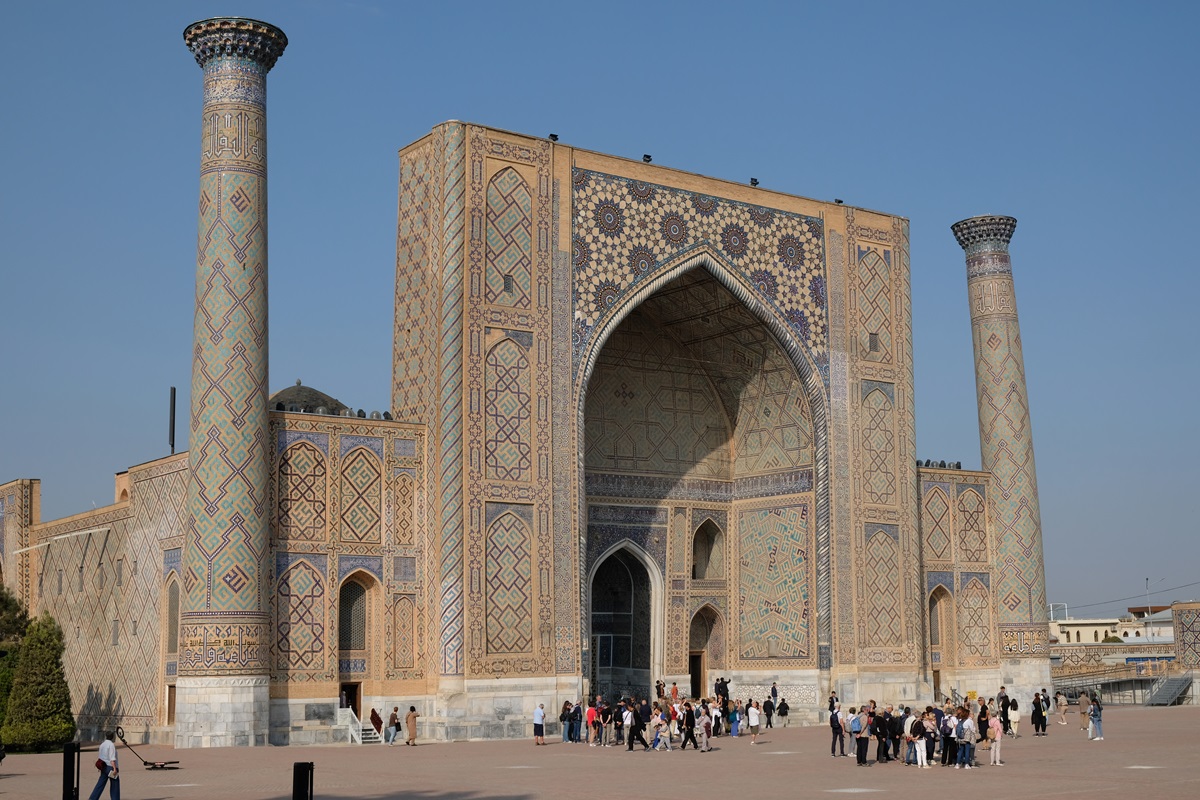
The Ulugh Beg Madrasah, the oldest of the three
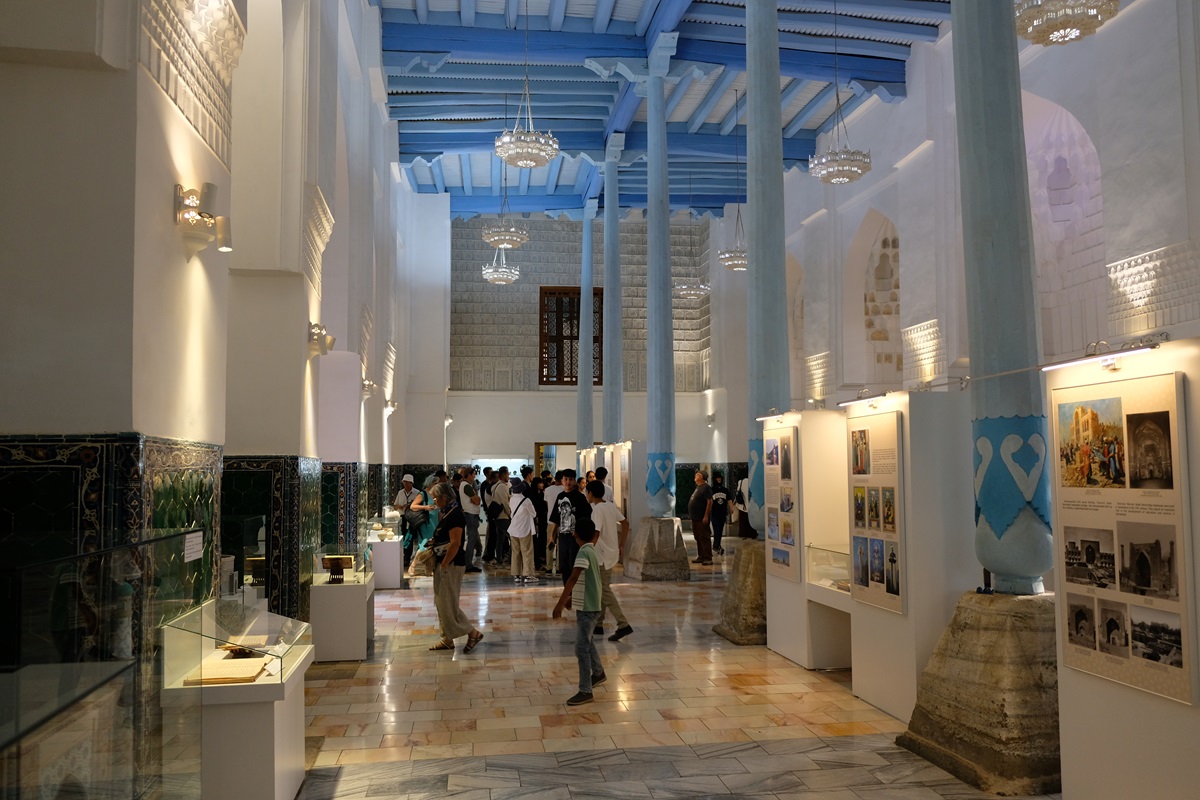
A museum showcasing Ulugh Beg’s achievements inside the madrasah
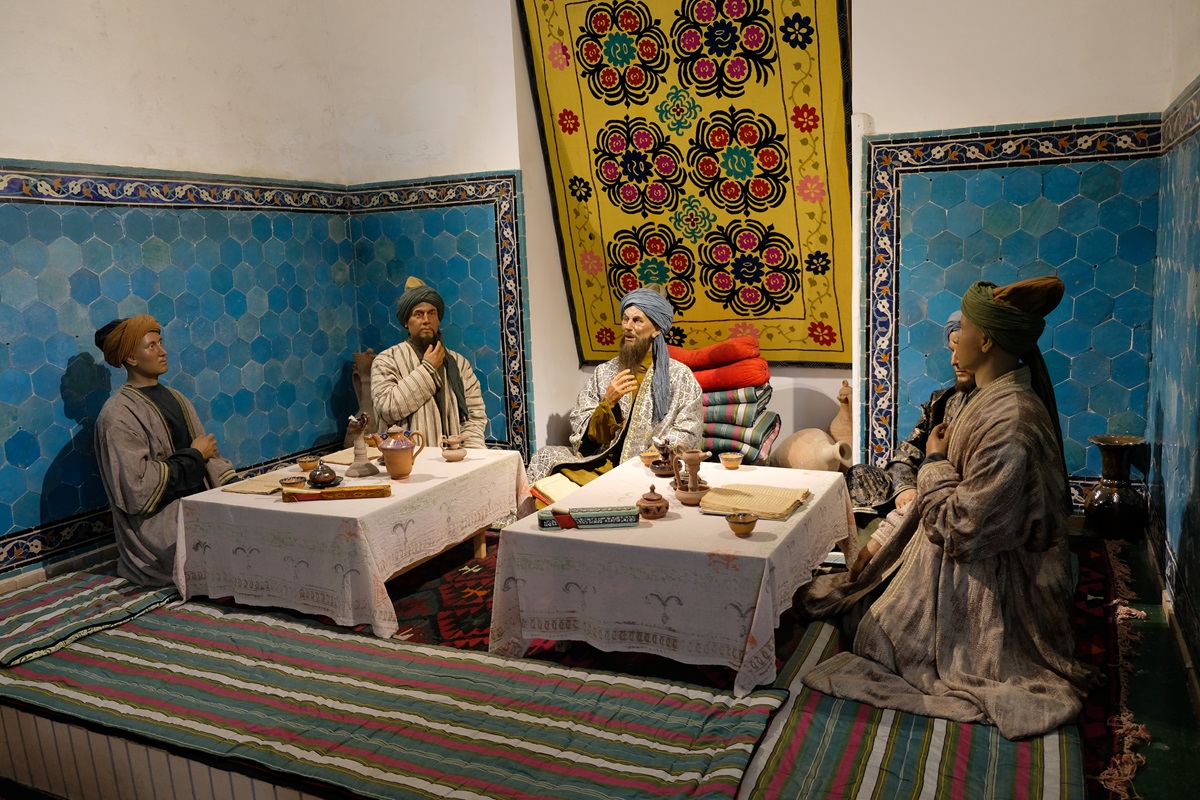
Reimagining a classroom during the heyday of the learning institution
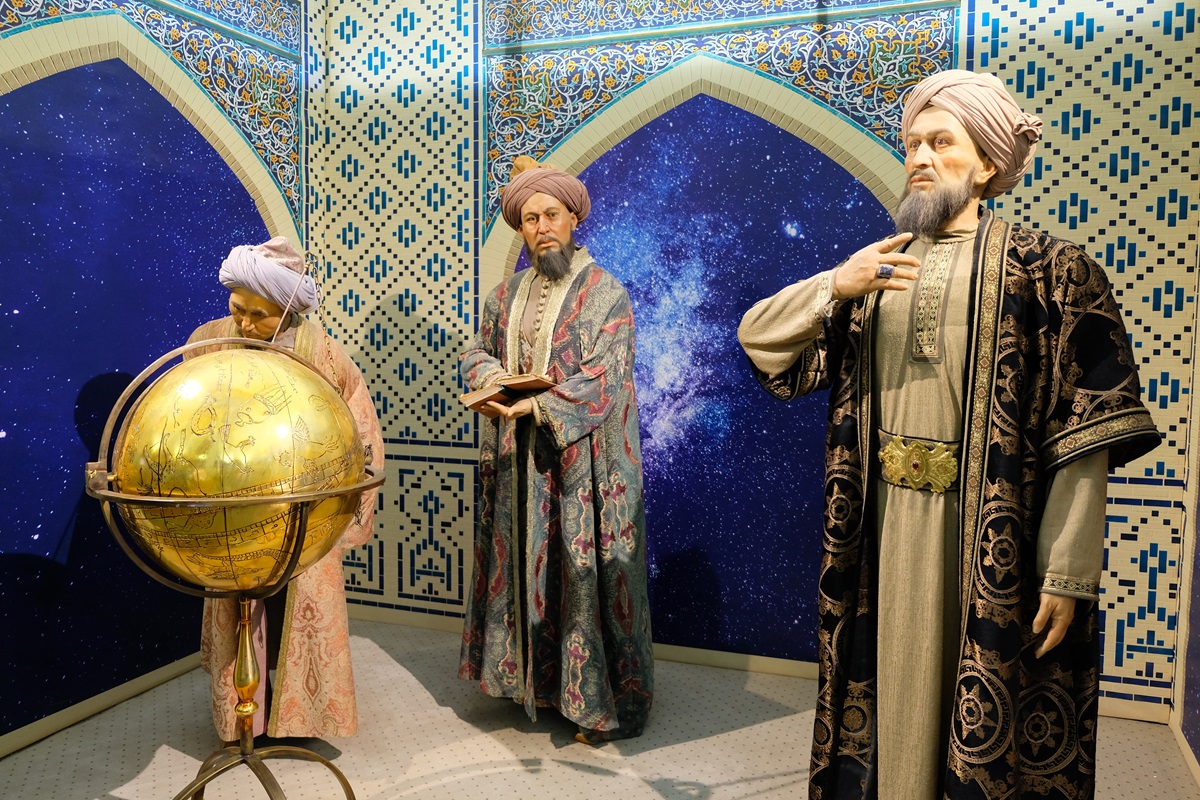
Ulugh Beg’s passion for astronomy put Samarkand on the world map as one of the leading centers of the subject
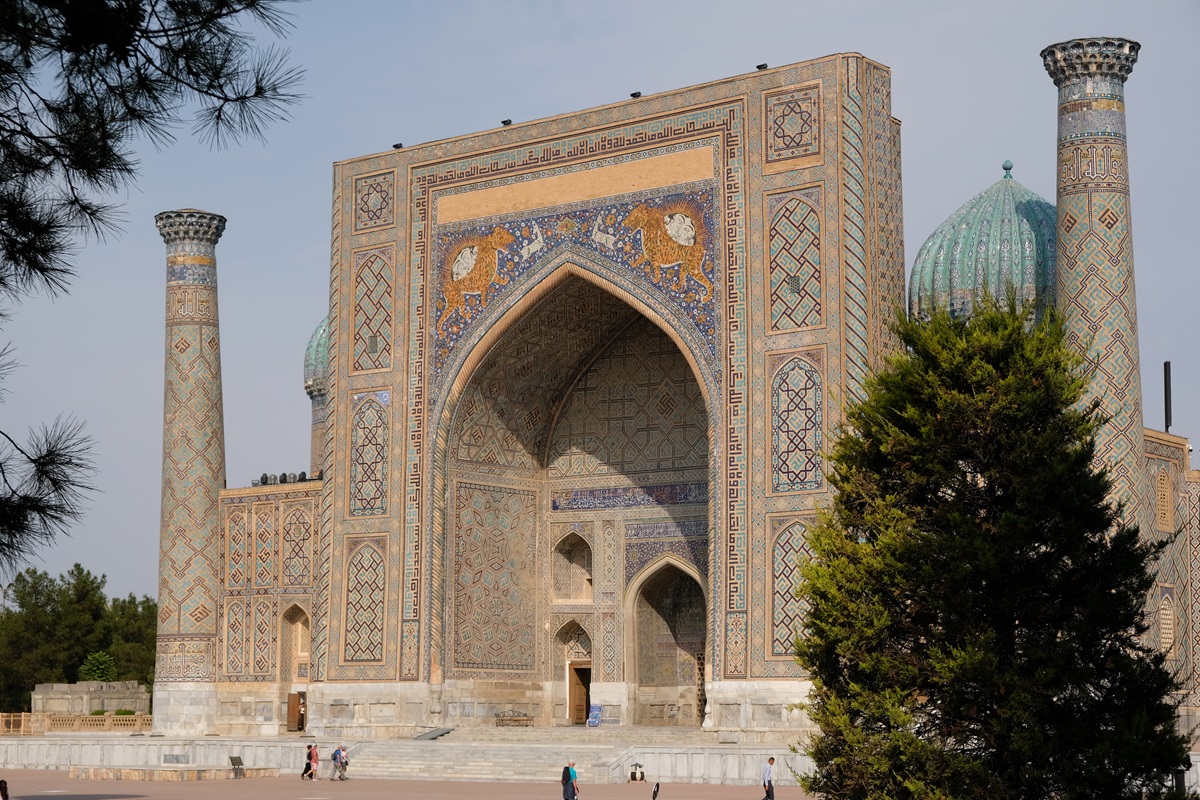
Taking a peek at the Sher-Dor Madrasah
Back at the Registan square, another imposing madrasah stood right across from where we were. Built two centuries after the completion of the Ulugh Beg Madrasah, the Sher-Dor Madrasah was commissioned by Yalangto’sh Bakhodir, the governor of Samarkand when the city was under the rule of the Khanate of Bukhara, one of the successors of the once mighty Timurid Empire. Equally richly-embellished with geometric patterns done in the banna’i (a technique of alternating glazed tiles with plain bricks) decorative style, the 17th-century madrasah also incorporated two ribbed domes covered with turquoise tiles and wrapped in Arabic calligraphy.
Its pishtaq (the rectangular gateway to an iwan), however, is what this former learning institution is most famous for, thanks to a very unusual portrayal of earthly creatures on its upper corners. Two large felines with the stripes of a tiger and the mane of a lion seem to be chasing deer. Behind each beast is a brightly-shining sun with a human face illustrated in the disc. None of these are common in Islamic art as the depiction of humans and animals are generally shunned. Different theories emerged as an attempt to guess the artist’s intention behind this unorthodox undertaking, but the real answer might have forever been lost to the ravages of time.
Before stepping inside the madrasah, it’s a good idea to take a look at the two niches situated to the right and left of the pishtaq. One houses an exhibition of Uzbek silk carpets, while the other is purportedly the final resting place of a revered Islamic leader. Inside the madrasah was a familiar layout like what can be found at the courtyard of the Ulugh Beg Madrasah, complete with souvenir shops occupying the hujras. When we went back to the main square, standing on the raised platform on which the Sher-Dor Madrasah was constructed, we gazed upon the youngest of the ensemble: the Tilya-Kori Madrasah. Built just a decade after the completion of the former, this three-century-old monument happens to be where one of the most impressive and important structures in the entire compound is located.
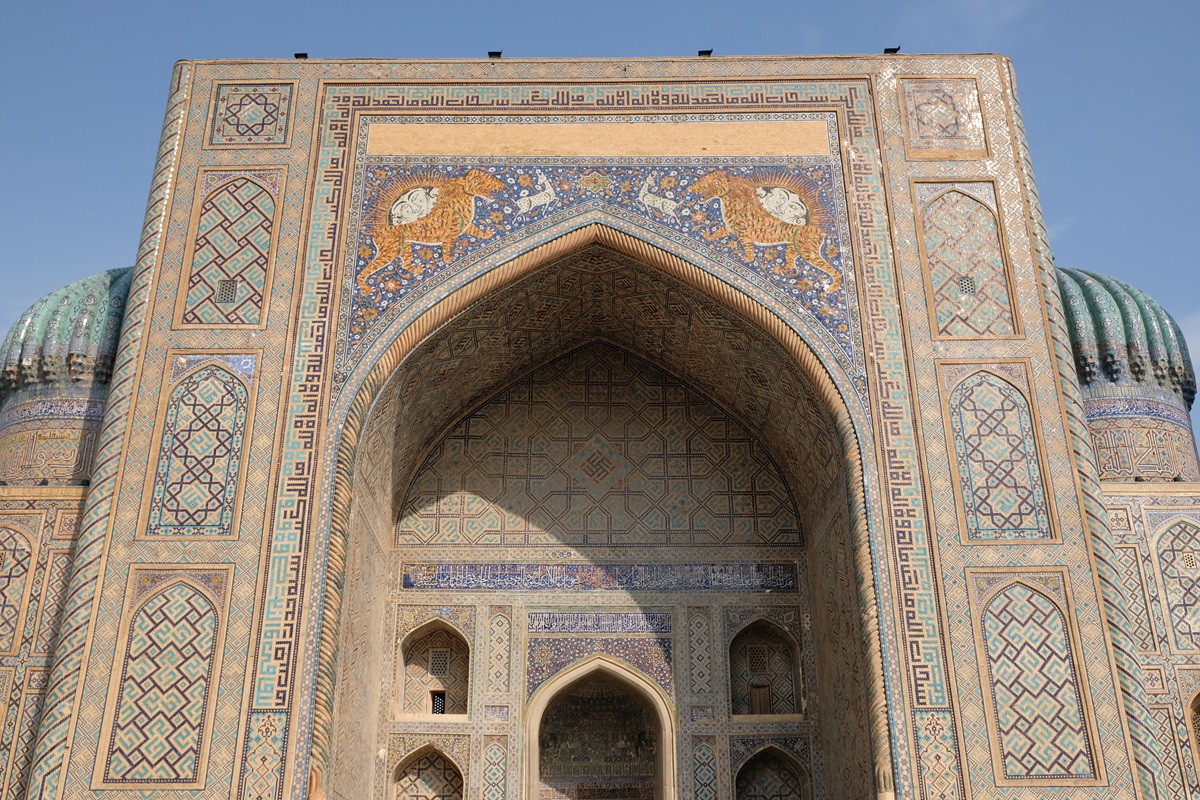
The enigmatic pishtaq of the Sher-Dor Madrasah with depictions of animals
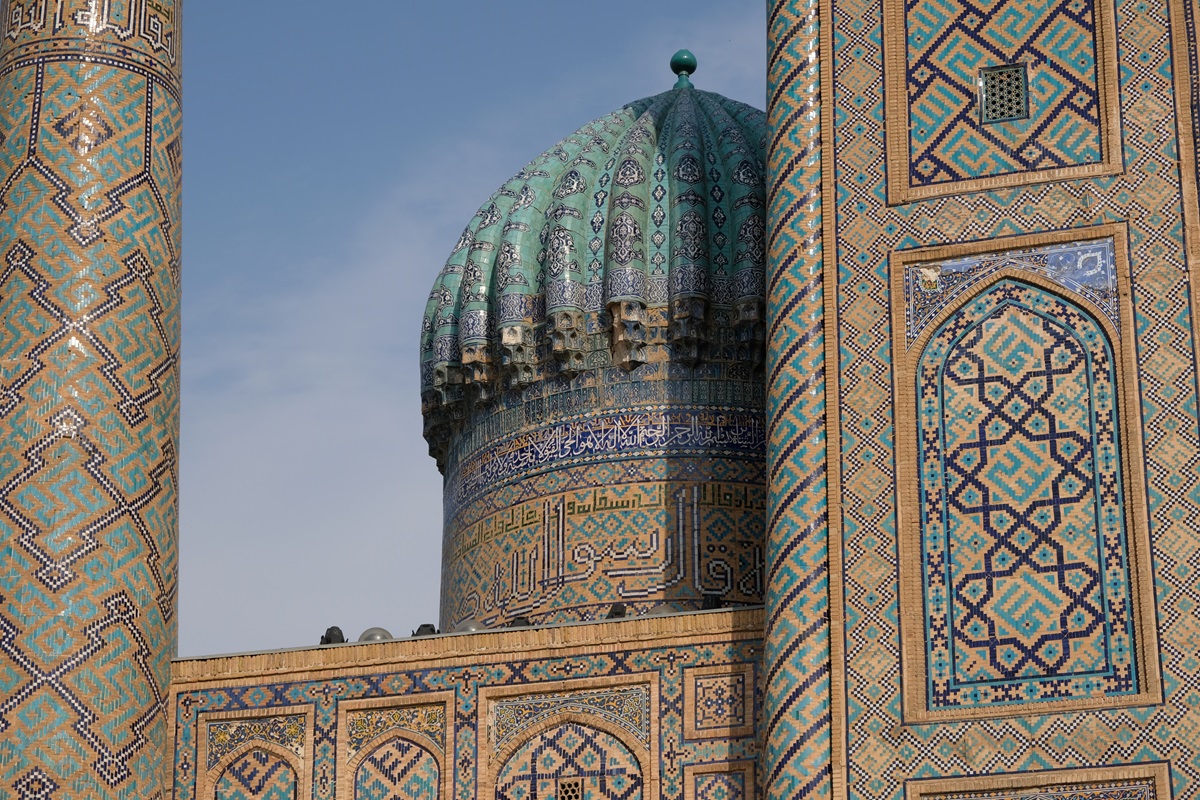
One of the richly-embellished ribbed domes of the Sher-Dor Madrasah
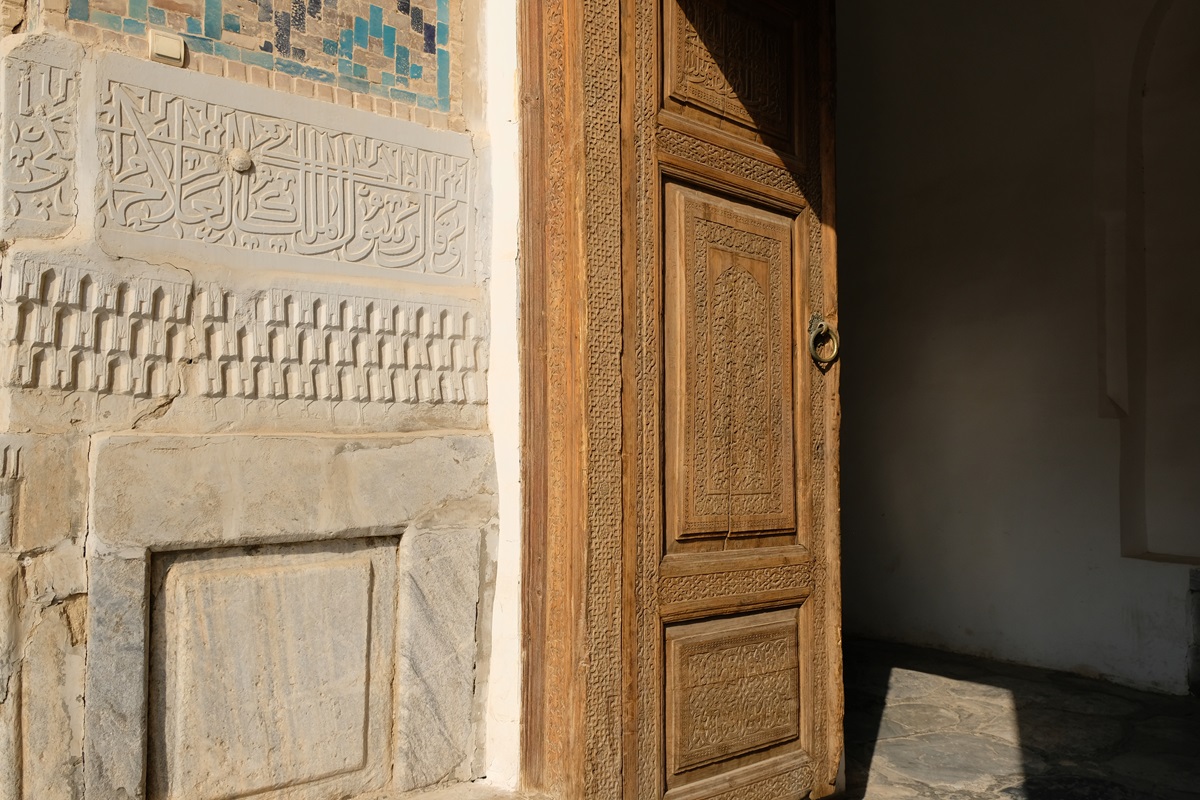
The doors are open for curious visitors
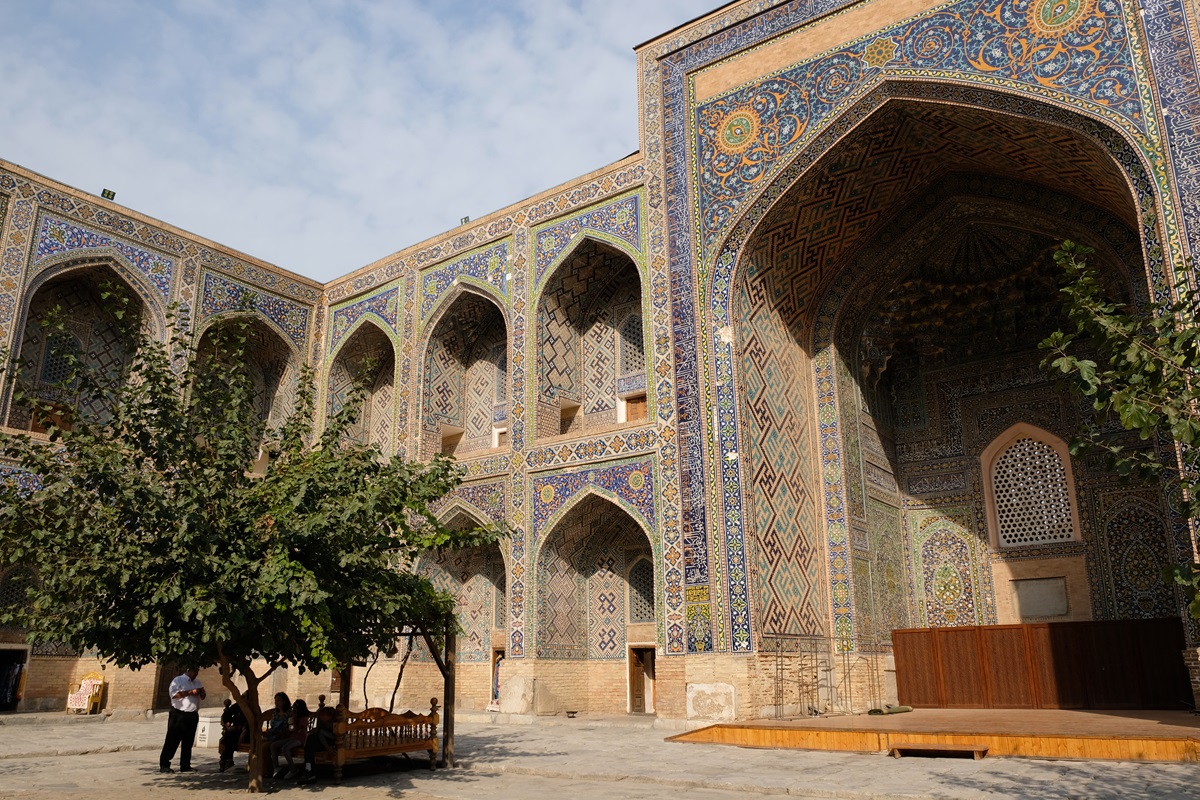
The courtyard of the Sher-Dor Madrasah
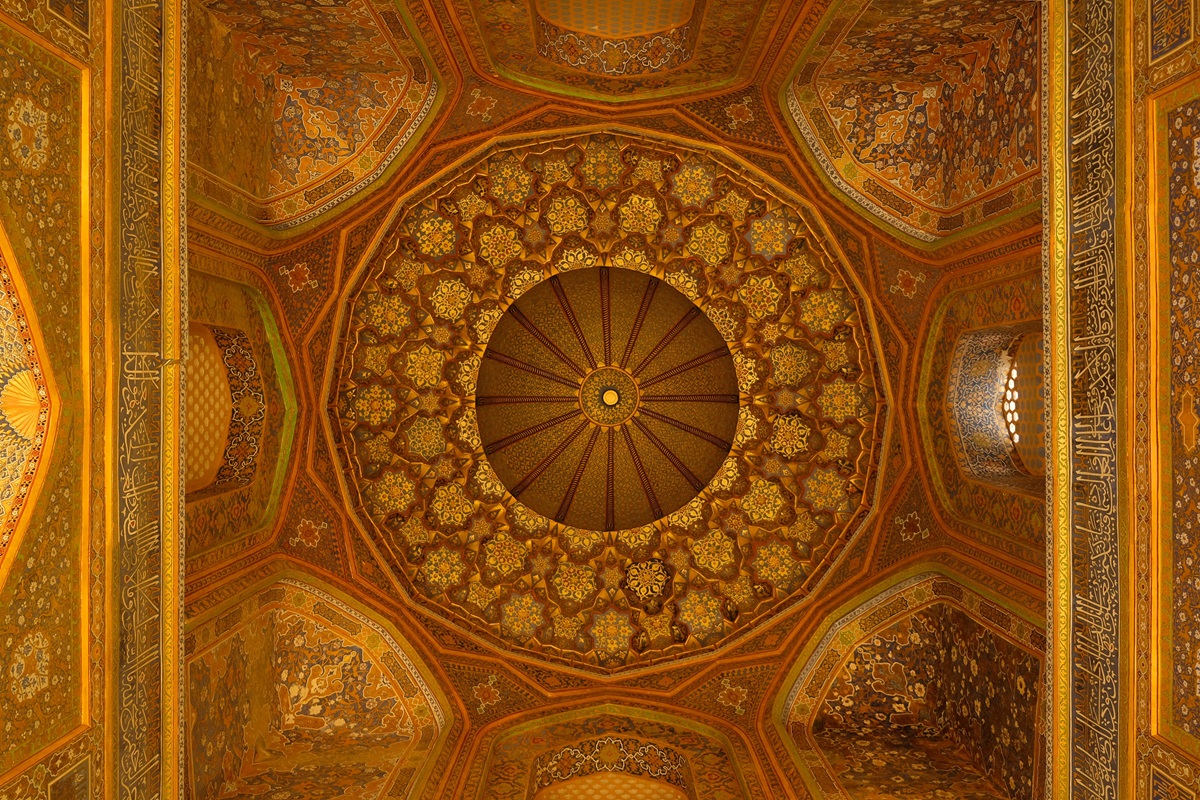
What lies underneath one of the domes of the madrasah
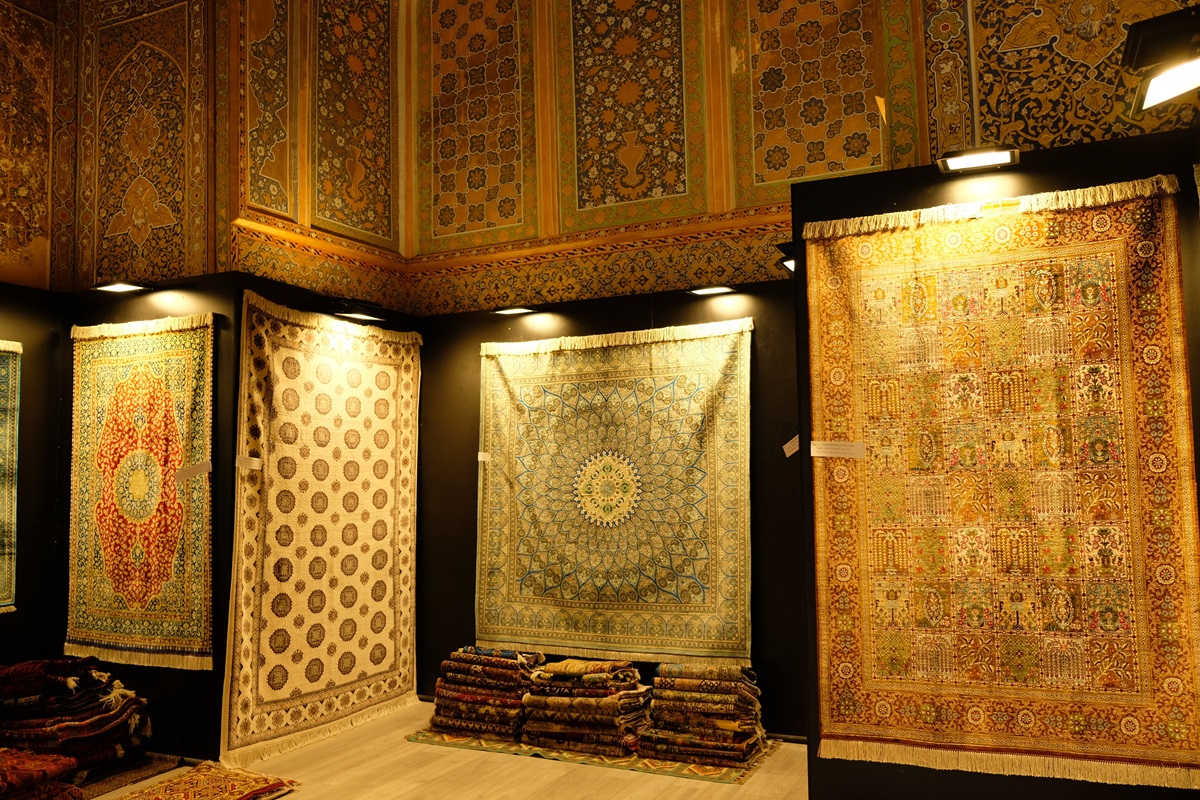
A showcase of Uzbekistan’s silk carpets
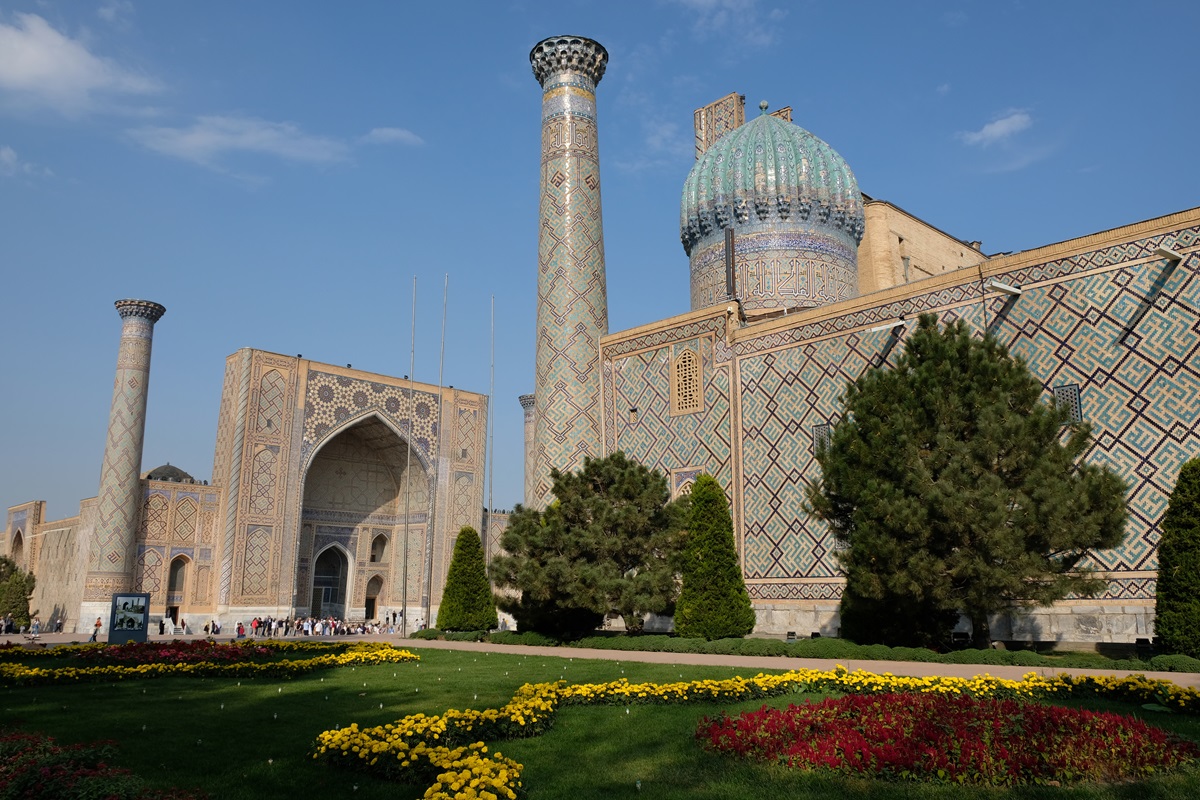
The Sher-Dor Madrasah (right) directly facing the Ulugh Beg Madrasah
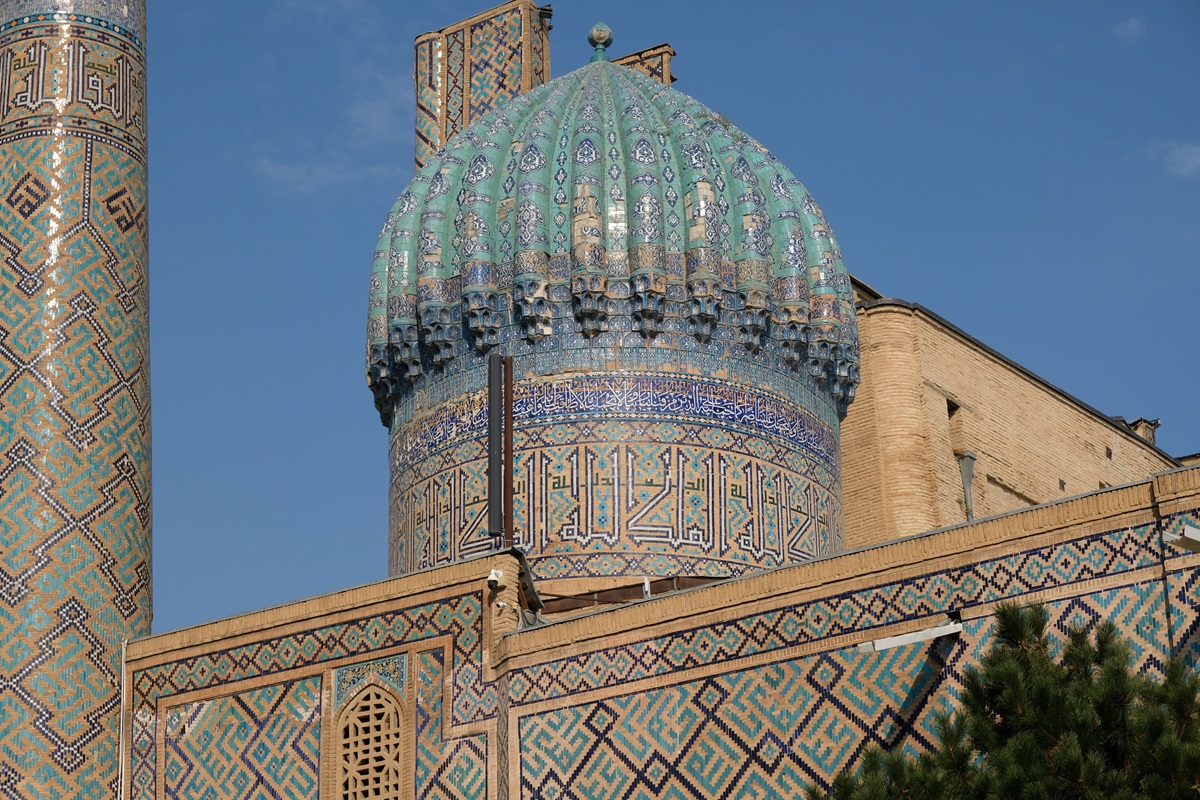
Beneath this ornate ribbed dome, however, was a grave in an austere chamber
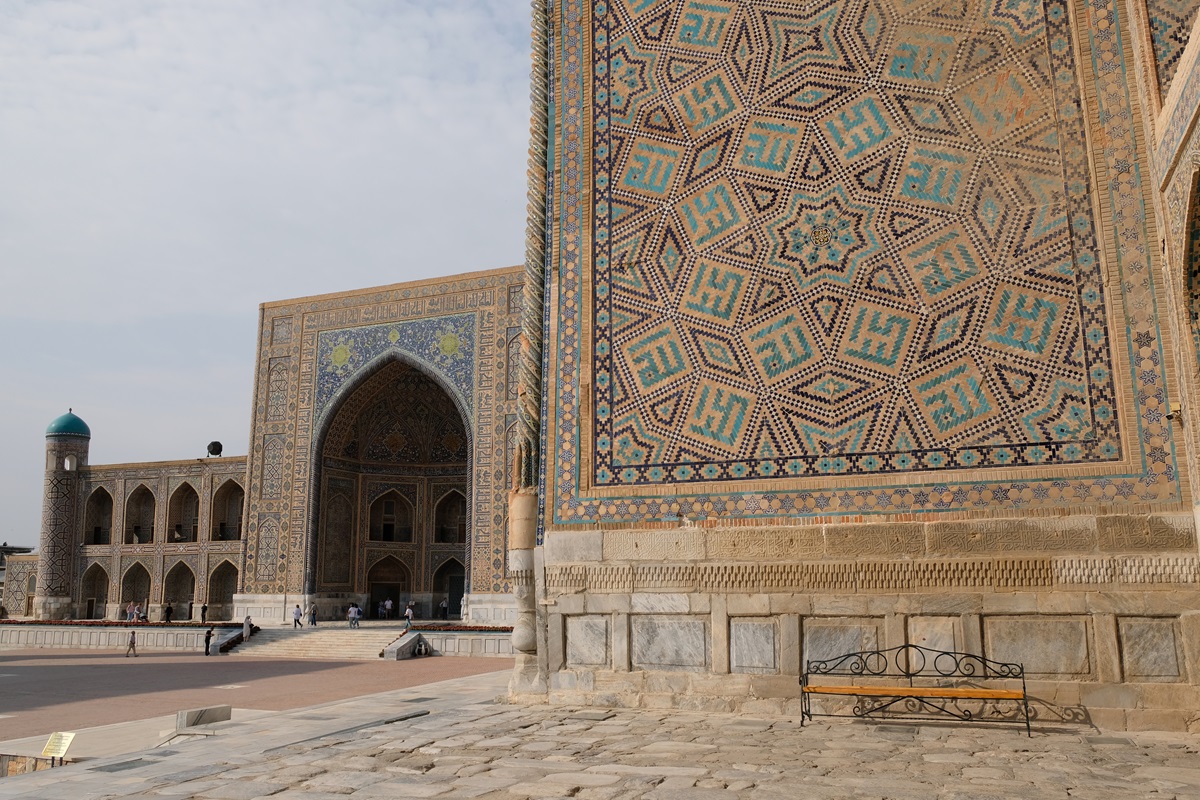
Looking at the Tilya-Kori Madrasah from the raised foundation of the Sher-Dor Madrasah
Situated right at the center of the ensemble, the Tilya-Kori Madrasah is the final structure built around the Registan square. It is distinguishable from the other two by its smooth turquoise dome that sits on the west side of the former learning institution. Once we walked past its monumental pishtaq, a large open-air courtyard was presented before our eyes. It was as if the trees and benches waved at us to come closer to soak in the peaceful ambiance. But our attention was drawn to somewhere else: the very structure underneath the same dome that gives this madrasah its iconic appearance. We followed the steady stream of visitors entering it, and once we were inside, we were stunned, our mouths agape in fascination.
Every inch of the wall all the way to the ceiling was covered in the most exquisite profusion of gold-and-blue embellishments. At first, I was overwhelmed by what I saw as I kept looking up just like everyone else around me. Then, I reminded myself to start taking photos, but I didn’t know where to begin. Eventually, after a few shots, I gradually got a grasp of the space, which was once a mosque. The kundal painting technique used to decorate the former prayer hall’s ceiling was so marvelous it made the flat surface appear as if it followed the contour of the dome above it. Apparently, this technique is still practiced in neighboring Tajikistan today.
Like the Sher-Dor Madrasah that was constructed on the ground of a khanqah (a Sufi lodge) from the Ulugh Beg period, the Tilya-Kori Madrasah was also erected on a plot of land once occupied by an older structure – in this case a caravanserai. However, whether one was part of a camel caravan that stayed in this type of accommodation, an explorer who helped to facilitate cultural exchanges between Europe and China during medieval times, or a modern-day visitor arriving in a bus or a taxi – like us – it is almost certain that the beauty of the Registan and its madrasah(s) would have left a deep impression. This centuries-old square was beautiful at dawn, in the morning, in the afternoon, and at night. And that was exactly what James and I did: we visited this jewel of the ancient Silk Road multiple times to see how it looked under different light conditions throughout the day. We were always awestruck no matter how often we returned.
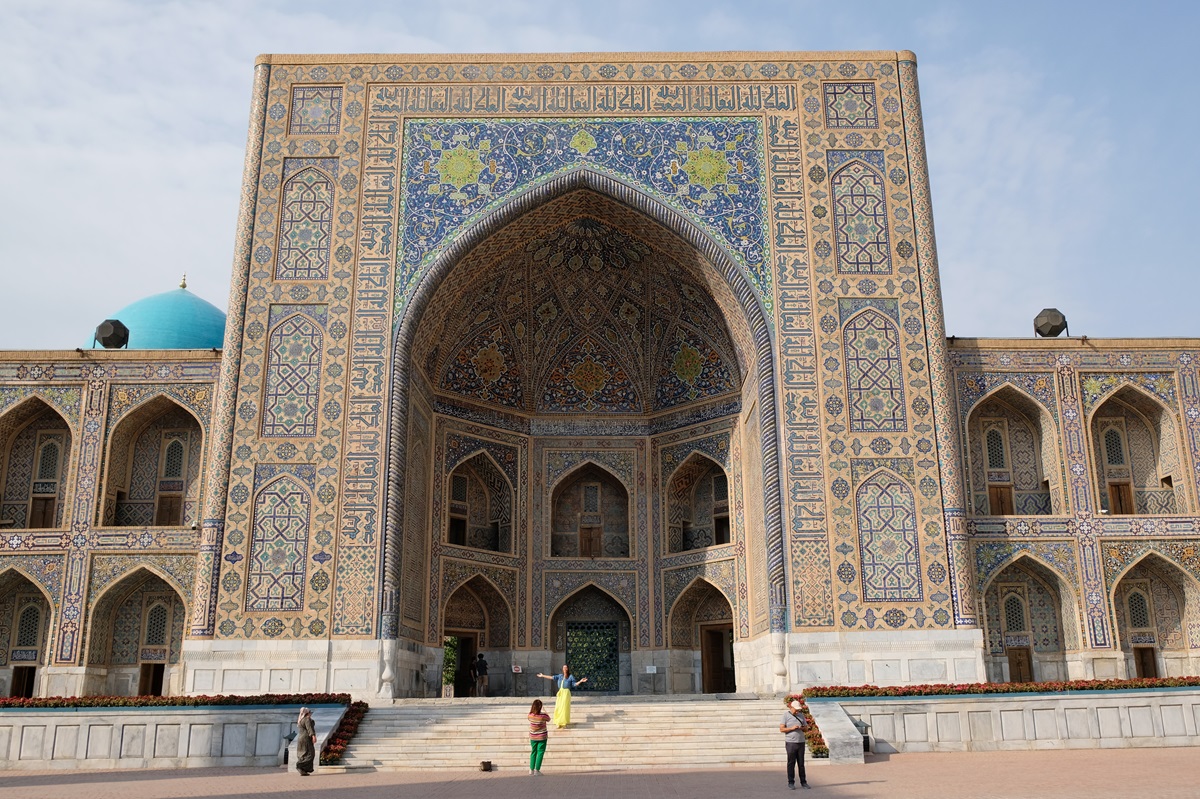
Entering the Tilya-Kori Madrasah, the youngest of the ensemble
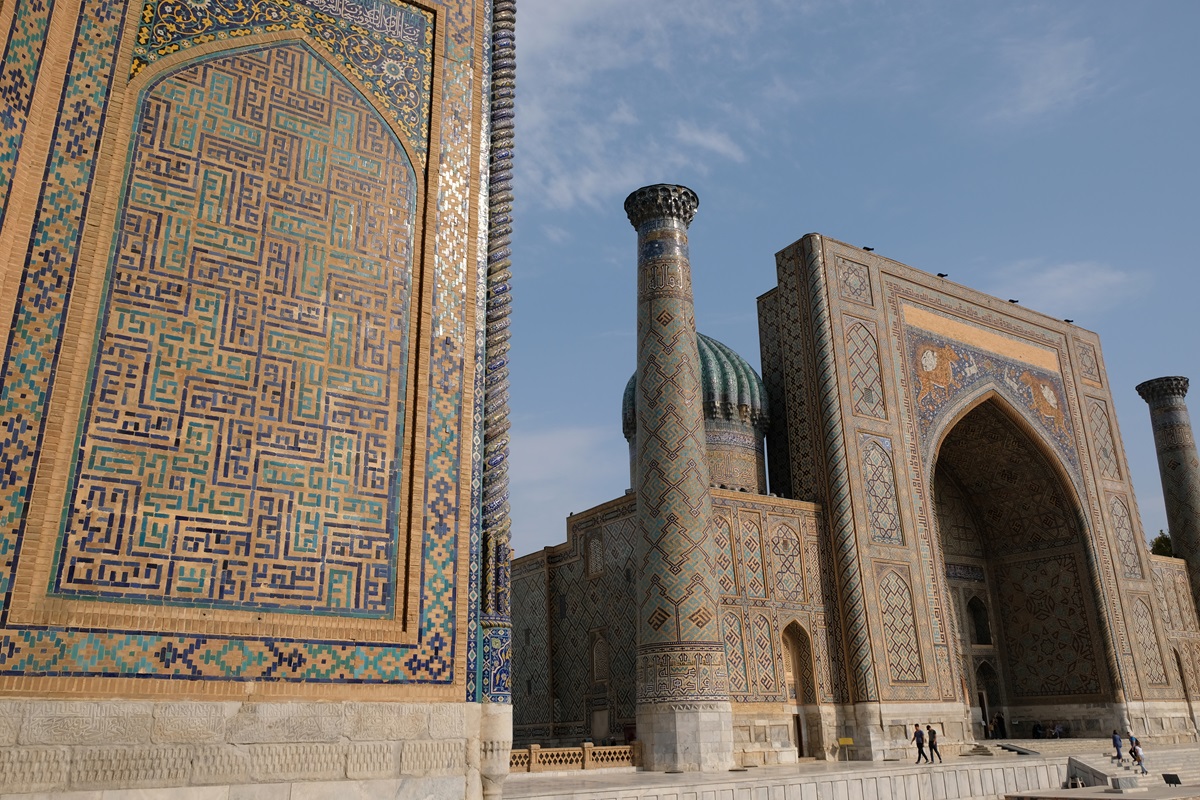
Taking a look at the Sher-Dor Madrasah
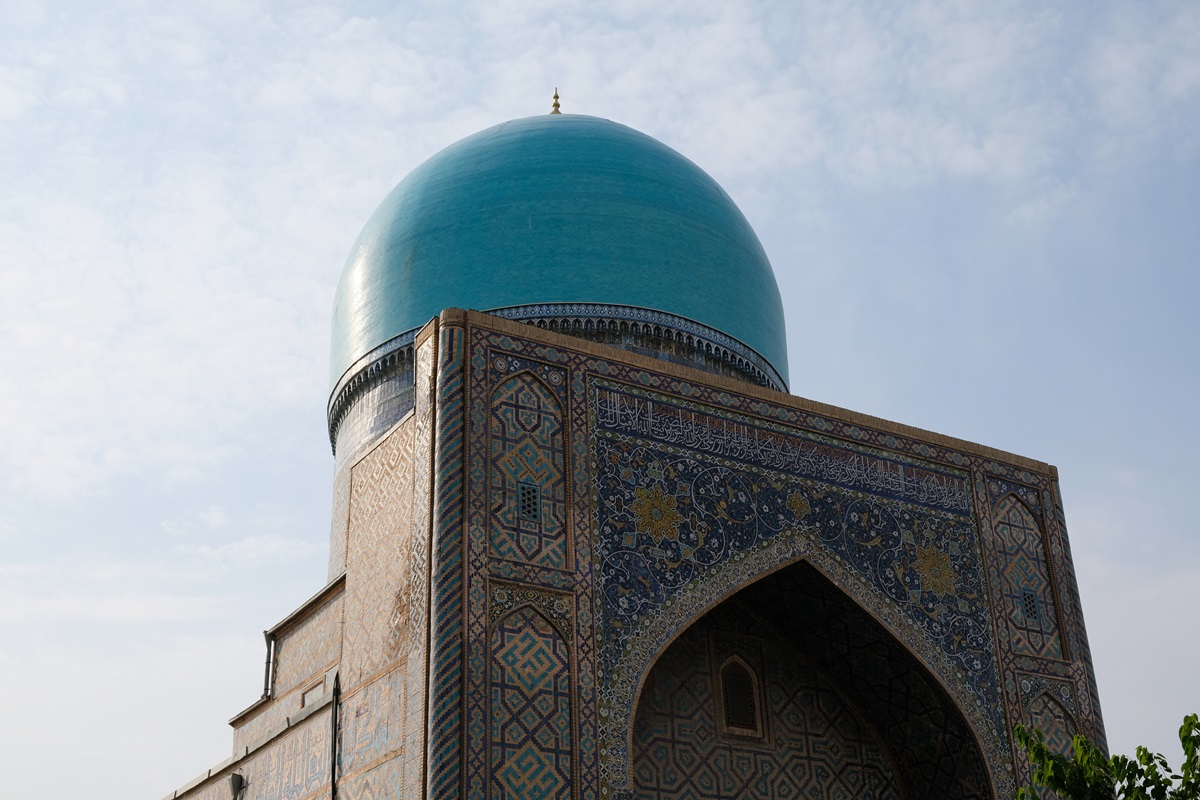
The smooth turquoise dome at the Tilya-Kori Madrasah
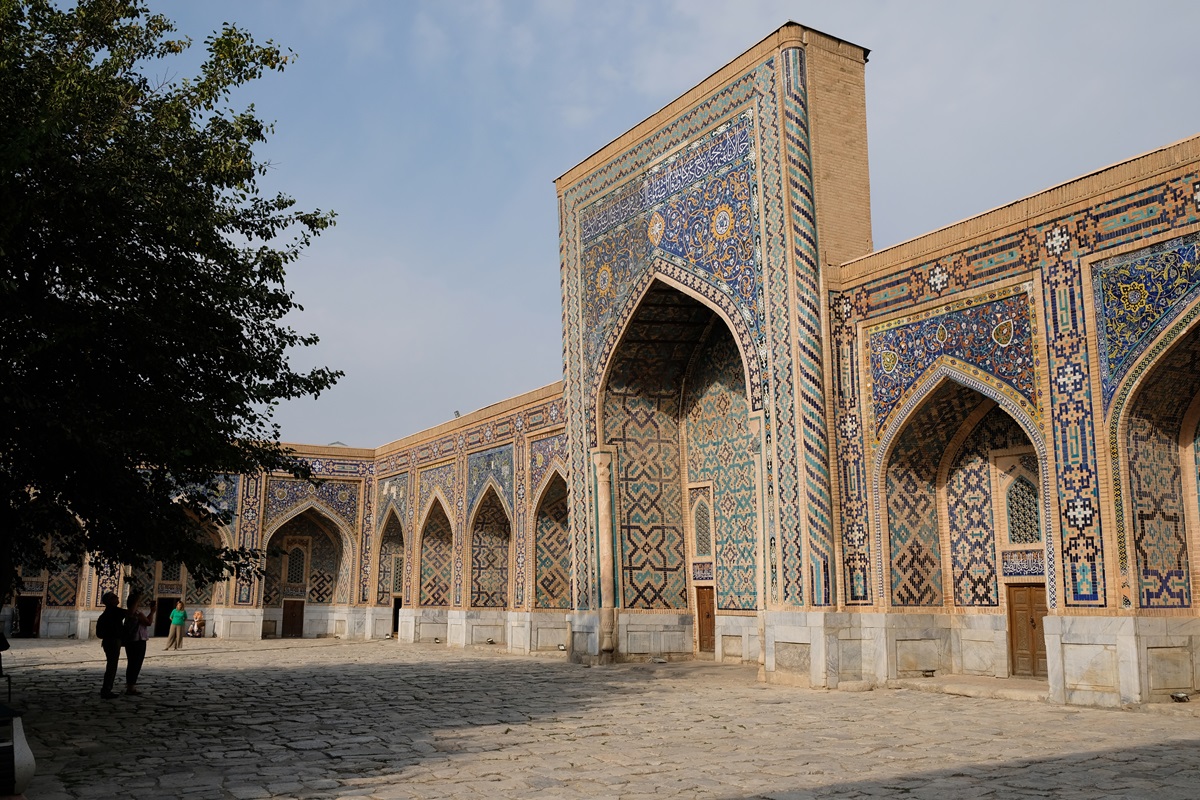
Some structures inside the madrasah were also tilted at precarious angles
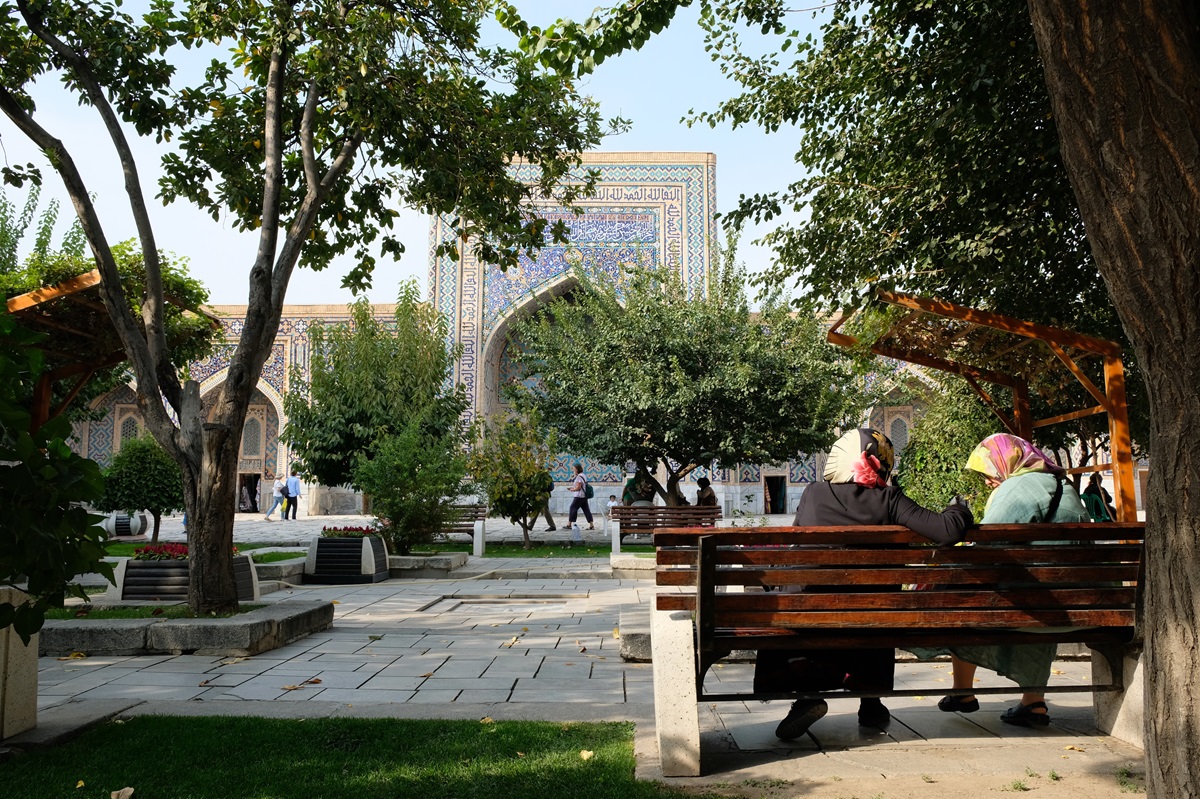
Such a nice and peaceful spot to have a long conversation
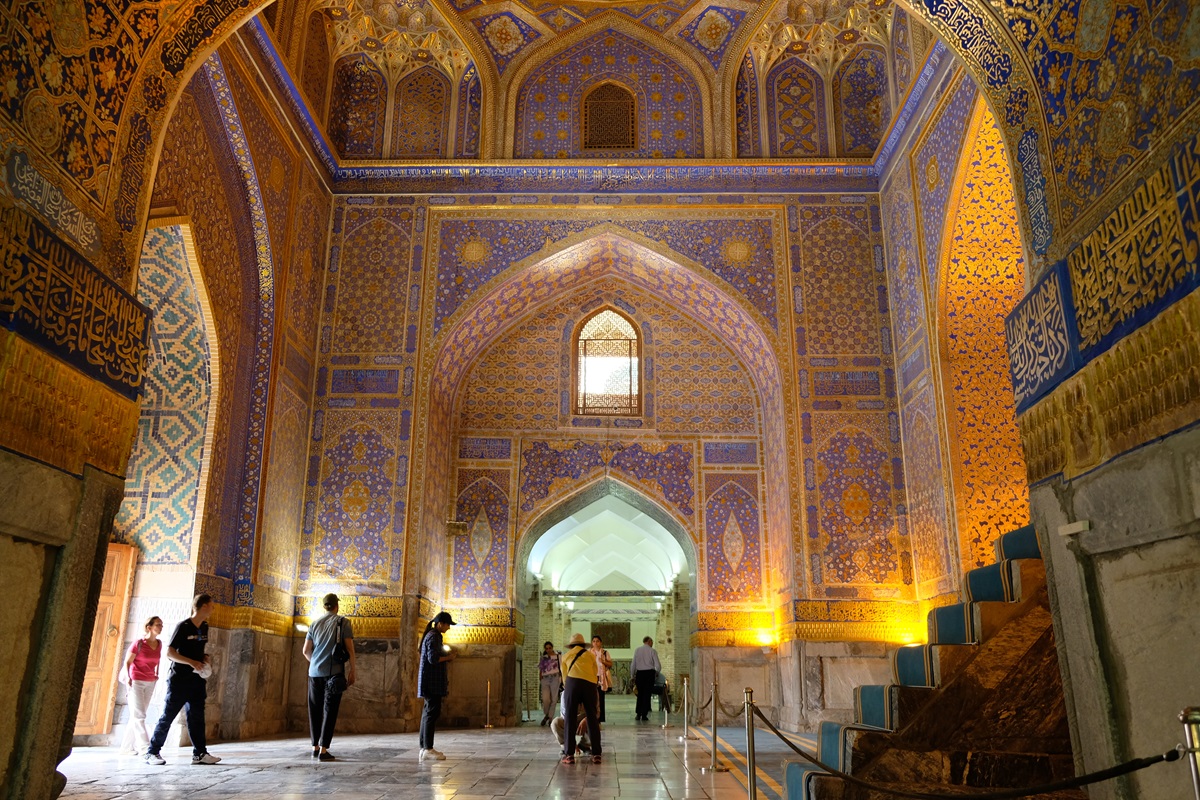
The former mosque underneath the dome
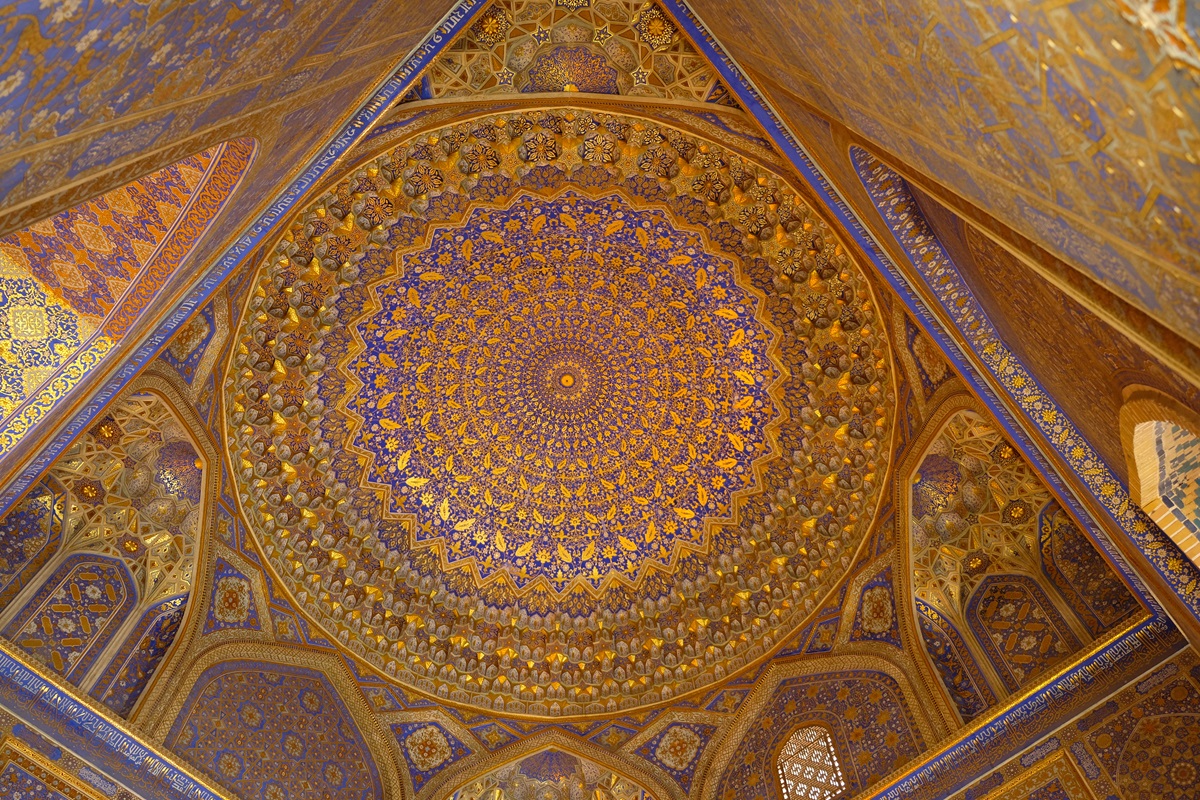
This ceiling might give the impression that it follows the contour of the dome above it, but it is actually flat
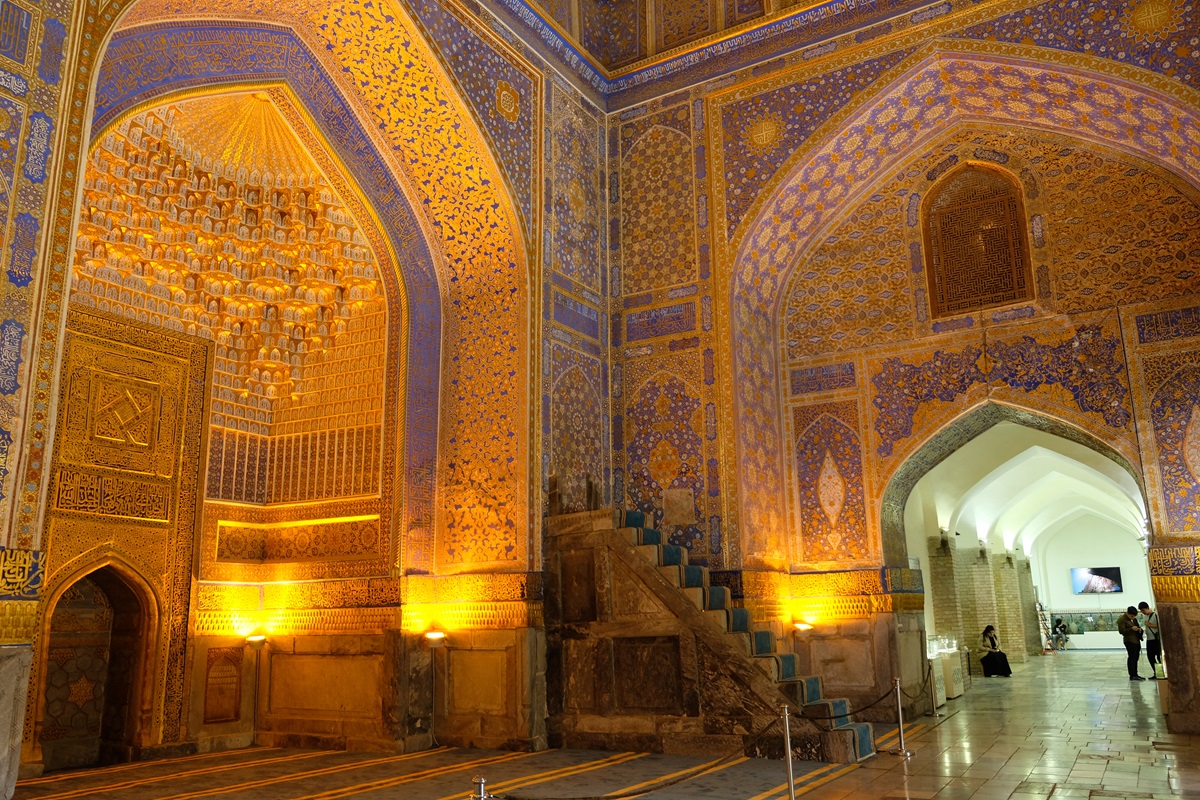
The mihrab and pulpit of the former mosque
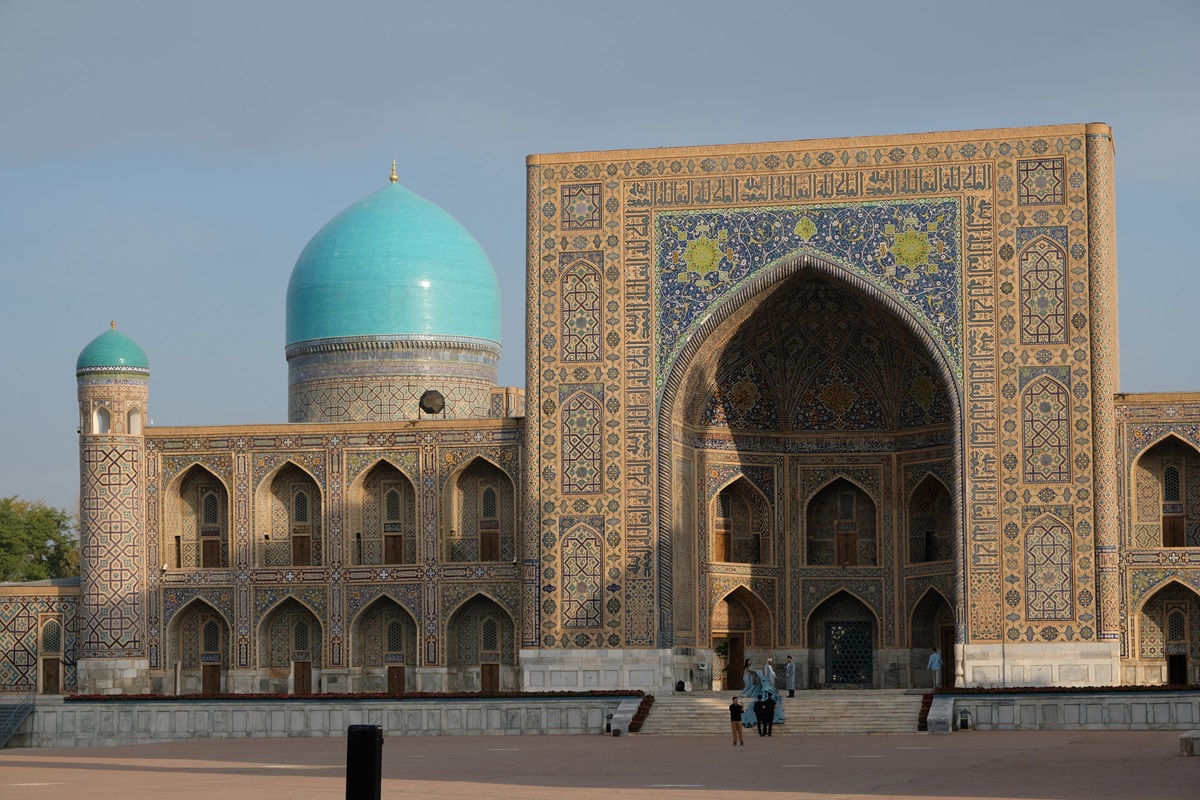
An exquisite monument from the past
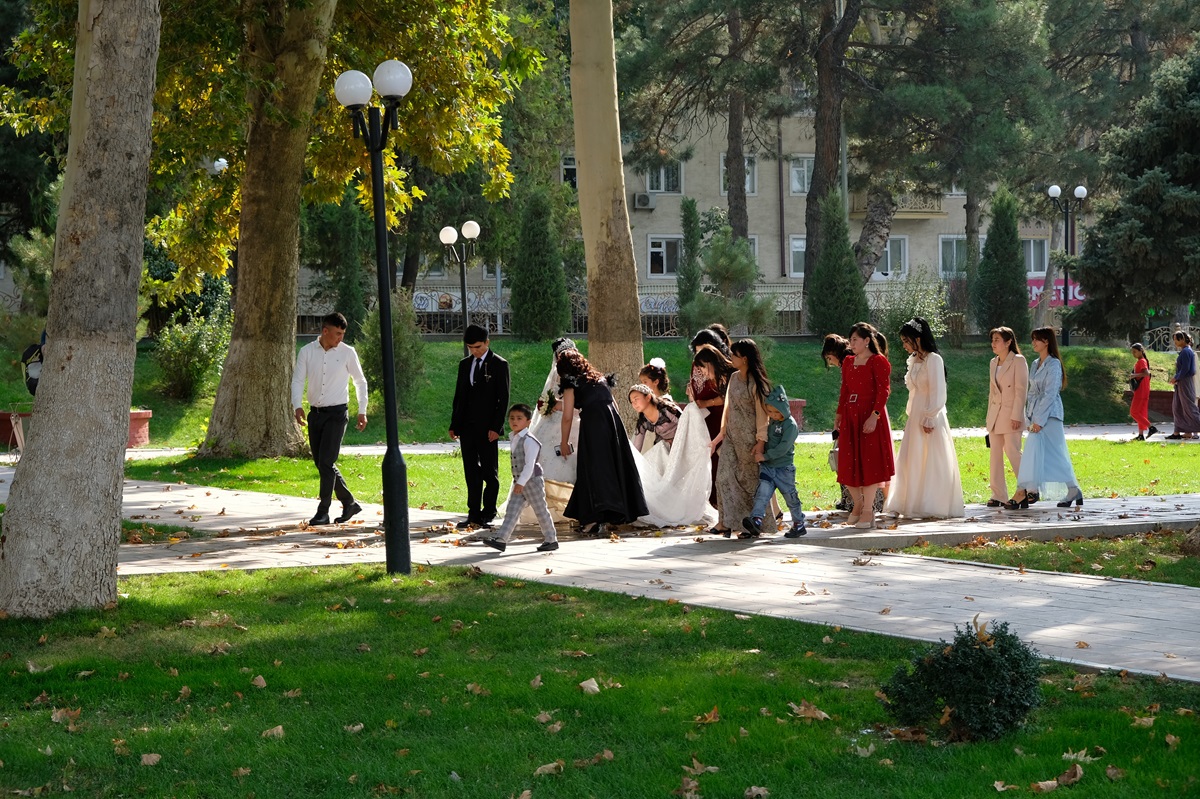
A bride and groom at the city park next to the Registan
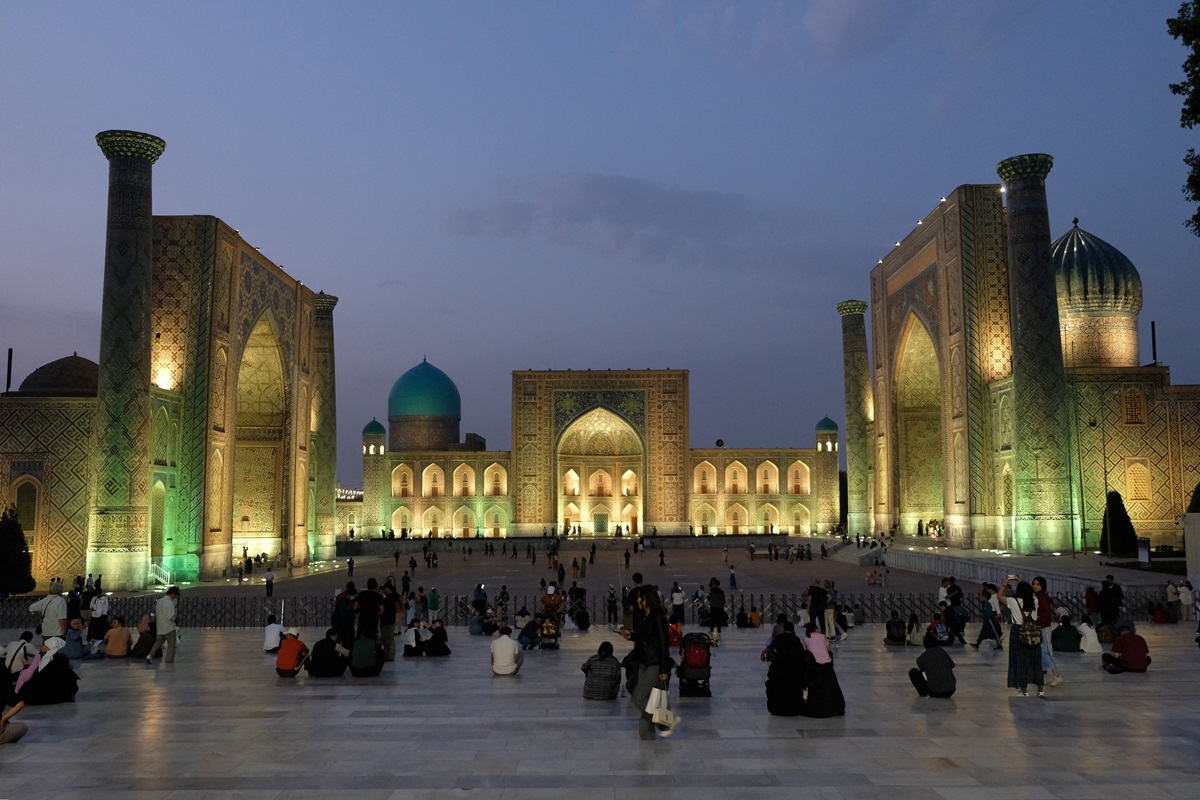
The magnificent square at dusk

 What an Amazing World!
I’m so happy that Registan lived up to and maybe exceeded your expectations Bama. We also stayed in a guesthouse nearby and saw the complex several times in every light. It took my breath away every time. Beautiful pictures, I felt as if I were standing there with you while you were taking them. Maggie
LikeLiked by 1 person
Your blog posts on Uzbekistan were among the biggest drives for me to really plan that trip to the Central Asian country, Maggie. When I saw those tiles with my own eyes, I kept saying, “I remember this from Maggie’s post.” Thank you for the inspiration.
LikeLiked by 1 person
Well I’m glad that our posts got you there 😊
LikeLiked by 1 person
Wow, Bama!!! This is such a stunning tour that you enjoyed and thank you for sharing the experience and these photos with us.
The exterior buildings are stunning and truly stood the test of time. I’m in awe of the detail from the symmetry, to the tiling and intricate details of the Arabic calligraphy and inside of the buildings and the mosque are so stunning! Love the details of the domed ceilings.
Interesting to see the recreation of the old classrooms. It did feel a bit elitist and patriarchal but such was historical societies!
So interesting to see the contrast of the old buildings with the modern day bride and groom at the end!
LikeLiked by 1 person
The Registan was stunning indeed. Even today, every time I look at the photos of the elaborate tilework I’m still awestruck by it. It’s amazing how they came up with the idea of decorating their schools and mosques with such a beautiful craftsmanship.
I did think the same about the old classrooms. But such was life back then. It’s good that today in Uzbekistan women are equally as educated as men.
The park around the Registan was a perfect place for people watching. I did capture some interesting scenes, but many of them turned out a bit blurry since they were taken candidly.
LikeLiked by 1 person
The candid photos are often the fun memories too. 😊🙏
LikeLiked by 1 person
Wow! I was amazed at each photo taken in Registan…the architecture is hypnotizing and very-reminiscent of the mosques I saw in Morocco and Andalusia, Spain (inspired by the Moors). The amount of detail to each line and color is incredible, and I’m happy you got to see another lovely part of the country!
LikeLiked by 1 person
I feel like there was a strong emphasis on intricate geometric patterns in Islamic architecture in the past. And speaking of Morocco, it has been one of the countries I most want to visit exactly because of the unique architecture (and the delicious food!). Glad you enjoyed this, Rebecca.
LikeLiked by 1 person
I’m always impressed by the smart, elegant architecture, so far away from everything.
LikeLiked by 1 person
Can you imagine traveling from Europe to China (or vice versa) centuries ago and stumbling upon something as magnificent as the Registan along the way? Truly a sight people will remember for their entire lives.
LikeLiked by 1 person
One of my dream destinations! We had to cancel our plans to visit this April, but your post makes sure it remains high in my 2C list.
LikeLiked by 2 people
So sorry for the cancellation. You would love Samarkand, I.J. And I have a feeling you would also be interested in visiting the Registan more than once during your stay. I hope you’ll get there sooner than later!
LikeLiked by 1 person
I couldn’t agree more with Monkey’s Tale. Like the Taj Mahal, being able to see it at different times of the day made it seem even more spectacular. And it does take your breath away.
Steve
LikeLiked by 1 person
Speaking of the Taj Mahal, after visiting those impressive mosques and madrasahs in Uzbekistan, now I really want to see the Indian monument to love even more. It was fascinating to learn the connection between the Timurid dynasty and the Mughal Empire.
LikeLike
An amazing post Bama! As always your attention to detail and the effort you put in is amazing! You have done the Registan justice for sure!!!
LikeLiked by 1 person
Thank you, Anna! This means a lot coming from you since you have also been there. The Registan was such a special place with so many treasures to learn about.
LikeLiked by 1 person
Many thanks, Bama, for having me taken back to Samarkand and its outstanding history and beauty!
LikeLiked by 1 person
My pleasure, Martina. I’m glad this post brings back some good memories from your trip to Samarkand. I wonder if there were far less tourists around when you went.
LikeLike
I suppose, Bama, because Karimov had been elected!
LikeLiked by 1 person
Wow! I wonder what you think of Uzbekistan today, if you ever revisit, since it now really opens up to the world.
LikeLiked by 1 person
You know, Bama, I don’t think that to open all countries to the wishes of tourists has only positive sides! All the best:)
LikeLiked by 1 person
Sadly that’s very true.
LikeLiked by 1 person
Wow! Just stunning, and the two-hour train journey makes it all that much easier.
LikeLiked by 1 person
You can see why the country is very proud of the Registan. And now it is eager for the world to also see it.
LikeLiked by 1 person
Absolutely amazing. Thanks for the virtual tour and the information post. The details on the architecture are stunning. (Suzanne)
LikeLiked by 1 person
Standing in the middle of the square really was an unforgettable experience. I wish I had a telephoto lens with me so I could take more shots of the intricate details. But I’m grateful with what I managed to get.
LikeLike
I adore Islamic design, Bama, and the tilework and architecture in this post also took my breath away, so I can only imagine how overwhelming and awe inspiring it must be to physically be surrounded by it. You cheered up my day that is grey and rainy with this wonderful post. Thank you.
LikeLiked by 1 person
I know you do, Jolandi. I think you would love Uzbekistan for its fascinating architectural heritage. Actually it has been raining too the past few days here in Jakarta. So, this post really freshens both of our minds. Much appreciated!
LikeLiked by 1 person
The tilework in all the buildings is exquisite and I love the choice of colours. How neat that you were able to visit at different times in the day, including at night when it’s all illuminated. Your pictures are beautiful.
LikeLiked by 1 person
Thank you, Linda. Blue happens to be my favorite color too, so when I saw those tilework and domes, I was ecstatic! It’s really worth staying close to the Registan, for it allows you to go back whenever you want without having to walk too far.
LikeLiked by 1 person
Blue is my favourite colour as well!
LikeLiked by 1 person
Great minds think alike. Ha! 😁
LikeLiked by 1 person
It’s just so incredibly beautiful, what a special, special place. I would love to visit one day.
LikeLiked by 1 person
I don’t know why but this comment was marked as spam. I highly recommend Uzbekistan for you, Hannah. I have a feeling you would enjoy it as much as I did.
LikeLike
Wow, what a stunning place! I have Uzbekistan on my list of countries to visit since I stayed at an Uzbek family some years ago, and now everytime I read about this country or see pictures, it gets moved up my list a bit. I hope I can soon go and visit it, but in the meanwhile, I really enjoyed reading your account of it and being immersed through its fascinating history through your words and pictures. Thank you!
LikeLiked by 1 person
I had read a lot of articles about Uzbekistan prior to my trip, and I’m glad to tell you that it was even better in person. The Registan was one of those places in the country that I thought I knew what to expect but I still ended up being utterly mesmerized.
LikeLiked by 1 person
I’m not religious, and I’m not Muslim, but even I felt a bit uneasy to see how the madrasahs and mosques were converted in shops and tourist traps.
One nice thing of the Registan was the people-watching, and the people watching me too! I was dragged to pose in many a wedding photo for some reason…
LikeLiked by 1 person
I also had mixed feelings about the souvenir shops occupying the former madrasahs in Samarkand. But I did love what I saw in Bukhara where a lot of artisans were working diligently on whatever crafts they were doing while waiting for interested tourists to come by and buy some of their works.
Fabrizio, I think you would experience the same if you go to Indonesia, especially in places outside the big cities.
LikeLike
Beautiful Registan ! well shared with beautiful photos 😊
LikeLiked by 1 person
Thank you for reading, Priti.
LikeLiked by 1 person
💐
LikeLiked by 1 person
Hello Bama.
Thank you for for your fabulous stories of a beautiful country I would love to visit.
I am a solo traveler in my 60’s. I enjoy it very much being on my own,
How safe is to go as a solo to Uzbekistan? .When I visit a far away country with a diverse history and culture , I like to do it for the max of 7 to 10 days.
I’m also very interested in visitingNuristan. Have you been there?
Can you provide any information any information on visiting this fascinating part of the world.
Please keep writing about your fantastic travel experiences.
Very appreciated!
Francisco.
LikeLiked by 1 person
Hi Francisco. Thank you for reading. For me, Uzbekistan felt very safe and I never had to put up my guard during my stay. As for Nuristan, if it’s the province in Afghanistan you’re talking about, no I haven’t been to that country. Maybe one day.
LikeLike
So colorful and spic and span clean! 😃
LikeLiked by 1 person
The Registan really is one of the most impressive places I have visited. I’m sure you would be mesmerized by it too!
LikeLike
Wow, what a truly amazing place to visit – I am in awe! This is a breathtaking architectural masterpiece and a true highlight of the city. I especially love the square that’s surrounded by three impressive madrasas as it offers a stunning visual spectacle. Thanks for sharing, and have a good day 🙂 Aiva xx
LikeLiked by 1 person
Can you imagine traveling from Asia to Europe and vice versa via the vastness of Central Asia? Then, suddenly you came across something as magnificent and spectacular as the Registan! It clearly left a deep impression to anyone passing it.
LikeLike
Bama, I thought the Registan was even bigger and more impressive than I’d imagined. A real highlight for me was the mosque of the Tilya-Kori Madrasah – I couldn’t believe just how ornate the walls and the ceiling were when we walked in from the quiet garden courtyard. And the steps leading down to the square were so good for people watching; it was so nice to arrive before sunset so we could be there at blue hour as the lights illuminating the Registan flickered on. I’m thankful the little hotel we booked was close enough for us to go back and see the three madrasahs one last time before hopping on the Afrosiyob to Bukhara.
LikeLiked by 1 person
The Registan is a good example of how some places will still impress you even though you have seen countless photos of it. I remember watching some really interesting scenes from those steps! And what was also nice was the fact that there were as many locals as they were tourists. Another great thing about our hotel was the plov!
LikeLiked by 1 person
Yet another incredible post, Bama. Truly inspiring!
The narration is so captivating and as always, the images are just amazing.
For us, the 80’s kids from Kerala has a special connection to the old soviet republics.
Because of the strong friendship and cultural bond between USSR and India, we had access to many beautiful books, especially story books, translated to our regional language. Stories from Uzbek, Tajik, Kazak, Latvian, Armenian etc; took us to a wonderland.
Anyway, the world order has changed and now some of these countries are hot destinations for travellers from Kerala.
I am looking forward to my visit to this beautiful country and the information shared will definitely help in my planning.
Your story is definitely an inspiration and I really appreciate the huge effort behind it.
Thanks again for sharing, Bama 😊
LikeLiked by 1 person
Hi Sreejith. I understand your reference about the past connections between Kerala and the former Soviet republics. I remember when I visited your home state in 2015, I saw emblems of the local Communist/Marxist parties everywhere. How nice that you were exposed to stories from places like Central Asia and the Caucasus from early age! I’m sure your visit to Uzbekistan will be a memorable one.
LikeLiked by 1 person
Yes, you are right, there are symbols of Communist/Marxist parties everywhere in Kerala.
But, for us, children, it was all about connections through books, magazines and stories.
So, we are used to the names of different places and common name of people in these countries.
I am so happy that you have fond memories of your trip to Kerala and please do let me know if you have any plans to explore this region again.
Have a beautiful day, Bama 🙂
LikeLiked by 1 person
The weather wasn’t ideal when we went to Kerala. So, I do wish to go back one day. It would be neat to see some of the festivals too, like Theyyam.
Enjoy your day too, Sreejith!
LikeLiked by 1 person
December to January would be the perfect time to explore Kerala with pleasant weather conditions and Theyyam experiences in many sacred groves in northern most Kerala 🙂
I live in Kannur, in the Theyyam country and you are always welcome 🙂
LikeLiked by 1 person
Much appreciated, Sreejith!
LikeLiked by 1 person
Isn’t it magical? Not surprised but so happy that you found it mesmerizing. Thanks (as always) for the snippet of history; I hadn’t written much of it on either of my two trips. Ah, Central Asia! My absolute favorite part of the world.
LikeLiked by 1 person
Absolutely one of the most magical places I’m lucky to have been to. After this trip to Uzbekistan, I’m more curious about this part of the world. You should write about your travels there, Ani.
LikeLike
Though these structures are not entirely original, they are incredible, especially those magnificent ceilings. It’s hard to believe that they are flat 🙂 Optical illusion at max level. Hats off to the Uzbek artists who restored them.
LikeLiked by 1 person
Standing right in the middle of the Registan square, surrounded by those impressive centuries-old structures, is one of the most memorable travel experiences I’ve had so far. The Uzbek craftsmanship is really amazing.
LikeLiked by 1 person