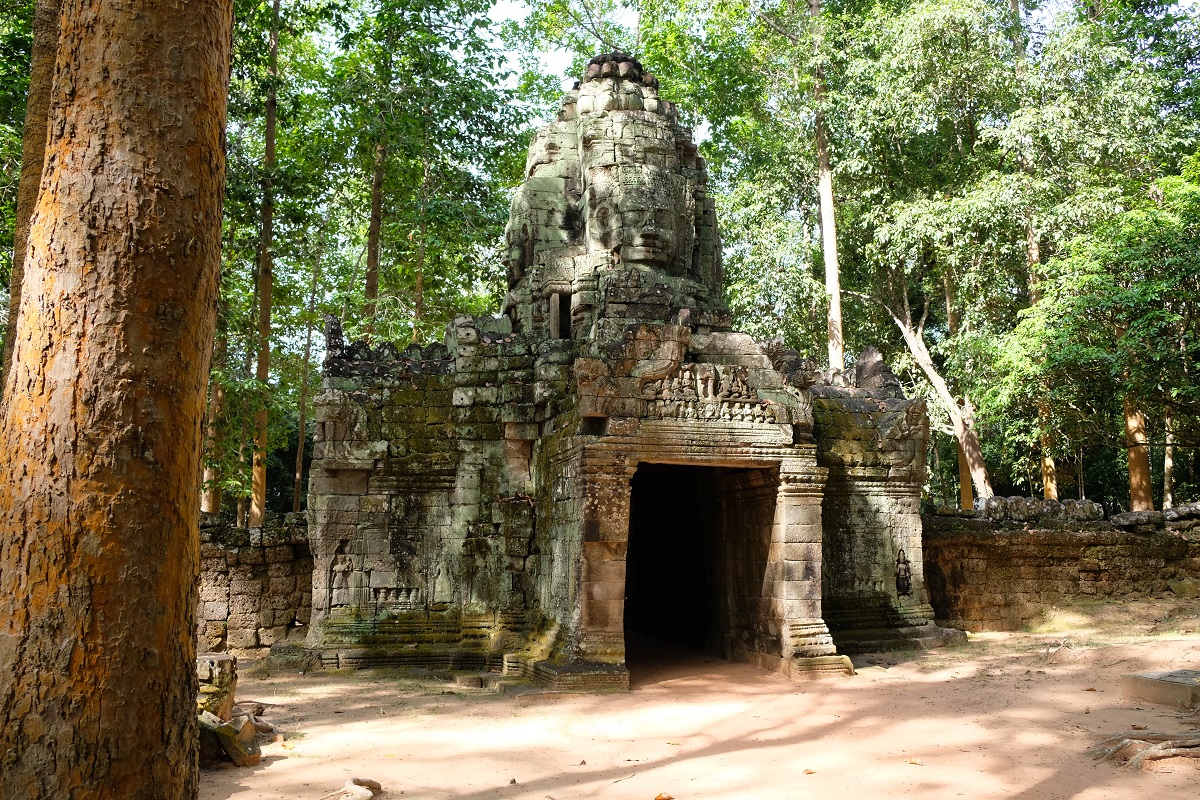
The western gateway of Ta Som
If someone mentions an ancient Khmer temple entangled with giant tree roots, you would probably think of Ta Prohm, the iconic centuries-old ruins that are almost as popular as Angkor Wat itself. And if someone brings up Jayavarman VII, the powerful king who was also a prolific builder, his state temple Bayon with its emblematic enormous faces would probably dominate the conversation. However, there is one temple also constructed under the reign of the same king, bearing architectural and decorative elements similar to those found at Ta Prohm and Bayon, which is much quieter and more peaceful than the other two today.
Known as Ta Som, this relatively modest 12th-century Buddhist sanctuary occupies a plot of land directly to the east of the Jayatataka Baray, a man-made reservoir also commissioned by Jayavarman VII. As we went inside the compound and walked around the structures, I had to pinch myself for not visiting this temple on my first trip to Cambodia thirteen years ago. But back then I was short on time, and this place is located along the so-called Grand Circuit as opposed to the Small Circuit which I explored by bicycle back then.
Unlike Ta Prohm which was built to honor the king’s mother, Ta Som was purportedly constructed to commemorate the king’s father. This begs the question: wasn’t Preah Khan also commissioned by Jayavarman VII to venerate his father? Another theory suggests that Ta Som was actually dedicated to one of the king’s teachers. Will we ever find out the truth? We don’t know. The answer may or may not be hidden somewhere in a corner of this incredibly atmospheric temple.
We walked further on to the eastern end of the complex and were met with a truly remarkable sight. A ficus tree whose original top part seemed to have been chopped off appeared to be strangling the ancient passageway beneath it. This was such a dramatic showcase of humans versus nature. The ancient Khmer people cleared this area of vegetation to build this temple, but nature slowly reclaimed the structures. Its progression was somehow halted or at least controlled by modern conservationists who wish to ensure the survival of these beautiful edifices for many more generations to come. However, the new growths atop the tree signal that Mother Nature will never rest.
We returned to the center of the compound and took our time to marvel at the carvings which some scholars said were created with a higher degree of finesse compared to those found at Ta Som’s contemporaries. It was such bliss to have all these before my eyes with only a handful of other visitors around.
An inscription discovered at nearby Preah Khan mentions a monastic complex called Gaurashrigajaratna (literally “Propitious Holy Elephant Jewel”) which some believe might have referred to Ta Som itself. There were no elephants when we went. But with good weather and the lack of tourists which is usually the norm at the bigger and more famous temples in Angkor, our visit to Ta Som was indeed propitious.

Ta Som’s photogenic eastern passageway

It looks as if the tree is trying to devour the structure

Large faces (purportedly those of Avalokitesvara) are a common feature at temples built by Jayavarman VII

An incredible sight to behold

Entering the main sanctuary from the east

Inside the core compound

It’s amazing to think that these were created almost 900 years ago
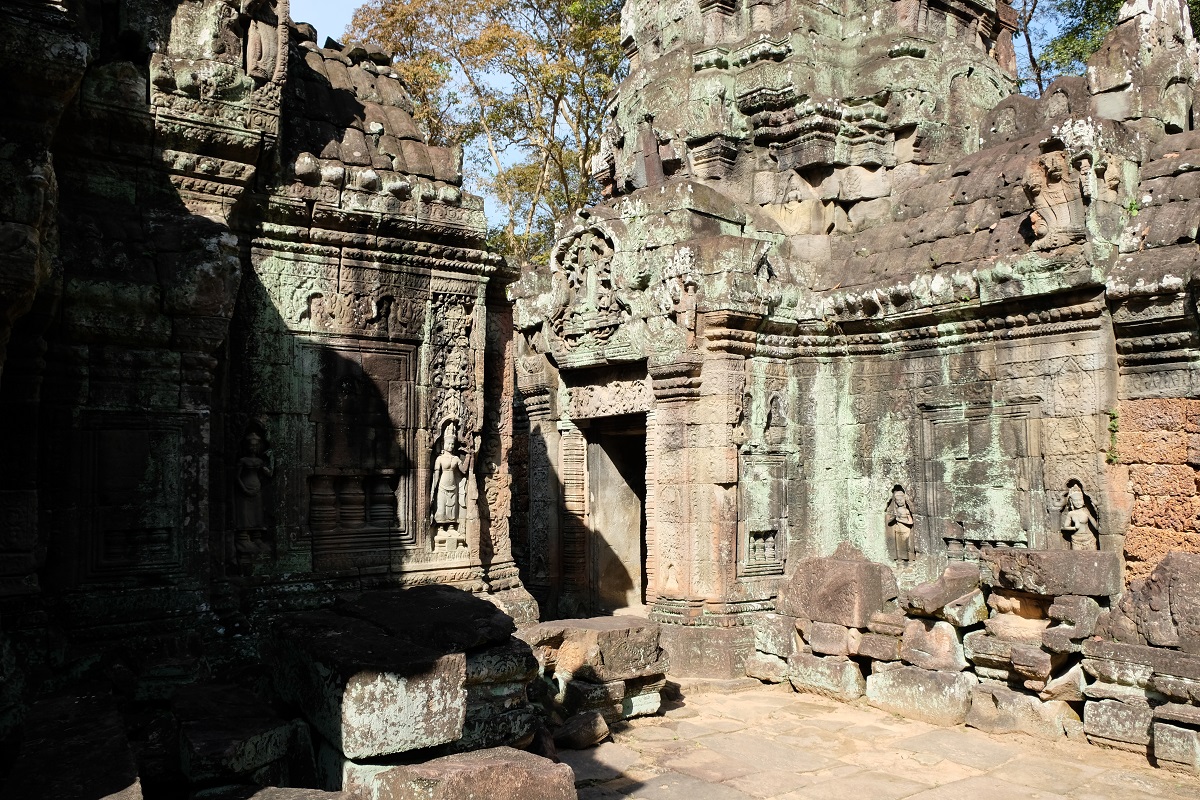
We had the temple almost to ourselves
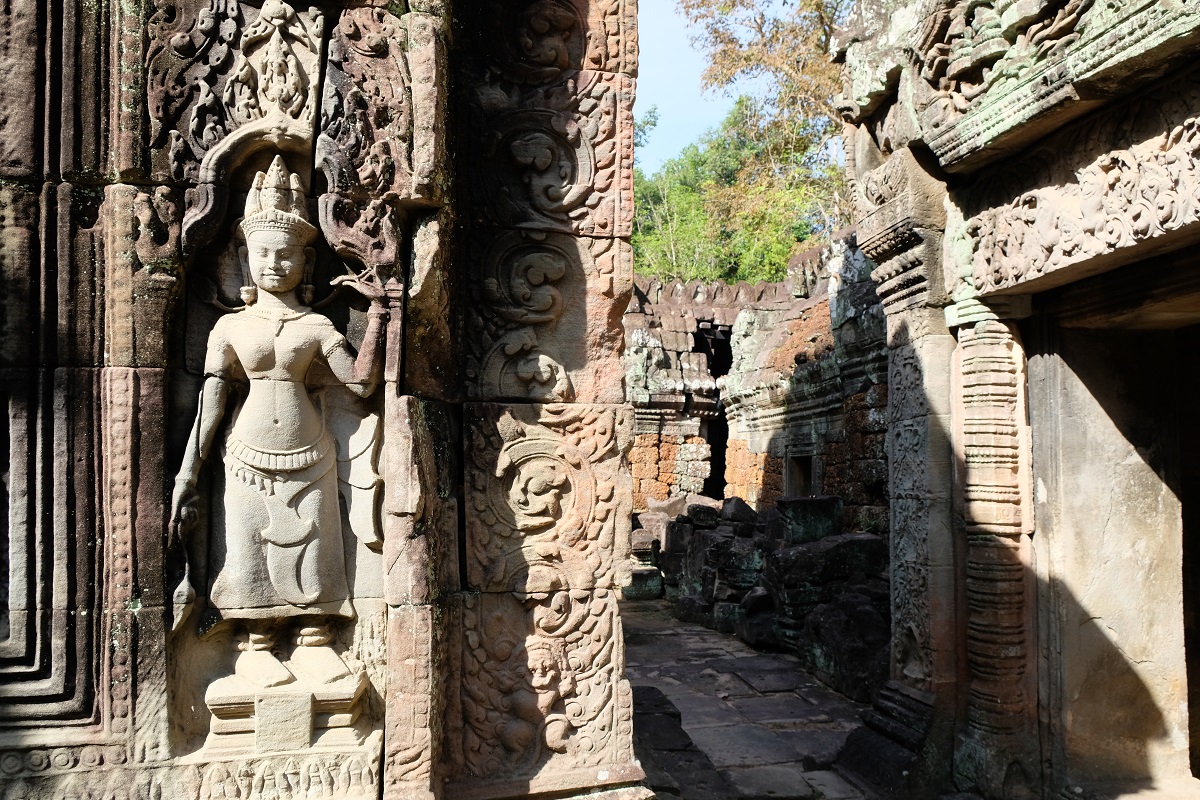
A smiling devata
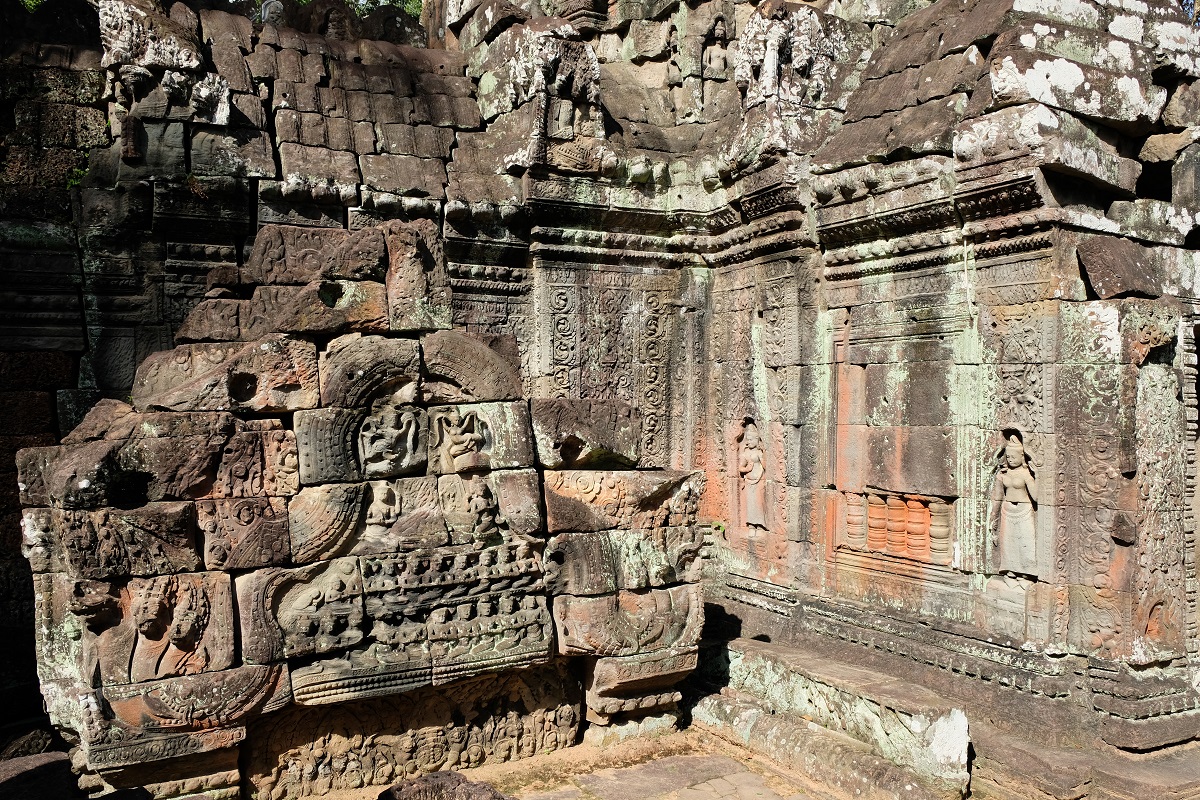
A fallen pediment that for some reason has yet to be restored to its original place
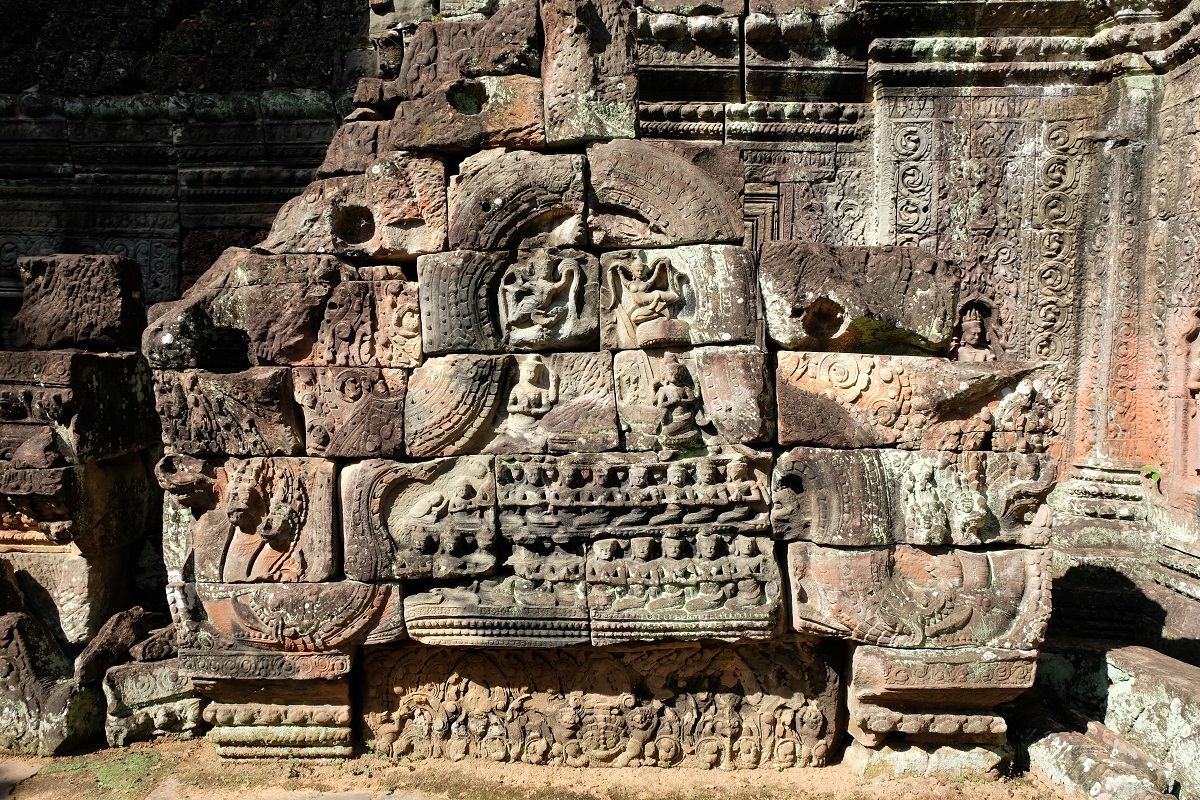
A depiction of Avalokitesvara, the bodhisattva of compassion

Each devata has her own headdress, with the patterns on the garment still discernible on some of them

A sanctuary built by the second Buddhist king of the largely Hindu ancient Khmer Empire

Nature’s slow and gradual takeover of the structures was palpable

The semi-derelict state of Ta Som

 What an Amazing World!
I vaguely recall walking through this site, under and between the jungle’s roots and branches. We had a great tuk tuk driver that took us there. We have almost the same picture as your second one. I remember at the time thinking that this site was better than Ta Prohm, and maybe that was because there was no one else there. Nice to hear it is still a place that the crowds don’t visit. Maggie
LikeLiked by 1 person
Ta Som is now one of my favorite temples in Angkor. Apart from its very photogenic corners, the fact that there were not many other tourists around when I visited really made the experience very satisfying. I hope the temple’s ambiance stays this way for many more years to come.
LikeLiked by 1 person
I think I have only been to Ta Prohm and not to Ta Som. I don’t know because the park seemed to go on forever for days in the hot humidity. These trees probably didn’t exist when these structures were first built. It’s hard for me to picture how different things must have been so many centuries ago. If these walls and trees could talk!!!
LikeLiked by 1 person
It’s true that there are so many temples in Angkor one can get overwhelmed by them. If those walls could talk indeed! I’m always curious about how life was like around ancient temples when they were still used.
LikeLiked by 1 person
Many carvings are still in remarkably good condition considering the age. A fascinating experience and the first photo helped me realize the size of the structure that I otherwise would have imagined as smaller without the tiny person in the foreground.
LikeLiked by 1 person
It never ceases to amaze me whenever I see carvings created centuries and even millennia ago. It makes me think of how long the structures we build and the artwork we make today can last.
LikeLiked by 1 person
Another unknown(for me) find and all the better for it. Btw, do you know the rate of growth of these tree roots? Just curious.
LikeLiked by 1 person
I guess in general trees from the ficus genus grow quite fast, but I have no idea about their exact growth rate. My parents used to have another species of ficus in their front yard. But eventually they had to cut it down because it grew so big it posed a risk to the structural integrity of the house itself.
LikeLike
The site seems uncrowded during your visit, leaving more room for the jungle. The temple can be very crowded, with lines of people trying to take photos at the best spots.
LikeLiked by 1 person
I guess you’re referring to Ta Prohm, which is very popular with tourists now. I think most tour groups include it in their itineraries of must-see places in Angkor, apart from Angkor Wat of course. Ta Som, on the other hand, was a world away from Ta Prohm. It was very peaceful and there were no wooden platforms for photos in front of those giant roots like in Ta Prohm.
LikeLiked by 1 person
I’m ashamed, you’re absolutely right, I confused it with Ta Prohm. The victory of the roots over the stone walls shows the balance of power over time.
LikeLiked by 1 person
No please, there’s no need to feel ashamed. Ta Prohm is so iconic it’s what we immediately think of when we see images of ancient temples strangled by giant tree roots.
LikeLike
Another beautiful post in this series!
LikeLiked by 2 people
I hope you went to this temple as well during your trip to Cambodia, Anna. But if you didn’t, you can always go back. 😃
LikeLike
I saw so many I honestly can’t remember! lol. I’d have to look over my notes… I’m getting old Bama, I can’t remember everything! 🤣
LikeLiked by 1 person
Lol! Same here. Sometimes I forget what someone said to me a few minutes earlier.
LikeLiked by 1 person
Truly, it’s wondrous just how ancient civilizations have built such intricate temples as a place to worship and find peace in this loud and chaotic world. Ta Som is no exception: I’ve not heard of it, but now I’d love to visit it some day. Thanks for sharing this incredible wonder, Bama!
LikeLiked by 1 person
Even with mass tourism, I’m glad that places like Ta Som still exist. They provide a respite from the huge crowds of the more popular sites in Angkor. I remember how quiet and magical this particular temple was when I went.
LikeLiked by 2 people
Lovely tour, Bama. It is indeed amazing and inspiring how this sanctuary is almost 1,000 years old and has stood the test of time. A craftsmanship that is lost in the passage of time.
Mother Nature is amazing in how it slowly reclaims its environment. Makes you wonder what else was lost through time and what has endured.
LikeLiked by 1 person
While it is nice that we can still see these structures today, it’s also very sad to think that the things we create now are often nowhere near as refined as what the ancient people made.
I do wonder a lot about all the temples that have been forgotten. Many of them are still hidden beneath thick jungles, or modern structures.
LikeLiked by 1 person
It’s nice that you were able to return to Cambodia and explore some of the other smaller temples like this one. I love how some of the trees are growing through and around the structures. Goes to show just how resilient nature is.
LikeLiked by 1 person
Oh this was from December 2022, Linda. It took me a really long time to finally write these last posts on that trip to Cambodia — I blame all the stories from the other places I went to last year and earlier this year for the delay! 😁
The tall trees really made the setting more atmospheric and mysterious. Angkor is just one great place to explore!
LikeLiked by 1 person
So well preserved. Amazing!
LikeLiked by 1 person
Amazing really is the right word to describe the temples in Angkor. I hope you’ll get to see them one day!
LikeLike
What a sight that tree is devouring the ancient construction. And what work went onto that construction! The carvings are beautiful, and reverential. The whole place must have been amazing in its time. Lovely story Bama.
Alison
LikeLiked by 1 person
When the ancient Khmer people built their temples, their imagination was limitless. What remain now are a boon to humanity. It is imperative to ensure that places like Ta Som will still be standing for many more generations to come. Thanks Alison.
LikeLiked by 1 person
It is always fantastic when one can escape the grounds, and have a gorgeous temple like that almost to yourself. The way the trees intertwine with these structures is truly an amazing sight, and one I will never tire of.
LikeLiked by 1 person
Did you visit Ta Som on your past trip to Cambodia? I wonder how the temple compound was like decades ago. The sights of those giant trees and the ancient structures are also something I don’t think I’ll ever get bored of.
LikeLike
I did, although I cannot remember it clearly, Bama, as all those memories are a bit of a jumble in my head. When I get home, I should find the external drive with my photos on and have a look at what it looked like then, compared to when you visited. I spent 8 days in Siem Reap, and made a point of visiting every single temple, including the ones some distance away. I managed a good balance by ‘tempeling’ in the morning, and spending the afternoon in a hammock next to the swimming pool of the hotel I stayed in. It was one of my best trips ever.
LikeLiked by 1 person
Your time to Siem Reap really sounds like a perfect trip! Funny thing is there was also a swimming pool at the hotel where I stayed. But I don’t know why I never used it.
LikeLike
I’m not a big fan of swimming, but I was there at the beginning of February, so it was hot, and I adored the hammocks they had, so I would jump into the water, and then spent my time in the hammock reading until I was dry, repeating the process a couple of times while also enjoying the free tea and snacks they provided. Total bliss. I almost never otherwise make use of hotel pools. This really was an exception, and perhaps also the reason it stands out in my memory. Those hammocks were so wonderful that I bought two in the market. I hope to by next year summer have found a place for them on the quinta to take siestas in during those brutal afternoon hours. And I’m sure I will remember my time in Siem Reap every time I use them.
LikeLiked by 1 person
That makes sense. Taking a dip when it’s hot is always a good idea. I remember you mentioning about the hammocks and your plan to put them somewhere in the quinta. I wonder if the cats will love them too.
LikeLiked by 1 person
This is fascinating and I love the history of this place. I feel a bit sad that nature is taking back the temple but there is a stark beauty to this.
You know, if you were my history teacher, I would have gotten better marks at school.
LikeLiked by 1 person
I understand why you feel that way. Knowing how over time nature eats away the stone slabs and blocks that make up a temple, I often wonder how the structure will look like decades and even centuries from now. That’s why I think we need to appreciate places like this while we can.
Ha! You’re too kind, Matt. The thing is I’m better at conveying my thoughts in writing than over speech.
LikeLiked by 1 person
Bama, I’m so glad you asked Vonn to take us to Ta Som while we were temple-hopping around Angkor. It felt so peaceful and undiscovered and I was surprised at the small handful of other visitors roaming the grounds. The compound’s forest setting, combined with its semi-ruined and partly overgrown state, made it even more charming. I remember I was taking pictures of the main structure when you came back and gestured for me to walk farther out to see something – getting that first glimpse of the eastern gateway with the ficus tree growing out of it was really a magical moment.
LikeLiked by 1 person
I didn’t expect to enjoy Ta Som so much. All I knew was this temple seemed worth checking out based on the photos I saw on the internet. I don’t remember what made me walk further to the end of the compound — maybe I saw someone did that and decided to follow that person — but I’m glad I did. The eastern gateway of Ta Som is easily one of the most photogenic structures in the entire Angkor archaeological complex.
LikeLiked by 1 person