
Tháp Bánh ĺt (Banh It Tower), an ancient Cham temple compound built between the 11th – 12th centuries CE
Across the globe, many ancient civilizations are still remembered by people today thanks to their achievements, or unique characters, or inspiring stories (whether they were true or not) that have been passed on for generations. However, in a world where physical appearance often overshadows other qualities, it’s natural for us to remember those who left great monuments better than those who didn’t.
Mention the ancient Egyptians and the ancient Maya, and their respective pyramids, distinct from one another, immediately come to mind. Speaking of the ancient Greeks, the Parthenon will probably be the first thing that pops up in most people’s heads. And when one brings up the ancient Khmer, I bet Angkor Wat is that one monument we would likely associate them with.
How about civilizations from hundreds and thousands of years ago who left ‘only’ relatively modest structures than their more famous contemporaries?
Regular readers of this blog might have noticed that in some of the posts of the ongoing series on the Khmer Empire, there is one kingdom that has been mentioned several times: Champa, land of the Chams. Who were they? Why do we know much less about them than their Angkorian counterparts? What other information have we understood so far apart from the fact that they used to settle in what is now the southern-central regions of Vietnam?
As I was delving into the history of Champa following my trip to Vietnam in early April, it turned out finding reliable online sources in English about them has been more challenging than I previously thought. Compared to the plethora of information about the Khmer Empire, most searches about Champa ended up showing results in Vietnamese, although thanks to Google Translate we are now mostly able to understand web pages written in foreign languages. While there are multiple reasons for this scarcity of information about Champa, in my opinion one of the contributing factors to the lack of attention to their history, especially from a foreign audience, is the perceived absence of ancient monumental edifices of the Cham people as opposed to what we can see in Cambodia today. But as a kingdom often mentioned in the history of the Khmer Empire, so much so there are depictions of the ancient Chams in a few Khmer temples, did Champa really leave nothing?
Before answering that question, let’s go back further in time. It is believed that more than two thousand years ago some groups of Austronesians from Borneo – the progenitors of the ancient Cham people – migrated to what is now the coastal regions of southern-central Vietnam. Back in the day, Austronesian peoples were skilled seafarers, known for their audacity and curiosity to explore the oceans, as beautifully illustrated in the animated movie Moana (here’s a link to the Disney film’s dramatic visualization of how ancient Austronesians roamed the oceans and looked at the stars to find out where they were – watching this always gives me goosebumps).
The Austronesians explored uncharted waters to discover new islands and build new communities on them. Using only outrigger canoes, their geographical reach spanned vast areas of the planet, from Taiwan to Hawai’i and Aotearoa (New Zealand). They also managed to get to remote lands as far as Madagascar off the eastern coast of Africa as well as Rapa Nui (Easter Island) which is now part of Chile. How did researchers come to the conclusion that the Cham people are also part of the Austronesian family? One of the most compelling pieces of evidence for this is the language they spoke (and still do) which is more closely related to the languages of Maritime Southeast Asia (spoken in countries like Indonesia, Malaysia, and the Philippines) than to Vietnamese.
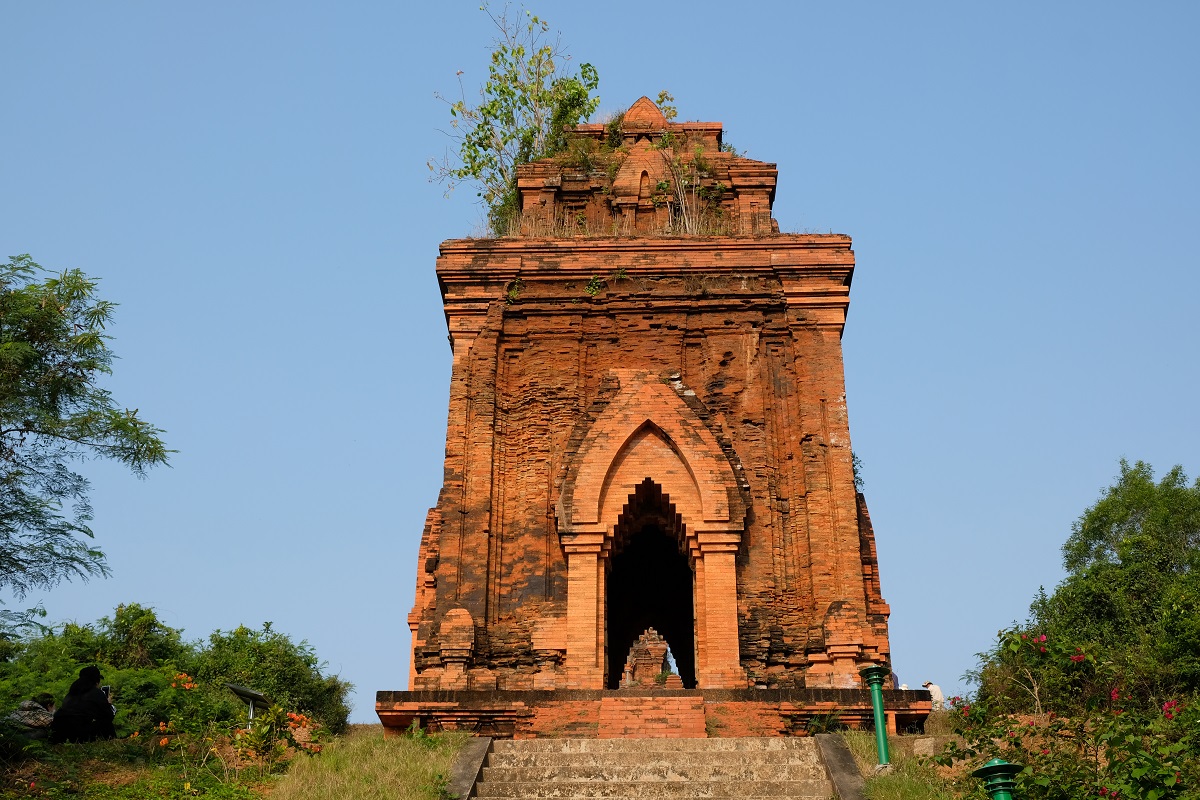
The gopura (main gateway) with a view of the kalan (sanctuary)
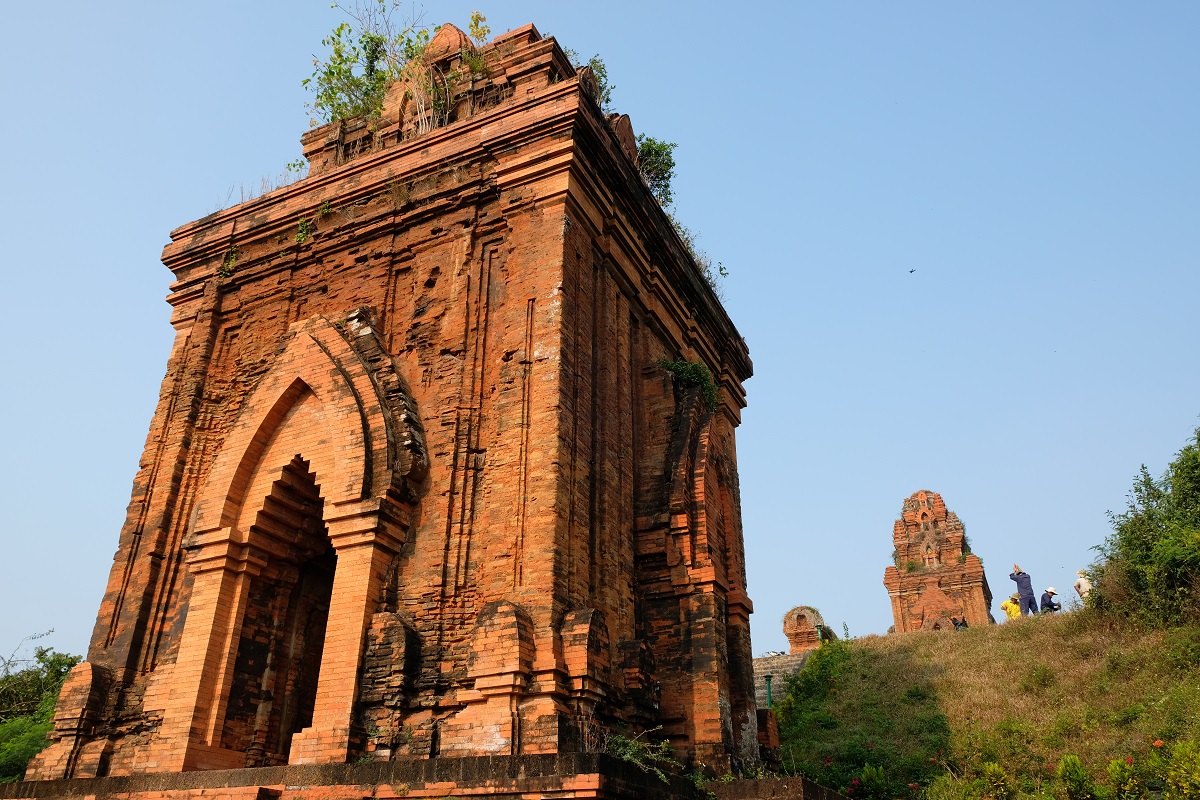
The gopura (left), the kosagrha (center), and the kalan
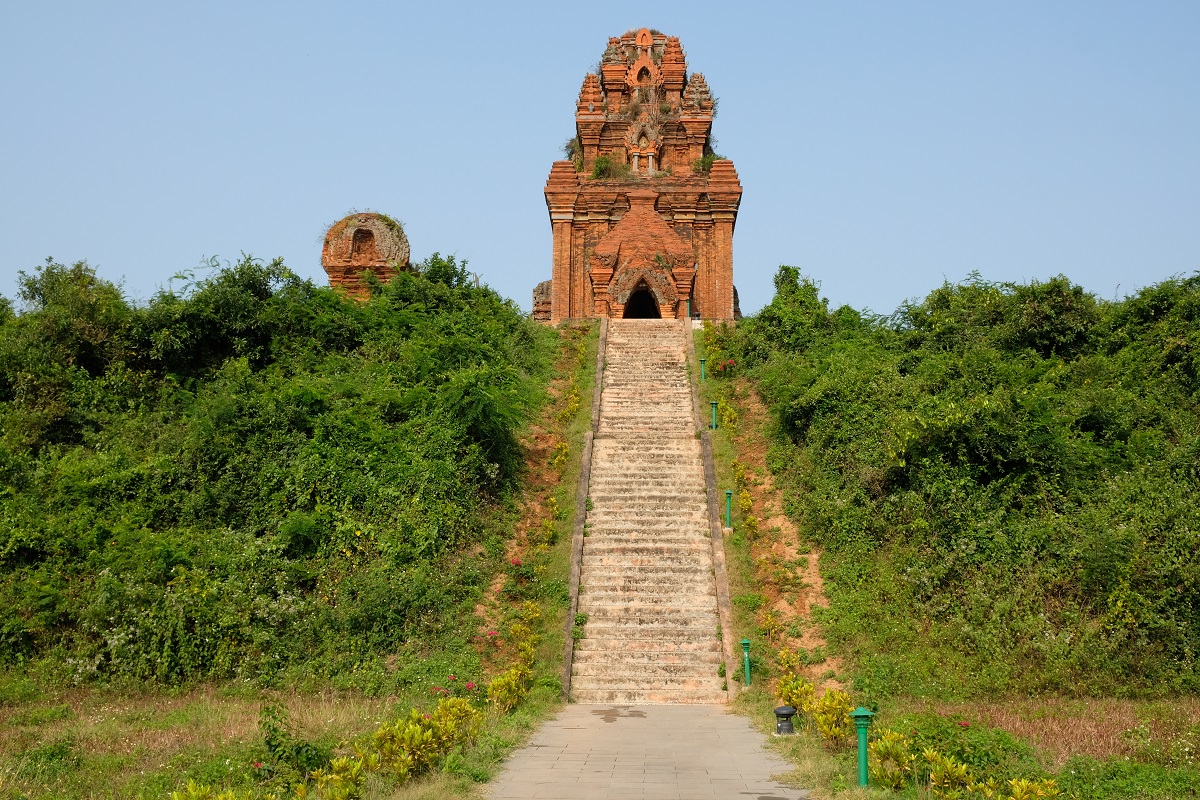
Situated on top of a hill, this temple compound is visible from the highway below
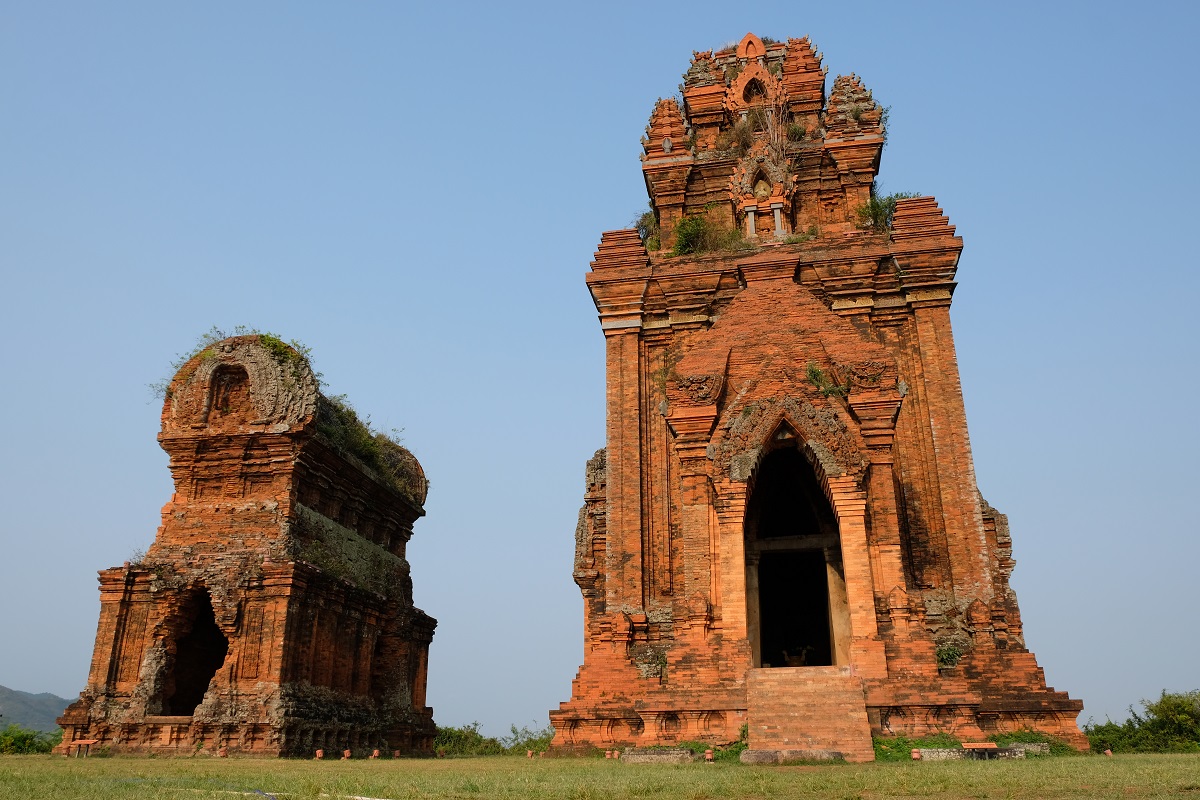
The kosagrha and kalan of Tháp Bánh ĺt
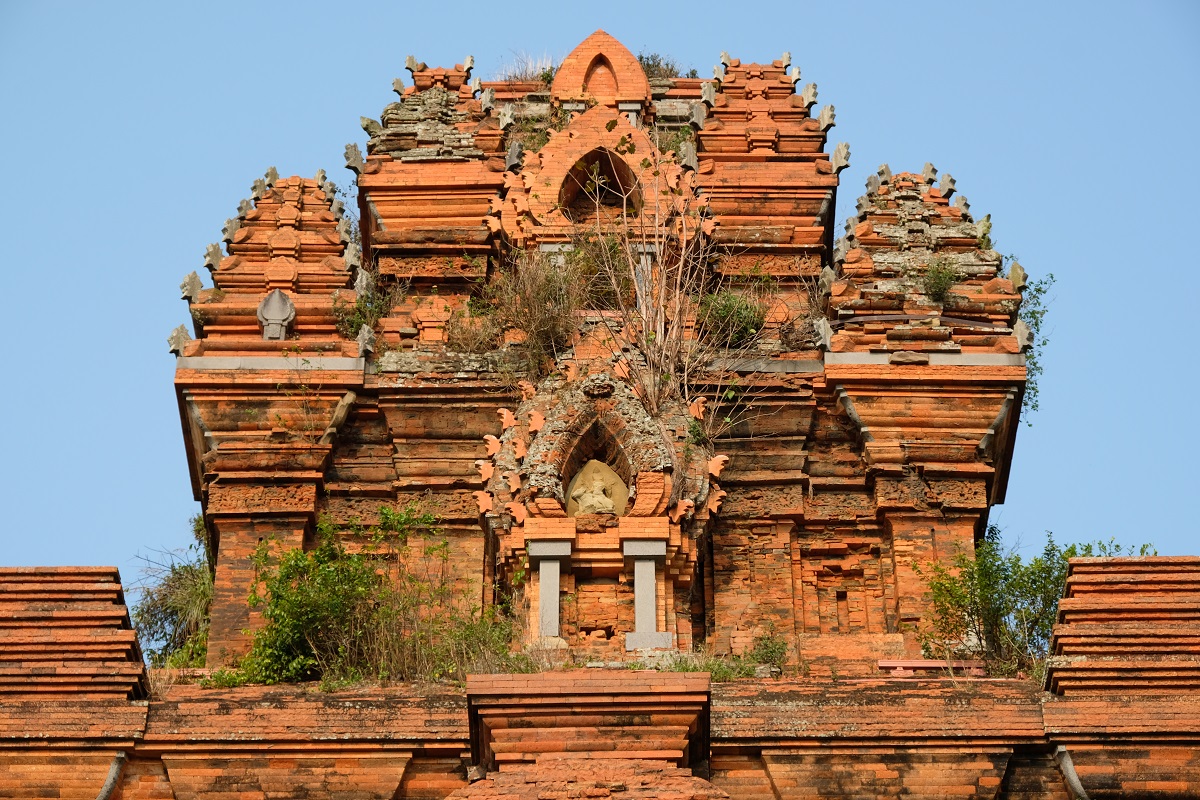
The pinnacle of the kalan showing the distinctive Cham architectural style

A replica of Shiva inside the kalan (the original is kept at the Musée Guimet in Paris)

The kosagrha overlooking the surrounding hills
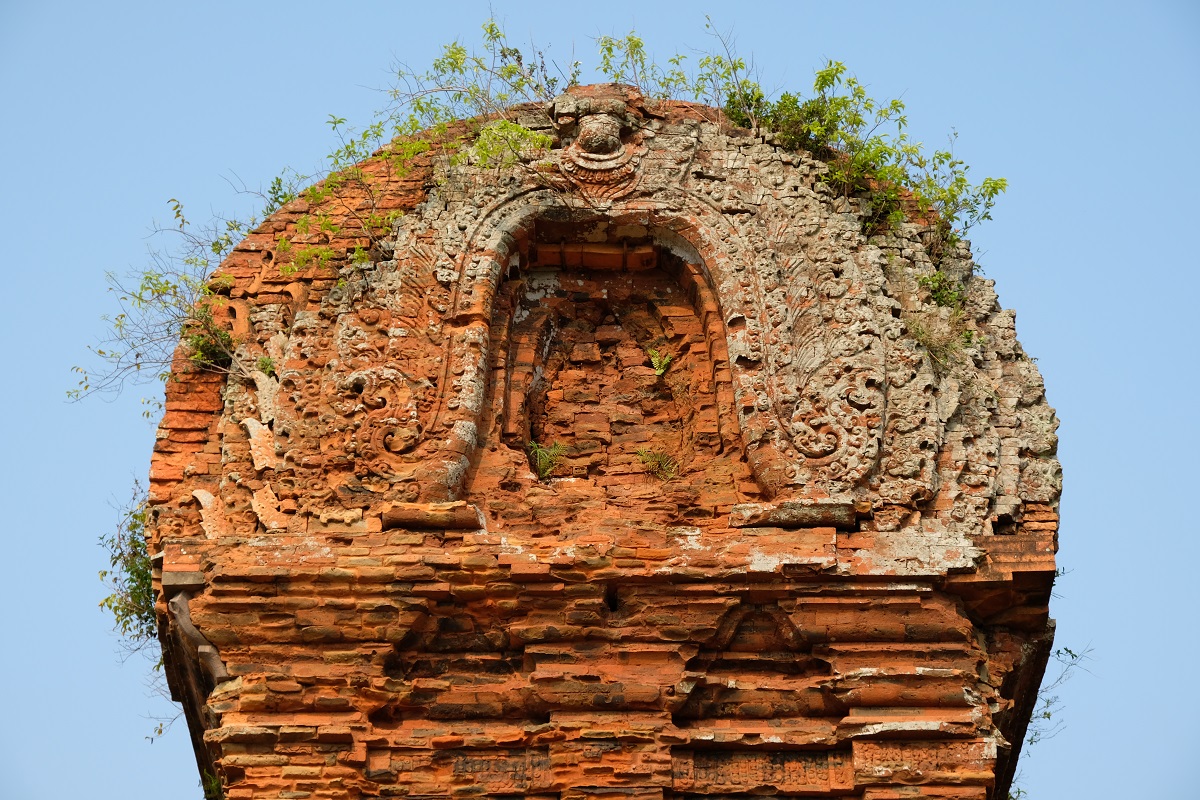
The kosagrha’s worn out pediment
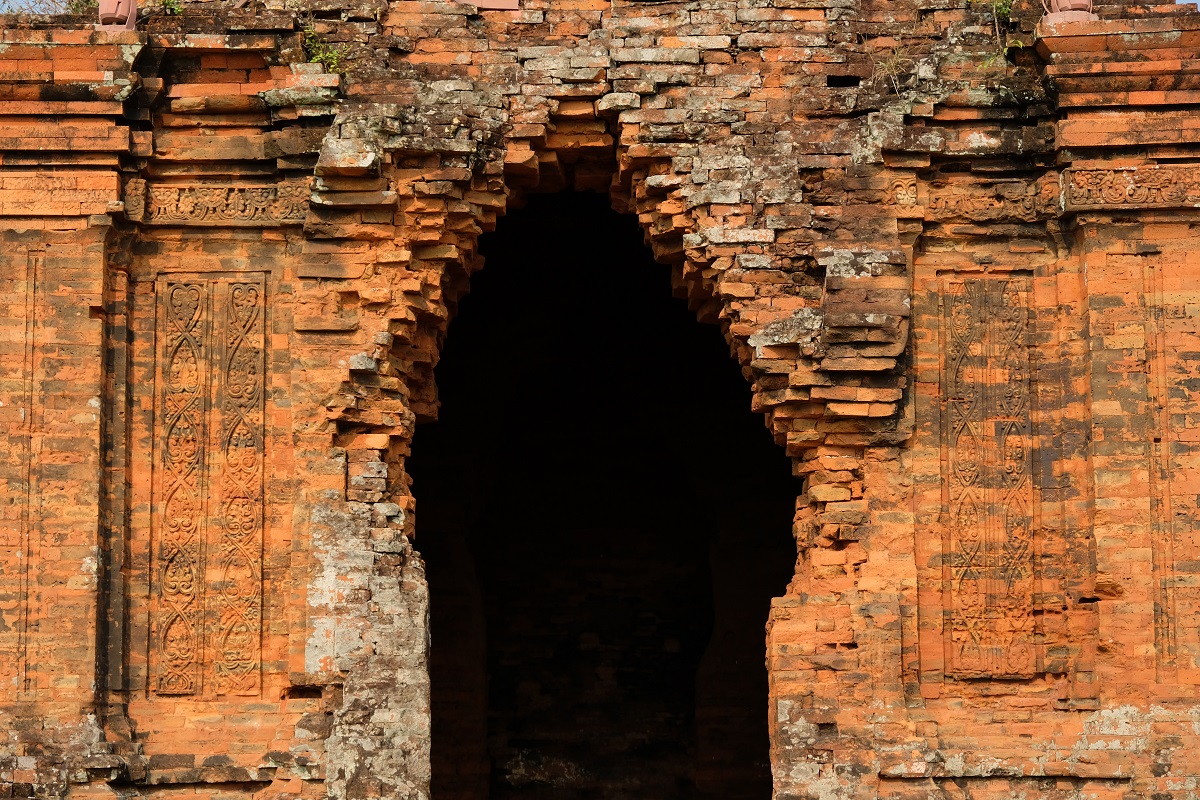
Floral motifs directly carved onto the red bricks
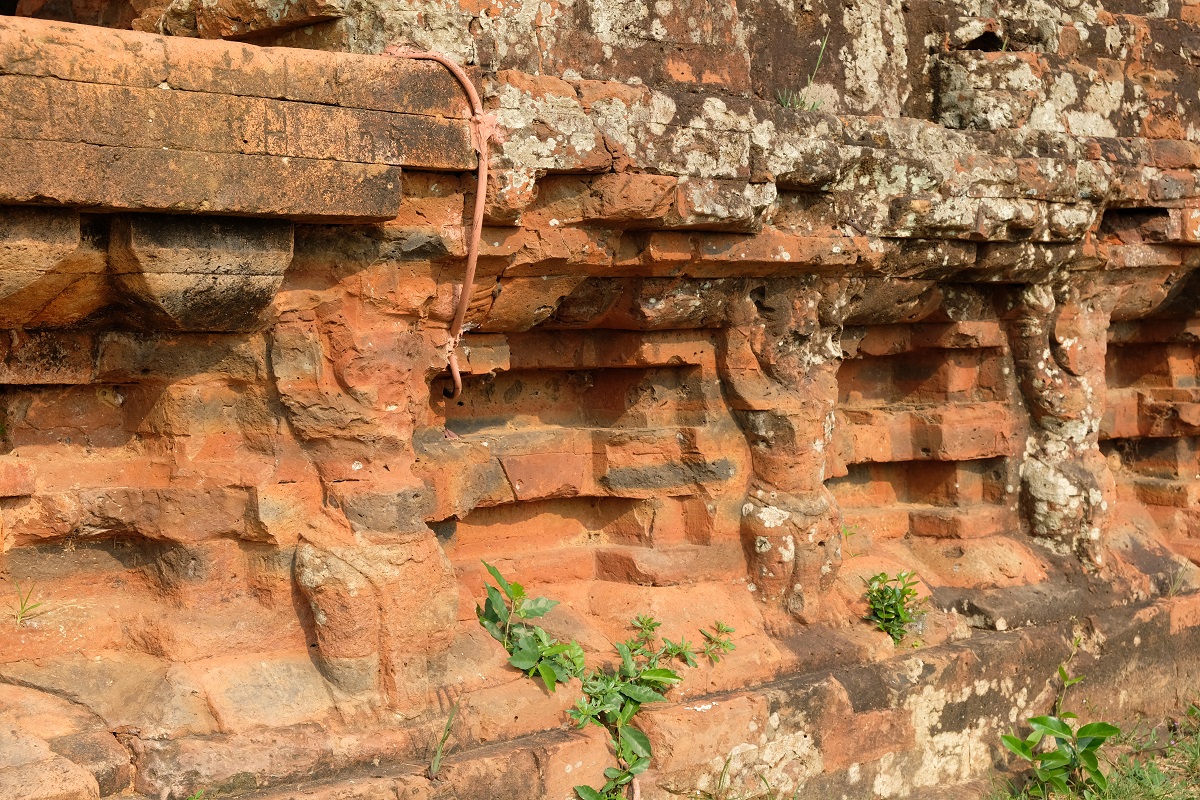
Badly eroded figures (probably lions) around the base of the kosagrha
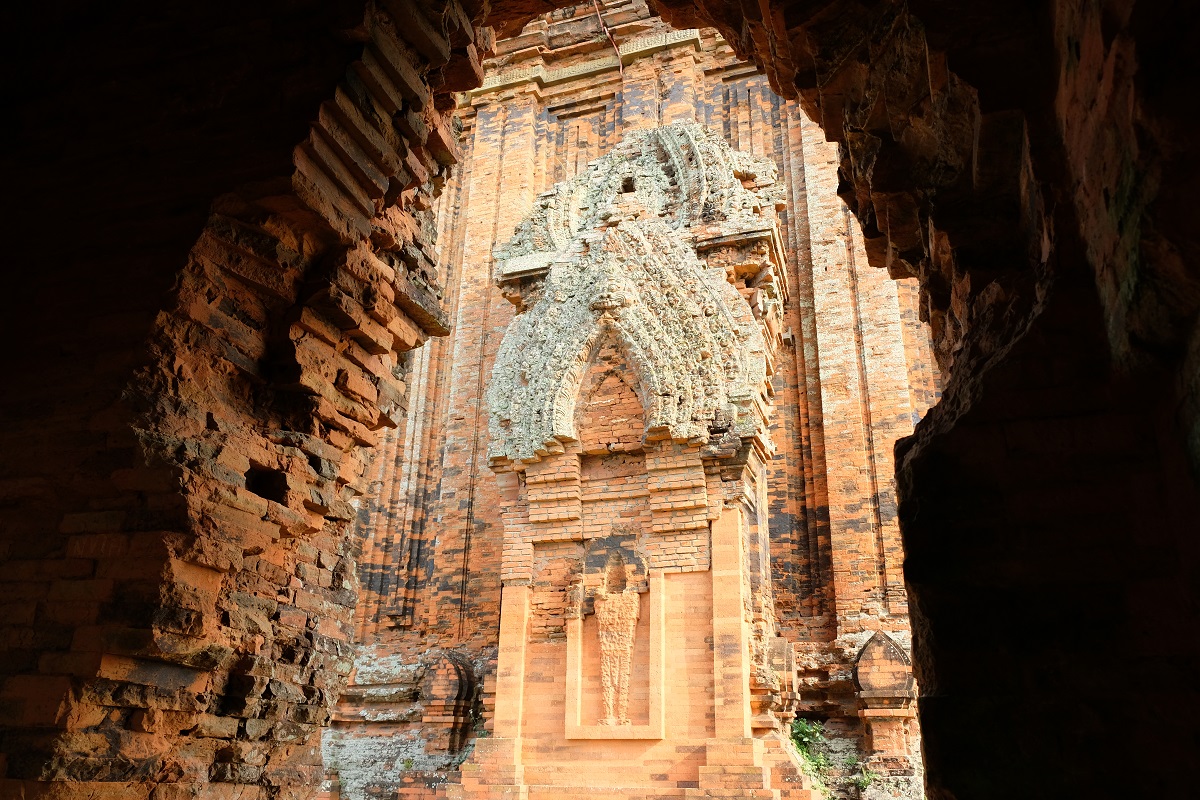
Looking at the other side
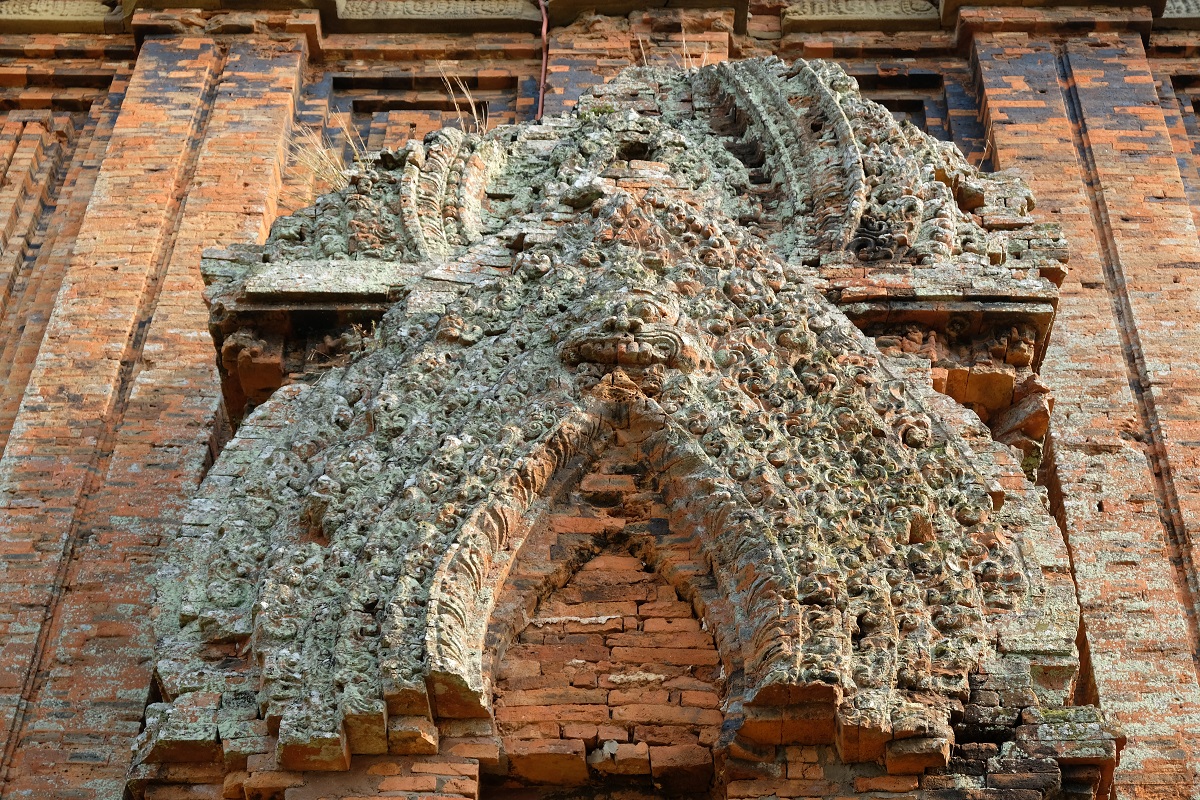
A fierce-looking kala/kirtimukha on the southern façade of the kalan
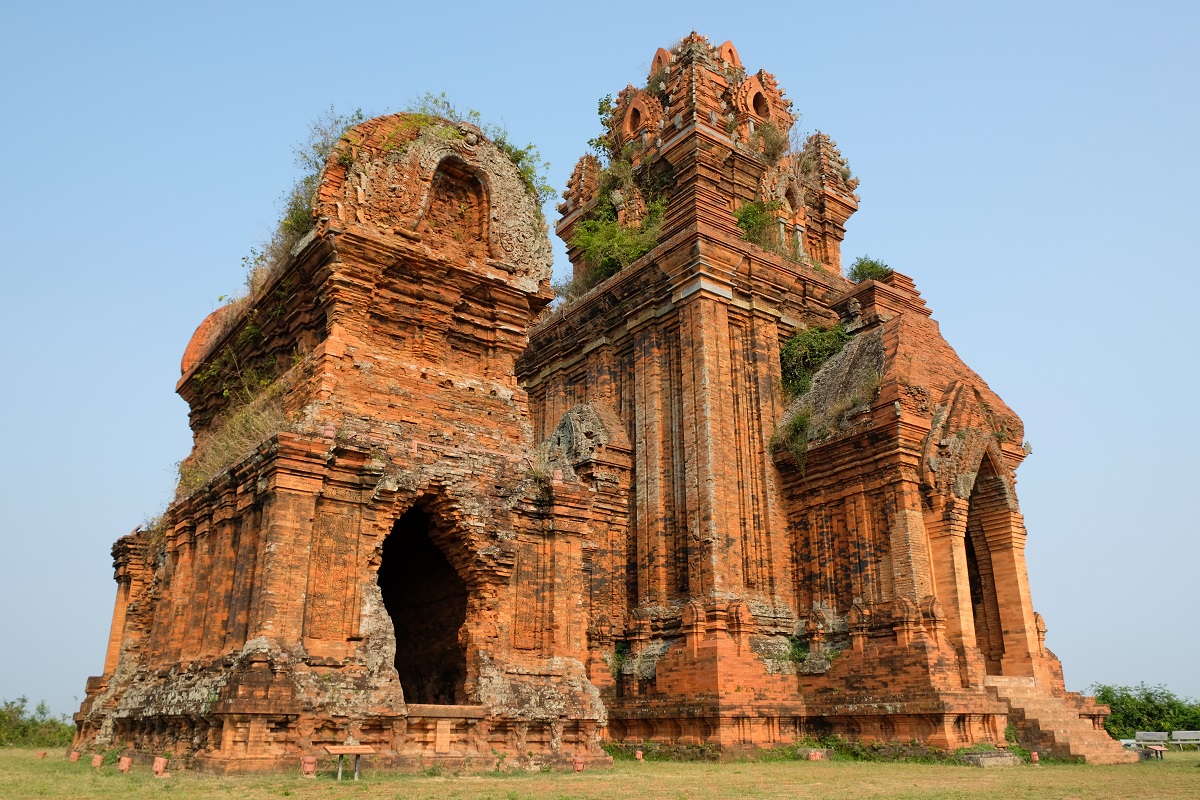
A view of the central structures of the Tháp Bánh ĺt temple compound
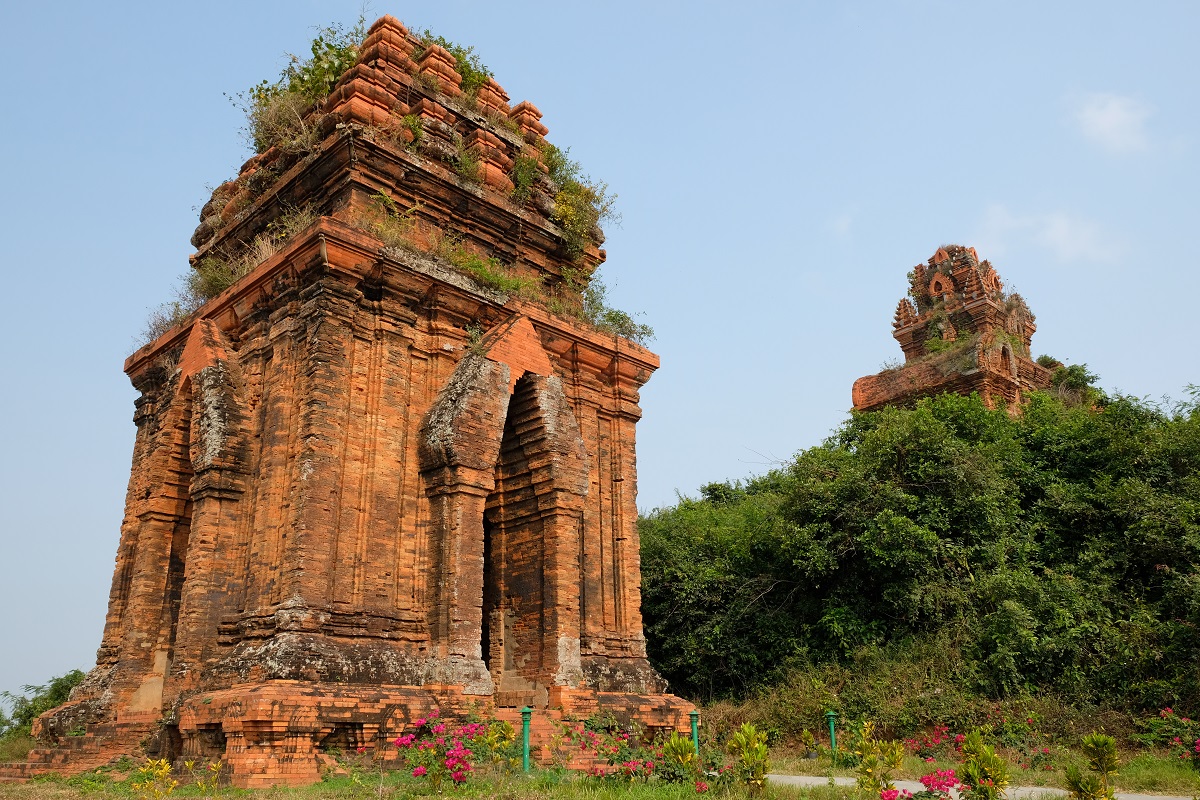
The posah (stele tower) directly south of the kosagrha
Over the centuries, the Cham people began to organize themselves and formed entities that would eventually become principalities forming a sort of loose confederation we now know as Champa. Traditionally, the kingdom comprised five major regions called (contiguously from north to south) Indrapura, Amaravati, Vijaya, Kauthara, and Panduranga that stretched along the coasts of present-day southern-central Vietnam. If you think the names sound Hindu, that’s because the Chams were in fact adherents of Hinduism, just like their contemporaries: the Khmer to the west, and the Javanese all the way to the south across the seas, among others.
At first, Indrapura in the northern part of Champa became the center of Cham civilization, and naturally this was where they built their grandest and most impressive temple with the ancient sanctuary of My Son (Mỹ Sơn) as the magnum opus of this society. This compound, located not too far from the charming town of Hoi An, happens to be one of the most famous ancient sites in modern-day Vietnam, thanks to the decision taken by UNESCO in 1999 to inscribe it onto the World Heritage list. I was fortunate to be able to visit this site back in 2017, and it was easy to see why it was awarded the coveted title: the architectural style is unique and distinct from other Hindu temples in the region; and the reliefs were ornate and delicate, skillfully carved onto red bricks and sandstone, two main materials used for constructing most Cham temples. Its history, however, was marred by the tragedy that occurred when the U.S. carpet-bombed this part of Vietnam, causing irreversible damage to some structures within the My Son compound.
While initially a nation of seafarers, Champa grew powerful by establishing trade relations with other empires and kingdoms, chiefly in East and Southeast Asia. And naturally, cross-border economic activities also brought about cultural exchanges, encompassing everything from religious teachings, sculpting techniques, and artistic inspirations. This is evident in the artifacts and monuments the ancient Cham people left where influences from ancient Cambodia and Java, among other places, can be traced. Due to their geographical proximity, the nature of relations between the Khmer Empire and Champa – both were predominantly Hindu nations – was just like that of many neighboring countries today: sometimes it was amicable, but tensions could flare up at any time.
Despite being the beating heart of the Cham civilization for centuries, Indrapura’s location in the upper regions of Champa close to the border with Dai Viet (Đại Việt), a monarchy of the Viet people (predecessors of the ethnic majority of modern-day Vietnam), made it susceptible to incursions from the north. Over the course of centuries, while the Hindu temples in Indrapura remained among the most sacred in the entire domains of the Cham people, the political center of Champa gradually moved southward, away from Dai Viet – but closer to Angkor, the capital of the Khmer Empire. When Vijaya became Champa’s center of power from the 12th until the 15th centuries CE, the Cham civilization was arguably at its peak. But this also marked a period of heightened tensions between Champa and its two immediate neighbors to the north and the west: Dai Viet and the Khmer Empire, respectively.
Being the former capital of Champa (or more precisely the mandala of Champa since the kingdom was never really unified under one central command), Vijaya intrigued me the most. I was curious about what the Cham people had built in and around it. However, unlike My Son, the Cham temples near ancient Vijaya are today rather off the beaten track, reachable from a city more popular among local Vietnamese than foreign visitors. But I was determined. After all, having read over and over again about Champa and its rocky relations with the Khmer Empire, I had to see what else the Chams built apart from My Son. Convincing James to take this journey with me proved to be easy since Quy Nhon (Quy Nhơn) – the closest big city to the ancient sites I wanted to see – seemed to be a lovely and picturesque place, and this part of Vietnam has many seemingly delicious regional specialties for us to try. Also, our fond memories of the country from that previous trip in 2017 certainly helped.
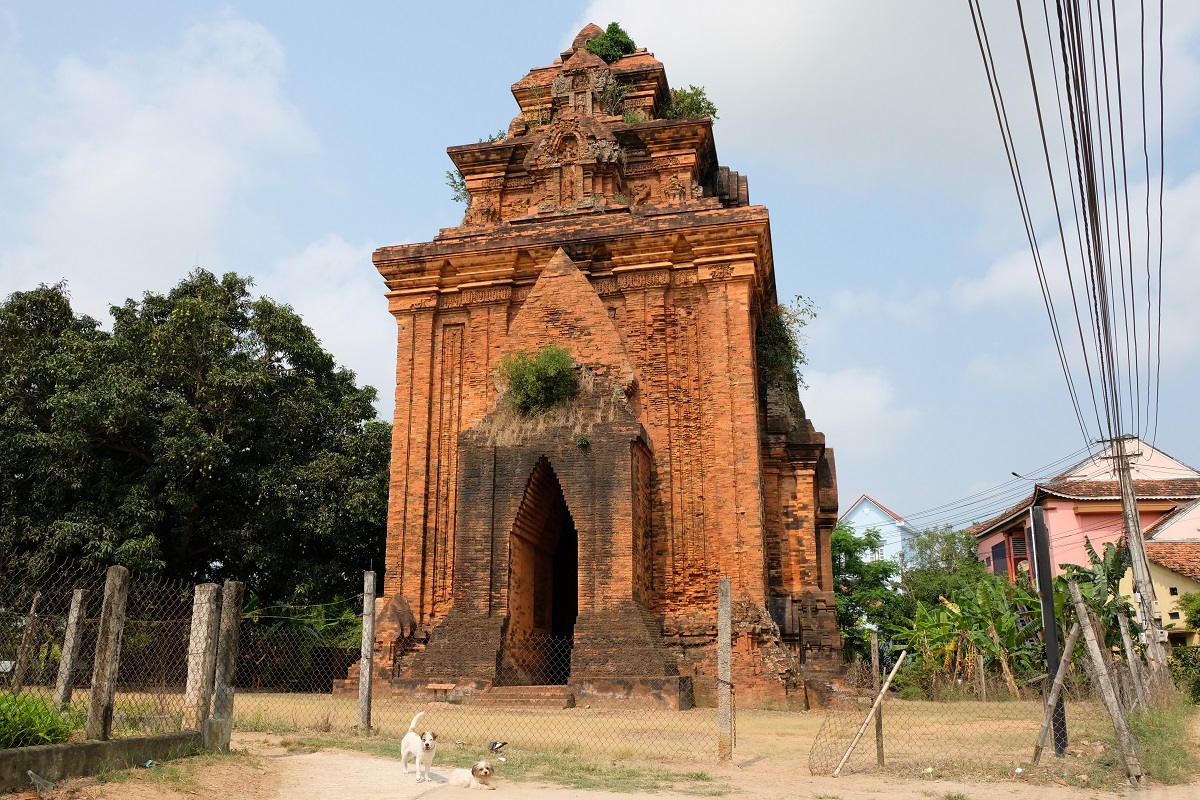
Tháp Bình Lâm (Binh Lam Tower) in the middle of a village (with two cute local residents)
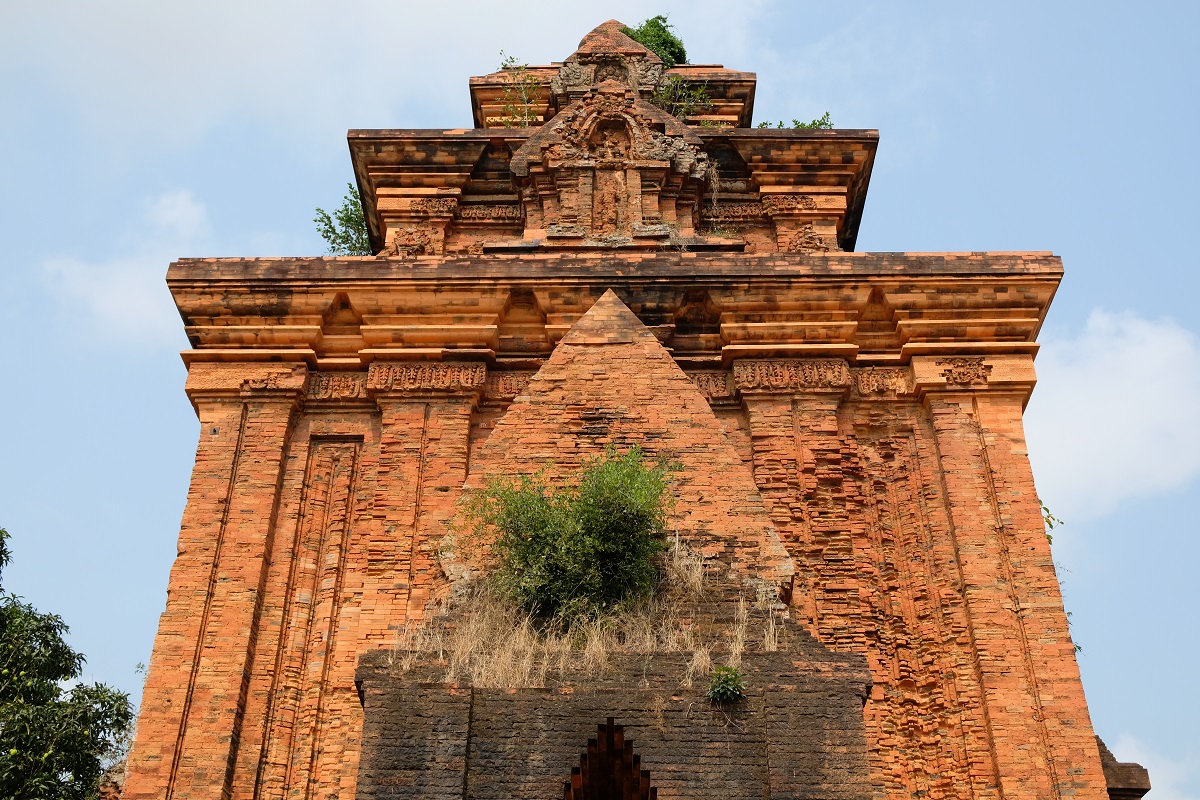
Unlike most Cham temples near Vijaya, Tháp Bình Lâm was not built on top of a hill
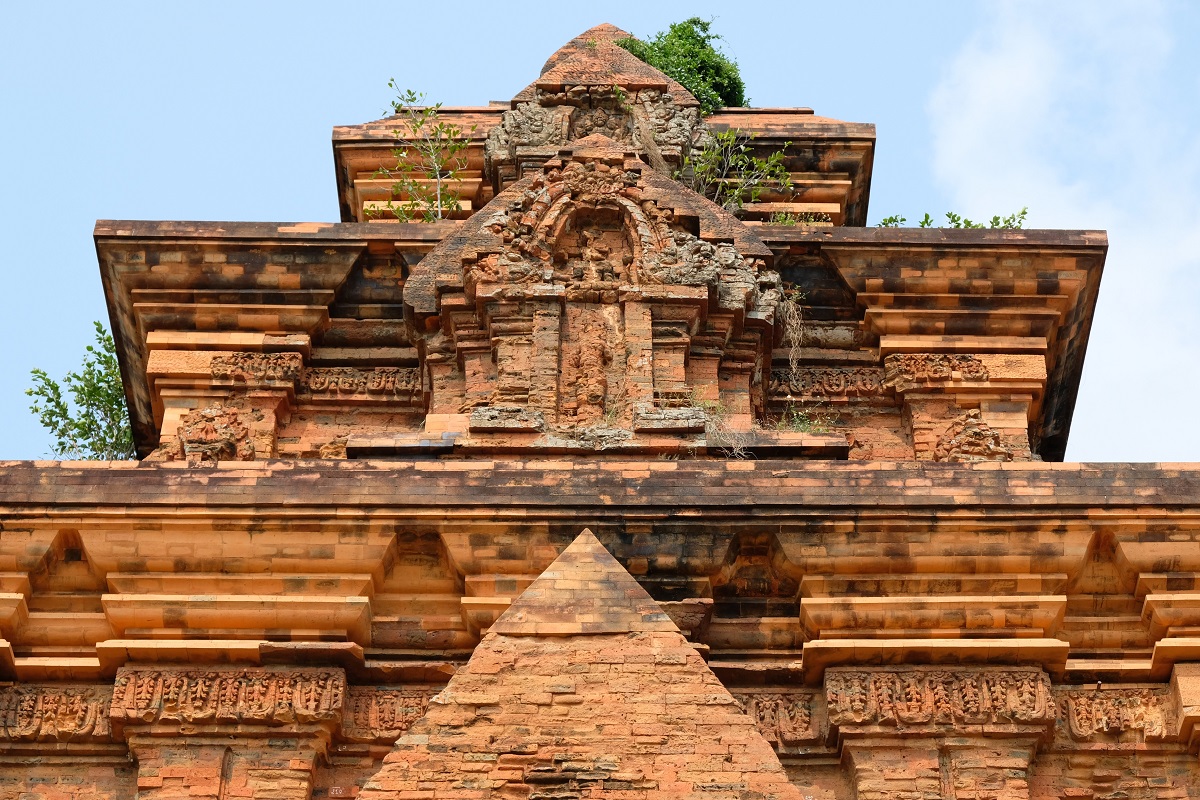
Still standing since the 11th century
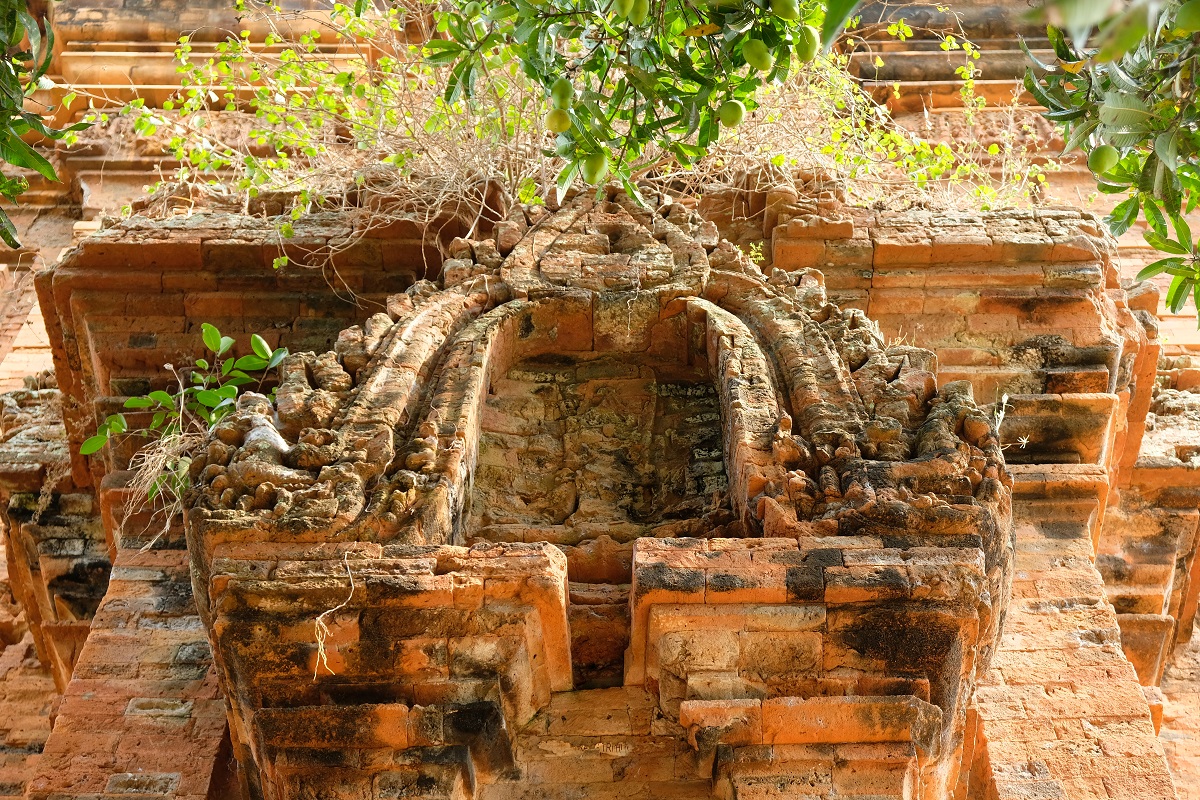
Faded but not forgotten
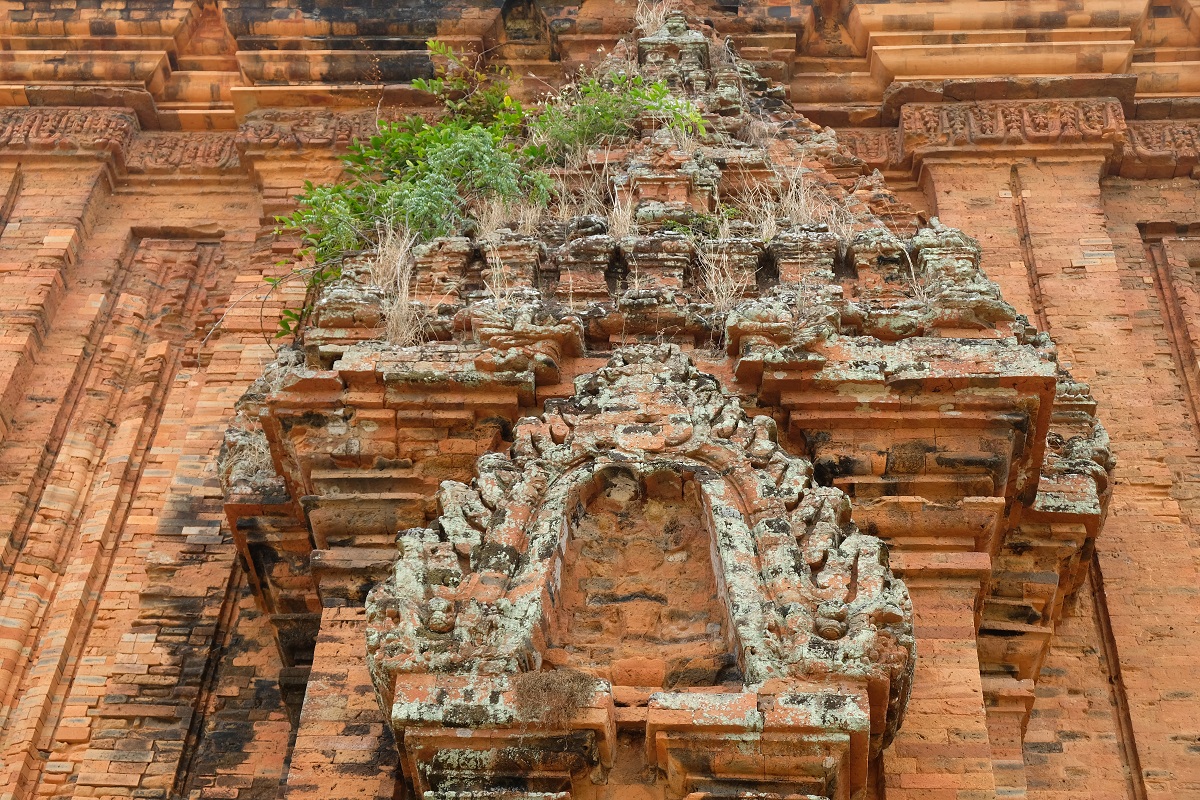
Imagine how this must have looked during the temple’s heyday
From Jakarta, we had to fly to Saigon first and spend a few days in the economic heart of Vietnam before flying to the small Phu Cat (Phù Cát) Airport which serves Bình Định Province (of which Quy Nhon is the capital). While the journey wasn’t straightforward, it gave us enough time to pay a visit to the Ho Chi Minh City Museum of History in Saigon which houses one of the biggest collections of Cham sculptures in the country. It’s always nice to see some of the finest works procured and salvaged from ancient sites, but nothing beats seeing the real monuments up close in person.
A few days later, as our taxi was approaching the outskirts of Quy Nhon, a man-made structure suddenly appeared on top of a verdant hill to the left of the main highway, a break after the seemingly endless vistas of ripening rice paddies, majestic mountains, and church-studded villages we had been seeing since we left the airport. Its red bricks were discernible from its green surroundings, and the outline of its pinnacle was a telltale sign of the skilled hands who crafted this work of art many centuries ago. The following morning, on our first full day in this city, off we went to see our first ancient Cham temple in this part of Vietnam.
Known to the locals as Tháp Bánh ĺt (Banh It Tower), this complex of temples is estimated to have been built around the 11th to the 12th centuries. The hilltop location is attributed to the ancient Cham people’s penchant for constructing sacred buildings at high locations, probably to make it easier for everyone in the vicinity of the capital to see them and remind them of their gods – although I wouldn’t be surprised if one of the reasons for this was also to impress foreign dignitaries. Today, four structures remain of the Tháp Bánh ĺt compound, consisting of the gopura (entrance gateway – the first structure visitors will come across), the kalan (main sanctuary), the adjacent kosagrha (with its unique saddle-roof architecture, similar to what I saw in My Son) whose main function was purportedly to store sacred objects or to place offerings, and the posah (stele tower), for it was here a stele mentioning the names of deities and kings worshipped/venerated at this place was once found.
Inside the kalan we found a Shiva statue, a faithful replica of the original which is now housed in the Musée Guimet in Paris. Seeing this made me think of the sheer number of artifacts currently stored in European museums that were taken away from their original locations during the period of colonization across the globe – which is a reason why I really want to visit Leiden in the Netherlands, for its museum is where some of the finest ancient Javanese sculptures have been put on display for decades.
Called le tour d’argent (“the silver tower”) by the French in the past, probably out of admiration, Tháp Bánh ĺt was in fact the nexus of three citadels of Champa: Thi Nai, Cha, and Do Ban (Đồ Bàn). Although it no longer holds such an important stature, its prominent location today easily steals people’s attention, enough to pique their curiosity to check out this site themselves. However, the same can’t be said about Tháp Bình Lâm (Binh Lam Tower), an 11th-century Cham temple less than an hour’s drive to the northeast from Tháp Bánh ĺt. Its relatively more remote location made this older temple practically deserted when we arrived. Even our driver missed the main road that goes to the village in which this sanctuary is situated, until he realized he should’ve made a turn earlier.
Unlike Tháp Bánh ĺt, Tháp Bình Lâm was not built on a hill, but rather on lowlands closer to the coast. A walled enclosure was discovered during the excavation of this ancient site, indicating a settlement or a fortress that once stood around this Cham tower. Apart from the fact that Shiva was also worshiped here, even less information is available about this 20-meter high kalan. Getting there certainly took longer than exploring this sole structure. But this visit (and the previous one to Tháp Bánh ĺt) provided us with a good introduction to – and helped set our expectations of – the other Cham towers located closer to Vijaya, the former capital of Champa. And that’s where we’re going next.
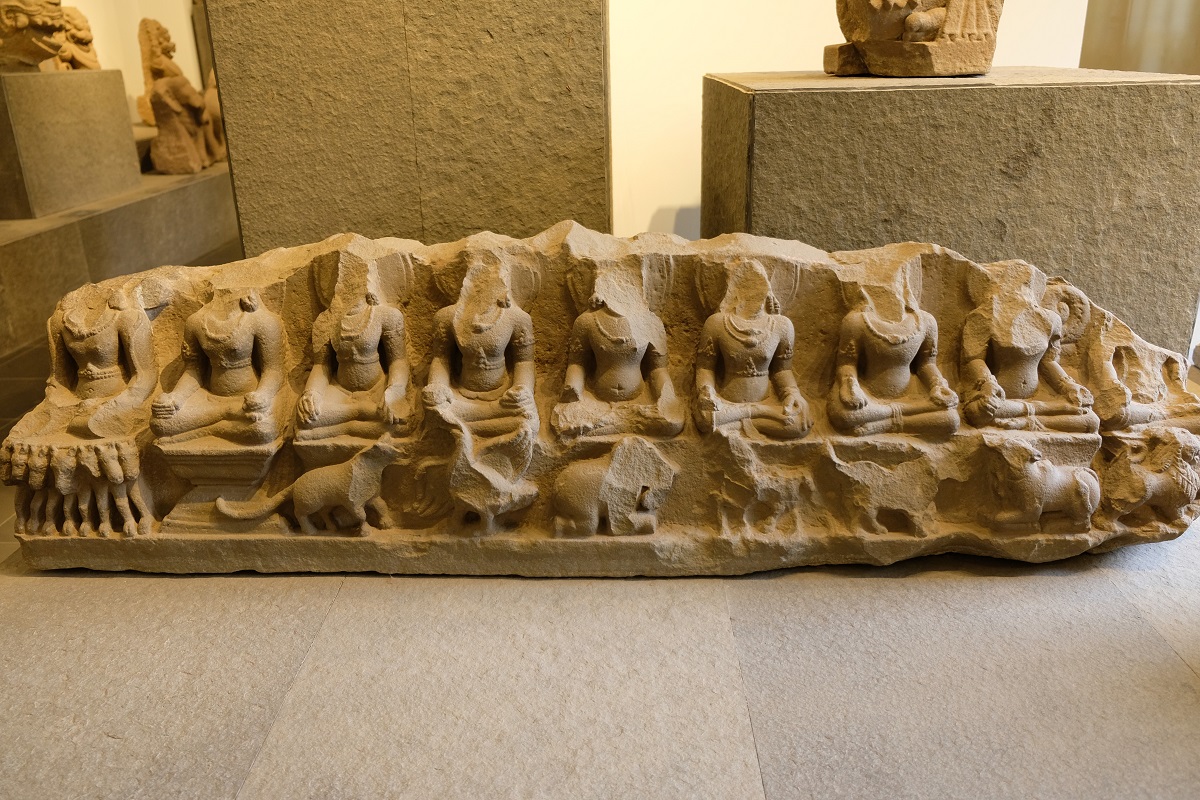
Navagraha, a sculpture from 10th-century Champa depicting the divinities associated with planets
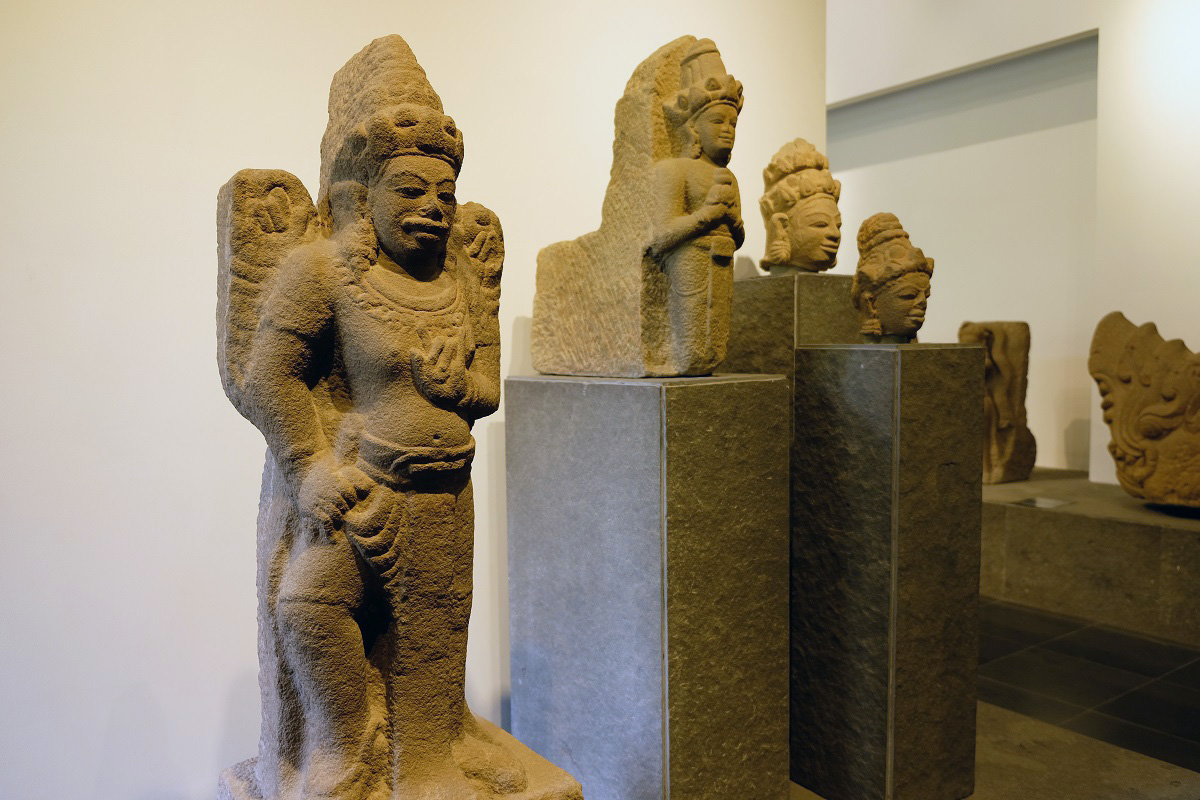
A 10th-century depiction of Vishnu
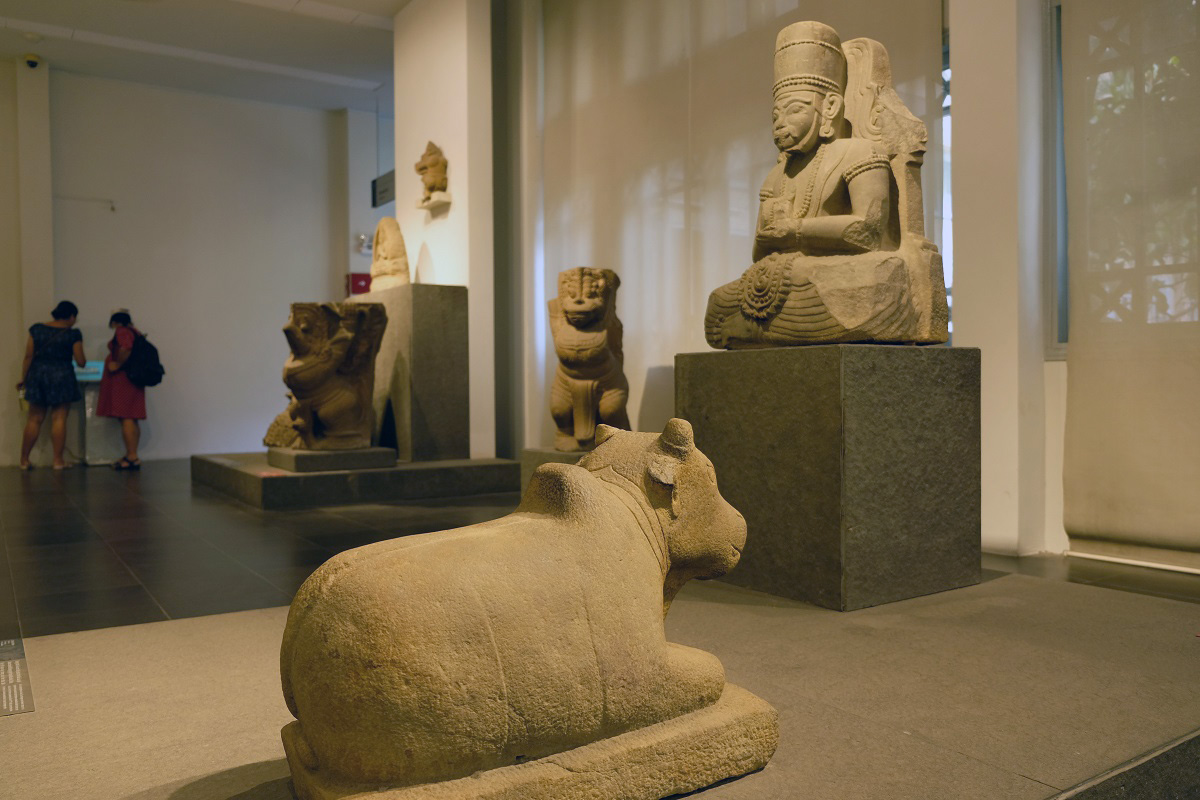
A 15th-century seated Shiva with an 11th-century Nandi
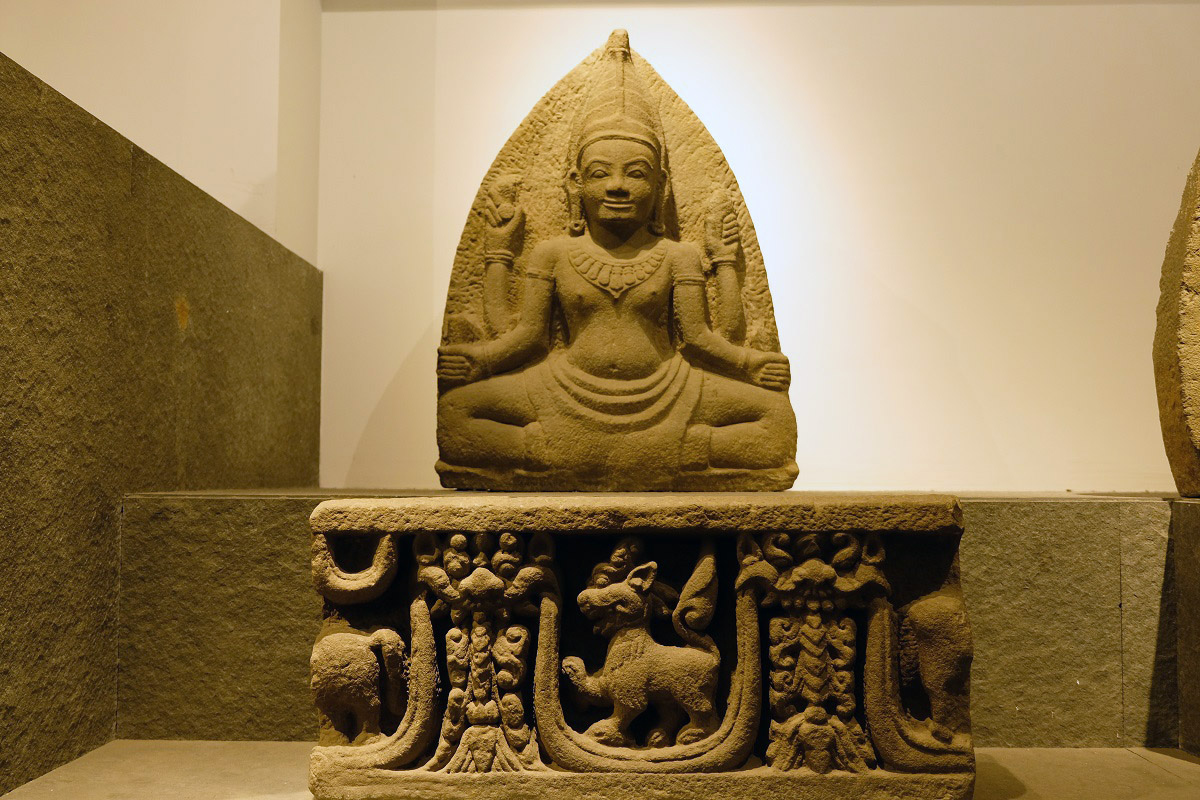
A 12th-century Lakshmi and a 10th-century frieze decoration
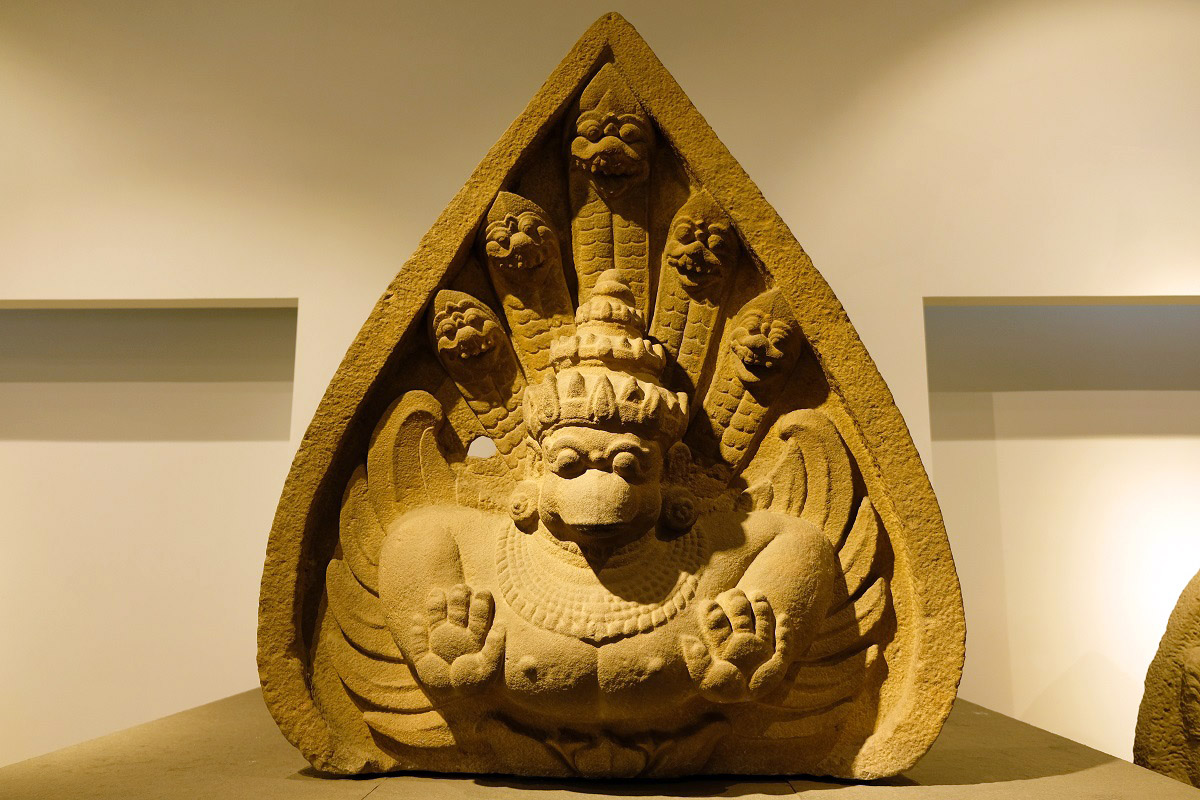
Garuda and naga, a 10th-century pediment from Simhapura, one of Champa’s ancient capitals

 What an Amazing World!
We also found My Son a fascinating place when we visited a few weeks ago, and even though we learnt extracts from the history of the Champa civilisation, we didn’t get anywhere near the extensive history you have provided here, which makes absorbing reading. I almost wish I’d read this post before our visit.
LikeLiked by 1 person
It took me quite some time to gather all the information I needed to write this post, but that’s because I feel Champa really deserves more attention than what it now gets. If you ever find yourselves returning to Vietnam, I recommend going to Quy Nhon and see the interesting Cham temples in the area.
LikeLiked by 1 person
fascinating
LikeLiked by 1 person
Absolutely! That’s why I decided to write three posts only on Champa from my recent trip to Vietnam. This is the first.
LikeLiked by 1 person
I enjoyed this lovely introduction to Champa, Bama. Thanks to travellers and bloggers like you, people are learning about the road less travelled destinations and sites around the world.
The structures are beautiful and I can only imagine the golden glow in the sunrises and sunsets. It’s too bad that some of the structures were irreversibly damaged by war, such is the heavy toll of wars.
Moana is a favourite movie we’ve watched over and over again at home so it’s interesting to see the connection here with the Austronesians in your post.
The Netherlands would be a lovely place to visit one day and I hope you get to do so!
PS, Still waiting for your food photos! 😆
LikeLiked by 1 person
I’m just returning the favor, Ab, for I’ve also learned from other blogs about fascinating places across the globe I would’ve otherwise not known.
Although they’re less durable, the great thing about ancient structures made from red bricks is that they really glow during the so-called golden hour.
Moana is definitely among my all-time favorite Disney movies. It made me dream of exploring those Pacific islands one day in the future! But before that, maybe I should go to the Netherlands first.
I’m sorry for making you wait. 😆 I’ll try to squeeze in some food photos in my future posts, hopefully in a few months’ time!
LikeLike
During Colonial times, there’s no doubt that many of Asia’s artifacts were actually stollen and are now sitting in European museums. When I look at the last two photos of That Bin Lam, I can’t help but wonder if there was a statue sitting in that empty niche that is probably somewhere in Europe today.
LikeLiked by 1 person
Recently I watched an interesting investigative series on Al Jazeera English about Asia’s stolen antiquities (if you’re interested, here’s a link to the first of two episodes: https://www.youtube.com/watch?v=ElCx5y8j8f0). It’s really encouraging to see how people are trying to reclaim their culture by demanding the return of stolen artifacts from museums in Europe and North America.
LikeLike
I saw this when I was in Australia recently as it’s an Australian production—extremely interesting and shocking at the same time.
LikeLiked by 1 person
Can you imagine how magnificent it would be if those artifacts were returned to their original places at those centuries-old temples?! But then keeping them safe would be too difficult, I guess.
LikeLiked by 1 person
Hard to know the best option, but perhaps at least a museum in their original country
LikeLiked by 1 person
Sorry, Thap Binh Lam (It’s annoying how WordPress changes the correct spelling)
LikeLiked by 1 person
This is an interesting post, Bama. I am impressed by how much you were able to learn about Champa, and as always, you photos are outstanding. Thank you for teaching me something today. Kellye
LikeLiked by 1 person
Thank you, Kellye. Not everyone finds blog posts filled with so much history interesting, so I’m glad you enjoyed reading this one as much as I enjoyed doing my own little research about Champa.
LikeLiked by 1 person
I never enjoyed history until I was older, but I love learning about all history now. That’s why I’ve always said that school kids should get to defer history until they’re 30. 😁You do such a great job with your posts!!
LikeLiked by 1 person
My younger self used to hate history, for it was merely a subject filled with dates and names to memorize. But then in my secondary school, we used this text book which was really good at connecting the dots between related events and at putting context in each chapter in history. It was as if I was reading a well-written novel! That’s when my interest in history started to grow.
LikeLiked by 1 person
And now you’re teaching us!
LikeLiked by 1 person
You are amazing Bama! The way you research and find facts and share them with us is appreciated! X
LikeLiked by 1 person
Thanks Anna! I must say generally it’s not easy to find facts about such lesser-known places. Sometimes I even have to download e-books or buy actual books to get the information I need.
LikeLiked by 1 person
I wish i had the time and dedication to do this! That is what sets your blog apart from so many others!
LikeLiked by 1 person
You’re too kind, Anna! In the end it’s blogs like yours that keep inspiring me to see the world. And when you do go to Uzbekistan next year, I will surely take a lot of notes from your posts.
LikeLiked by 1 person
Very interesting post and lovely photo. Always very informative. (Suzanne)
LikeLiked by 1 person
Much appreciated, Suzanne!
LikeLike
Fascinating post. I really enjoy reading about the places you visit.
LikeLiked by 1 person
Thank you, Steven! I guess it’s always interesting to read about faraway places through other people’s perspective, just like how I enjoyed your travel account from Juneau.
LikeLike
Our visit to My Son in 2017 certainly piqued my interest about this not-very-well-known civilization, and I can see why you said it was a good idea to spend time at the Museum of History in Saigon to see the Cham sculptures before flying to Quy Nhon. Thap Banh It was my favorite ancient temple of the handful we visited while in the area – thankfully the weather was mostly cooperative that week! I suspect we will focus on the Cham monuments farther south on a future trip to Vietnam.
LikeLiked by 1 person
It’s interesting that when you were at school the history of South and Southeast Asia, especially about the ancient Hindu/Buddhist kingdoms in both regions, was not taught at all. My suggestion to see the museum in Saigon was because of my own experience in 2011 where I went to the Angkor National Museum in Siem Reap before seeing the temples. That definitely helped me appreciate those centuries-old structures more. You know I would never say no to seeing Po Nagar and Po Klong Garai!
LikeLiked by 1 person
Bama, I find this post fascinating and your pictures impressive! I too have a hard time finding information about ancient cultures and indigenous people from Mexico in English, knowing Spanish really helps me to expand my research capabilities. I don’t have the time to read books these days and I miss that, but reading your blog really keeps me educated, it’s like I’m reading a book! 😊 I don’t know much about Champa or the Austronesians, but your blog post and your example of Moana got my attention. It just shows me that there is so much to learn about ancient cultures and the stories we have yet to uncover. Great post!
LikeLiked by 1 person
Liz, it’s good that your Spanish helps you tremendously in finding information that is otherwise not readily available in English. This is also the case for me every time I try to find online sources about places or cultures in Indonesia that are generally overlooked by foreigners. I’m glad this blog post opens the door for you to learn more about the Austronesians. And maybe, you can start with Moana. It’s such a heartwarming movie that not only felt fresh but also very close to my heart.
LikeLike
I love that place where history and myth intersect, Bama. And to wade through language barriers just to be able to sift through facts is an immense task. Like you say, with Google Translate that is now possible, but it is still an immense task, which is why I love your posts so much. As you know well, these deep dives are what gets me excited too. And I´m sure that for you, like me, the hope is that people will be able to use our respective writings as good resources. This was a fascinating read, and I love how you went in search of more evidence and history of the Champa. I´m looking forward to the next two installments.
LikeLiked by 1 person
Sometimes myths are a good starting point to dig deep into the history of a place and the people who built it. But doing so can lead us down the rabbit hole — you really need to know when to stop and look for answers somewhere else instead. Actually when I was reading your latest post about Pedro and Inês, I couldn’t help but think of the similarities with the way I wrote about the kings and queens of ancient Java, with all the convoluted layers of history. Thanks for your kind words, Jolandi!
LikeLike
You raise a good point about how it’s easier to remember certain people or events based on monuments and other buildings left behind. It’s a shame that everything else gets kind of forgotten about. Thanks for taking us back in time and sharing more about the history of Champa and the Austronesians. It’s funny that you brought up Moana because I just watched that movie a few weeks ago!
LikeLiked by 1 person
Like it or not, we do tend to gravitate toward things that are pleasant to the eye, including beautifully-made monuments. But as we know, there’s more to a place or a culture than meets the eye. Did you enjoy the movie? I particularly loved the tropical feeling of it, as well as the scenes of the early Austronesian sea-explorers.
LikeLike
I did! I thought the movie was very well done. Plus the songs are pretty catchy. And it made me want to visit the Polynesian islands.
LikeLiked by 1 person
That’s exactly how I felt after watching it! It made me want to go to places like Hawai’i, French Polynesia, and Samoa, among other islands.
LikeLiked by 1 person
Part of me wishes I had read this before going to Vietnam and Cambodia (you explain things so well!), but part of me knows that I never would have taken the time to read through the history of a place and people that were not “real” to me yet. I feel much better informed about what I saw there after reading your post!
LikeLiked by 1 person
That actually makes sense. But you know what, when you come to Indonesia one day, and if you make Jakarta your first stop, I’ll definitely explain to you about places you will see during the trip so when you’re there you’ll know what to look for.
LikeLiked by 1 person
You know you will be my #1 resource if (no, when!) I come to Indonesia!
LikeLiked by 1 person
What a fascinating post Bama. Unfortunately we didn’t visit any of the Chama sites when in Vietnam, a reason to return. It’s impressive to think they originated in Borneo and became such a large civilization. Too bad not much of it is remembered today. Great research and explanation of it all. Maggie
LikeLiked by 1 person
Next time you go to Vietnam, you really should check out some of the ancient temples of Champa, Maggie. It was one of the most influential powers in Southeast Asia during the region’s Hindu-Buddhist classical period. Fortunately, some of their those temples still stand today so that we can learn more about this oft-overlooked civilization.
LikeLiked by 1 person
Could these temples and stone carvings be some of the most moving relics found in Southeast Asia today?
Great post and such wonderful photos from a place I have yet to visit. As I’ve never been to Champa or Vietnam, I read with great interest. One day, I would love to discover the awe-inspiring art and architecture of the ancient Kingdom of Champa. Thanks for sharing and have a wonderful day 🙂 Aiva xx
LikeLiked by 1 person
Due to the relative remoteness of the Cham temples I mention in this post, it actually makes more sense, especially for first-timers to Vietnam, to visit My Son. I hope you’ll get the chance to see the remnants of Champa one day. It’s not as popular as the neighboring Khmer Empire, but its history is no less fascinating. Thanks Aiva!
LikeLiked by 1 person
Lovely post, I can see many Hindu influences. Gopurams exist in South Indian temples, a part of temple architecture. The image of Shiva, and the idol of the cow- Nandi might give you an impression of Indian temple with some changes.
LikeLiked by 1 person
For sure there are similarities between ancient Hindu temples in India and in Southeast Asia. Even the ones in India vary from one place to another, which is a reason why I really want to go back. As for the temples of Champa, what I read is that you can tell from which era they were built by looking at their building materials. More stones indicate stronger Khmer influence.
LikeLiked by 1 person
You are right. Also, there are differences between the period in terms of architecture. The temples in south India used different type of stones than in the North India.
LikeLiked by 1 person
Oh I loved the video! So exciting!
We briefly visited a Cham community in Vietnam, and I wish we’d had more time to connect with them.
Alison
LikeLiked by 1 person
That video really made me want to embark on a sea voyage like they did, although I know that’s just a wishful thinking given my propensity for vomiting every time I go aboard a boat. So nice that you got to see the Cham community! I wish we had more time to do that.
LikeLiked by 1 person
Fascinating! Wandering around in Sumatra and Sulawesi, I remember being told that they build their houses like ships or boats because their ancestors came by boats. But I had assumed the voyaged from India, given the origins of names/religious figurines and stories. I never thought to dig deeper back to Austronesians. Just learned something new. Very cool!
LikeLiked by 1 person
I learned that when the people of Tana Toraja in the highlands of South Sulawesi first built their traditional houses, the shape of the roof was indeed inspired by their boat, suggesting their origin. And a little further up in Central Sulawesi, there are these groups of megalithic effigies curiously positioned to face north. Some think this might have been done to indicate the direction from which they arrived on the island — by way of the Philippines from Taiwan. Fascinating, isn’t it?
LikeLike
Wow absolutely incredible! I have so much more to learn about the world. There are so many impressive ruins and ancient cultures that it really is mind boggling. Brilliant photos and history as always.
LikeLiked by 1 person
There are just too many fascinating places like this, and my wish list only keeps growing. I hope you’ll get to see more of Asia’s ancient ruins in the future, Nicole!
LikeLiked by 1 person
Me too!
LikeLiked by 1 person
This is very interesting, thank you! I fear our generation won’t have much to show in centuries to come… certainly no great architecture.
LikeLiked by 1 person
That’s also what I’ve been thinking about. Even the temples people build today are generally less ornate and impressive than those constructed centuries ago.
LikeLike
Well written with excellent information.
LikeLiked by 1 person
Glad you enjoyed this post!
LikeLike
I’m positive you used to be a teacher or a historian in a previous life. I appreciate the length you went through to do the research for this entry (and others). This was a nice read.
LikeLiked by 1 person
Ha! Maybe. I remember in one of my previous jobs, at one point I had to teach some people at the office something — I can’t recall what exactly. But I remember I enjoyed it very much. Really appreciate your kind words, Matt.
LikeLiked by 1 person
What a gorgeous place! I’ve not heard of Champa, but it’s certainly a site steeped in history through its many ruins. Despite the difficulty of finding information about it (isn’t Google Translate so helpful these days?), you got through it and had an enriching visit!
LikeLiked by 1 person
Champa certainly is not as famous as their Southeast Asian counterparts, like Angkor, Sukhothai, or Bagan. But when one is curious enough to find out more about it, this ancient kingdom definitely has a lot to tell! Glad you enjoyed traveling to this part of Vietnam through this post, Rebecca.
LikeLiked by 1 person
Beautiful. Beautiful. Beautiful. Your beginning argument gave me much to think about as I read the rest of your post: “it’s natural for us to remember those who left great monuments better than those who didn’t.” Thank you for this introduction to Champa. It’s surreal to see the little bit that has been left from their history, because so much of it closely mirrors ruins in West Bengal India. As always, taking copious notes for when and if I ever get to Vietnam.
LikeLiked by 1 person
I remember your post on Bishnupur. It’s a corner of West Bengal I’ve been wanting to see, especially since the first time I learned about those terracotta temples. Vietnam is a fascinating place, and exactly because of that I keep finding myself coming back to this country. Plus, its proximity with Indonesia definitely helps. I hope you’ll get there one day!
LikeLiked by 1 person
Amazing peek in to the Cham people and their civilization, Had never known about their existence, not surprising though. A very delightful read, well researched and detailed. Thanks to you that we get to learn so much. The photos are lovely, the structure intriguing. So much similarity to India yet so very different. The Shiva figurine is captivating. The rest of the statues too, Vishnu or Navagraha, Lakshmi.
LikeLiked by 1 person
That’s exactly why I really wanted to write about Champa and visit more of its ancient temples, because this fascinating Hindu kingdom was often overshadowed by its neighbors. And you’re right about the similarities with India. That is why I could identify some of the Hindu deities at the temples in India because I grew up learning about them, and also because of the plethora of ancient Hindu temples in Java.
LikeLiked by 1 person
BTW, this post was open in my laptop since Friday and I finally got an opportunity to get to it 😀
LikeLiked by 1 person
Ha! No worries, Neel. Thanks for reading and sharing your thoughts.
LikeLiked by 1 person
Wonderful viewpoint with this post, Bama. The history and accomplishments of the Chams are impressive, and you ask good questions about ancient civilizations remembered thanks to their achievements. I wonder if buried in ancient history are benevolent leaders who instead of wishing to build great monuments not just for religious reasons but also partly based on ego, looked more at the “loss” of resources (income and lives of the people), and instead built up a community. Granted, war tends to feast on such places, which is sad… great, powerful empires and benevolent leaders are not a common mix 🙂
LikeLiked by 1 person
You summed it well, Randall. Benevolent leaders and powerful kings and emperors usually don’t go hand in hand. Funny enough, what you said makes me think of the late sultan of Oman who was often cited as a “benevolent dictator”. Instead of going down the same path Dubai, Doha, and Kuwait City took, I read that Muscat remains a low-rise city filled with buildings in Omani traditional architecture.
LikeLike
This is a great comment about Oman… it makes me want to visit Muscat and fall into the culture there, I love this. Cheers to a great day ahead, Bama!
LikeLiked by 1 person
Pingback: An Introduction to Champa | Rashid's Blog: An Educational Portal
It’s great to read about your travels to the Champa Kingdom sites and see their ancient structures. I’ve heard of them but didn’t know much. It’s fascinating to learn about this kingdom which lasted for centuries and was Hindu but then disappeared. Vietnam would be much different if Champa had managed to hold off defeat.
LikeLiked by 1 person
I think the fact that Champa as a Hindu kingdom lasted for so long in a land that people don’t associate with Hinduism at all today makes it even more fascinating to learn about. And you’re right, Vietnam (or at least the southern part of it) would have been a very different place indeed — probably more similar to Malaysia and Indonesia.
LikeLiked by 1 person
The spread of Hinduism and existence of Hindu kingdoms is a really fascinating part of Southeast Asia’s past and makes you wonder what if Hinduism had remained intact, as it has in Bali.
LikeLiked by 1 person
And since you mention Bali, the Hinduism practiced there is actually quite different from the one in India. As the religion traveled, it seemed to have evolved as well.
LikeLiked by 1 person
That’s interesting to know though understandable given the distance between Indonesia and India. Would it be fair to say the same with Islam in Indonesia as well?
LikeLiked by 1 person
In general, I would say so. However, there has been an increase in the adoption of a more puritanical version of the religion… until Saudi Arabia’s sudden decision to embrace a relatively more relaxed interpretation of Islam, and the push from Islamic groups in Indonesia who have for a long time been championing what you can call a more localized version of the faith.
LikeLike
I suppose having a localized and less puritanical version might be a good development. I have heard about Aceh practicing sharia law and some of it sounds quite harsh.
LikeLiked by 1 person
Indeed. Recently non-sharia-compliant banks had been barred from operating in Aceh. But then a few months ago the biggest sharia bank in the province suffered from cyberattacks, effectively shutting down its economy. The last time I read, businessmen over there plead to the local government to allow non-sharia banks to return. And don’t get me started on public flogging.
LikeLike
Banning non-sharia-compliant banks from operating there seems extreme.
The public floggings were how I learnt that they had sharia law. Those really are barbaric and medieval. I hope they don’t still carry those out.
LikeLiked by 1 person